

A 770 MVA flexible DC transformer — the largest of its kind built anywhere, according to the companies behind it — was positioned at the end of September inside a converter station in Guangzhou’s Tianhe district, in the middle of a city where land is the scarcest input. It is the second main transformer delivered to the 220 kV Tangxia back-to-back project, which the grid operator says it will energise for trial operation before the end of 2026. The station is 49 metres tall, and the site around it is planned to hold EV chargers, batteries, a data centre and a solar array as well as the substation itself.
What a 770 MVA Flexible DC Transformer Actually Does
The project is a back-to-back flexible DC station, which means two or more AC networks are tied together through converters rather than through a DC line. Guangzhou’s grid has three core supply districts — Mumian, Zengcheng and Guangnan — whose ability to help each other has historically been weak. When one of them is short of power, the transfer has to be arranged through the surrounding AC network, which takes time and pushes fault currents up.
The Tangxia station sits at the geometric centre of the three. China Southern Power Grid describes the effect as adding a controllable sluice and a bidirectional pump between the districts: power can be pushed one way or the other in milliseconds, and the flow can be stopped instantly if it would overload anything. That second part matters as much as the first. Adding more AC circuits into a dense city raises short-circuit current, which then requires higher-rated switchgear or current-limiting equipment. Doing it through converters at a back-to-back station avoids that problem altogether.
The transformer is the piece that connects the AC side of each district to the converters, and its rating sets the ceiling on how much power the station can move. The utility says the site will add 900 MW of supply capability in the core districts and is designed to cope with the loss of an entire 500 kV substation.
Why 770 MVA Is the Number That Matters
At 220 kV, a conventional power transformer is typically rated between 120 and 240 MVA; even a deliberately large selection usually stays under 350 MVA. The unit now at Tangxia is 2.2 times the top of that large-selection band and 3.2 times the top of the common range — our arithmetic from the figures published with the announcement. One unit is doing work that previously needed several.
| Conventional 220 kV unit | Tangxia flexible DC unit | |
|---|---|---|
| Rating | 120–240 MVA typical; up to 350 MVA for large selections | 770 MVA |
| Construction | Single-phase units, outdoor | Three-phase integrated, fully indoor |
| Cooling | Oil natural / oil forced air | Water-cooled, enclosed balanced ODWF |
| Noise | — | Measured below 67.9 dB(A) |
The reason for the format is the site, not the voltage. A city-centre plot will not take a conventional outdoor transformer bank, so the design pushes in the other direction: keep the three phases in one tank, put the bushings, water cooling and control gear inside the same envelope, and shrink the civil works. The manufacturer says that cuts the converter station’s construction, installation and auxiliary-equipment scope, which is the part that costs land and time in a district where neither is available.
Two other engineering details are worth naming because they are the ones city grids care about. The unit is quoted at a measured noise level below 67.9 dB(A), achieved with a multi-stage coupled noise-reduction design; separately, the project team developed a perforated resonant absorber for the walls around the transformer that the state broadcaster says removes 80–90% of the 100–400 Hz low-frequency noise large transformers emit. And the manufacturer describes a full-chain digital twin for condition monitoring and predictive maintenance rather than scheduled inspection.
One piece of context keeps the record in proportion. At the same product appraisal in Jinan, the same manufacturer also had approved an ODFPS-1000000/1000 high-impedance UHV auto-transformer — 1,000 MVA at 1,000 kV, described as carrying the highest short-circuit impedance in the industry. So the frontier of Chinese transformer manufacturing is not 770 MVA. The 770 MVA unit is a record about density: how much power can be put into a city centre, quietly, indoors, on as little land as possible. That is a different problem from going to a higher voltage, and it is the one Guangzhou had.
Two Transformers, Two Ratings, and a 2,996 km Delivery
The 770 MVA unit is the second main transformer at the site. The first was a smaller 495 MVA three-phase integrated water-cooled converter transformer, model SSPZ-RZ-495000/220, which the manufacturer says was the first 220 kV converter transformer at that capacity anywhere to pass a sudden short-circuit withstand test — the test that simulates an extreme fault and verifies mechanical strength. It weighed 343 tonnes.
| First unit | Second unit | |
|---|---|---|
| Delivered | June 2026 | Late September 2026 |
| Rating | 495 MVA | 770 MVA |
| Model | SSPZ-RZ-495000/220 | SSPZ-RZ-770000/220 |
| Weight | 343 t | Not disclosed |
Getting the first one there was its own project. It travelled 2,996 km from the manufacturing base in Shandong over more than ten days, arriving at Huangpu port before being trucked into Tianhe. The utility’s team ran six rounds of route rehearsal and multiple physical simulations, relocated six streetlights and trees, reinforced three bridges and adjusted the trailer deck height five times. Neither the utility nor the manufacturer has explained why the two units differ in rating. In a multi-terminal station the converter transformers are sized to the power each terminal is expected to exchange, which would account for it — but that reading is ours, not a stated one.
The Site Is Designed to Host the Load, Not Just Deliver It
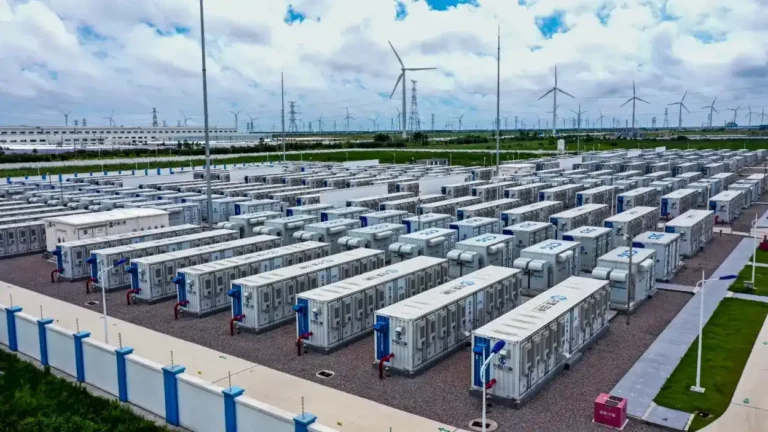
The part of this project that should interest anyone working on charging or storage is what is planned around the converter station rather than inside it. The grid operator says the district will host a combined campus bringing together the substation, a computing centre, an EV supercharging station, a battery storage station, a solar array and 5G and BeiDou base stations — billed as the largest and most complete “multi-station in one” power park in the country.
That is a different model from building each of those things on its own plot. A substation already has the one thing a charging hub or a data centre needs most and can least easily get: a high-capacity connection. Putting them on the same land, behind the same transformers, turns the grid node into a customer of itself. It is the same logic that has BYD talking about fitting storage to every one of its flash-charging stations, and the same constraint that makes grid-enhancing technologies attractive as an alternative to new lines: in a dense city, the connection is the scarce asset, not the generation.
How much of this is funded and scheduled is not public. The converter station itself is, and the countdown is short — trial energisation before year end, with hundreds of workers on site through the National Day holiday. The station has also been given what the project describes as the country’s first seismic-resilience star rating for an industrial building.
What Has Not Been Disclosed
Four things belong next to this story.
The first is that the transformer has been positioned, not energised. Everything above describes equipment being installed. Trial operation is a plan, and the capacity added is a specification, not measured output.
The second is that the world-record claim is the supplier’s and the grid operator’s own. There is no independent register of converter transformer ratings, and the claim is scoped narrowly: it applies to flexible DC transformers at this voltage class, not to transformers in general. As the same manufacturer’s 1,000 kV, 1,000 MVA auto-transformer shows, the category matters more than the word “world”.
The third is cost. No project investment figure and no equipment price were published, so it is not possible to say what a 770 MVA indoor water-cooled converter transformer costs, or what it cost per megawatt of added supply capacity.
The fourth is a discrepancy worth flagging. The state broadcaster and the grid operator put the household figure for the added 900 MW at about 350,000 homes; one reference entry gives 450,000. Working backwards, 900 MW across 350,000 households is about 2.6 kW each, which is a normal Chinese residential coincidence factor and suggests the lower number is the one to use. The widely repeated line that the transformer could slow-charge 100,000 electric cars at once is a conversion rather than a specification — 770 MVA divided by a 7 kW on-board charger gives about 110,000, so it checks out, but no car charges at its full nameplate rate all night.
The Bottom Line: A 770 MVA flexible DC transformer — the largest at its voltage class, on the supplier’s and the grid operator’s own account — has been positioned at the Tangxia back-to-back station in central Guangzhou, inside a 49-metre converter station. It is the second main transformer at the site, after a 495 MVA unit that took more than ten days and 2,996 km to arrive. The project is designed to move power between three core supply districts in milliseconds and add 900 MW of supply capability, and the surrounding plot is planned to carry EV chargers, batteries, solar and a computing centre alongside the substation. It has not been energised yet; commissioning is targeted for the end of 2026, and no costs have been published.
Notes: Capacity, dimensions, noise and construction figures are the manufacturer’s and the grid operator’s figures and have not been independently verified by EVsays; the world-record claim is theirs and is scoped to flexible DC transformers at the 220 kV class. The 2.2× and 3.2× comparisons against conventional 220 kV transformer ratings, the household figure of about 2.6 kW, the 110,000-vehicle conversion from 770 MVA and the reading of why the two units differ in rating are our calculations and interpretation, not disclosed facts. Reporting drawn from Chinese-language sources was cross-checked against the grid operator’s own release and the manufacturer’s product material. EVsays did not visit the site, has not tested any equipment and has no relationship with China Southern Power Grid, China Electrical Equipment Group or any supplier named. See our editorial policy and correction policy.
Sources & Further Reading
- China Southern Power Grid — “电力心脏刷新世界纪录 广州新型电网建设攻坚破局铸重器” (9 October 2026) — the grid operator’s own account, and the primary source for the 770 MVA figure, the three districts, the 49-metre converter station, the 900 MW supply capability, the 80–90% noise reduction, the multi-station campus plan and the end-2026 commissioning target.
- China News Service — “大国重器就位!世界最大容量’电力心脏’有多强” (October 2026) — the state broadcaster’s field report from the Tangxia site, including the back-to-back sluice-and-pump description, the millisecond transfer claim and the 100,000-vehicle figure.
- Industrial news release carried for China Electrical Equipment Group — “中国电气装备2项新产品通过国家级鉴定” — the manufacturer’s product appraisal, giving the model number SSPZ-RZ-770000/220, the indoor three-phase integrated water-cooled layout, the ODWF cooling structure, the measured noise level below 67.9 dB(A), the digital twin system, and the parallel approval of the 1,000 MVA / 1,000 kV auto-transformer used here for scale.
- China News Service (广州供电局) — “世界最大容量柔性直流变压器在广州’就位'” (29 September 2026) — the 28 September delivery announcement, the three-phase integrated intelligent water-cooled description, and the list of technical bottlenecks addressed in development.
- Reference entries drawing on the 广州供电局 project documentation — the 495 MVA first unit, its model number, 343-tonne weight, 2,996 km route and short-circuit withstand test, plus the transport preparations (six rehearsals, six streetlight and tree relocations, three reinforced bridges, five deck-height adjustments) and the 450,000-household figure that conflicts with the grid operator’s.
- EVsays — US AI Is Running Out of Power — Hyosung Sees Its Chance — on the transformer as the piece AI data centres are short of, and the world-first claims made in that market.
- EVsays — BYD Energy Storage Is Now the Group’s Strategic Centre — on fitting storage to every flash-charging station, and why the charging network is becoming a grid asset.
- EVsays — Grid-Enhancing Technologies — the case for getting more out of existing networks rather than building new ones.