

A quiet pivot is underway in the auto industry. By mid-2026, nearly 20 major carmakers had jumped into humanoid robots. Some are building their own. Others are backing startups or spinning out robotics units. Tesla, BYD, XPeng, Chery, GAC, Li Auto, Xiaomi, Geely, SAIC, Changan, Seres, FAW, BMW, Mercedes, Hyundai, Volkswagen — the list keeps growing. This isn’t a side project. It’s the industry looking for a second act.
The rush is already real
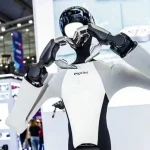
XPeng has moved the fastest. The company rebranded itself “XPeng Group” and now calls itself a global embodied-intelligence company. Its IRON humanoid stands 178 cm tall, runs on a Turing AI chip with 2,250 TOPS, and uses a self-developed physical-world model. More than 500 units are already working inside XPeng’s Guangzhou and Zhaoqing factories. The company claims a 30% efficiency gain and 35% lower labor costs. Mass production is planned for the end of 2026, targeting more than 1,000 units a month, with commercial sales starting in 2027. He Xiaopeng is blunt: “Operating a traditional automotive enterprise is painful. Sales volumes fluctuate and gross margins are just too low.”
BYD confirmed its own program when Stella Li said the company wants two to three robots in every dealership, with commercialization possible within one to two years. The project, known as “Xiao Di,” dates back to 2022 and draws on the same blade-battery and motor expertise that powers its cars. Chery’s MoJia brand has gone furthest on volume. It delivered more than 300 humanoid robots in January 2026 — the first automaker to reach that scale — and by late July claimed cumulative deliveries past 2,000 units across more than 60 countries. GAC’s fourth-generation GoMate Mini, a wheel-leg hybrid, entered small-batch production this year and is already running on Guangzhou’s metro. Li Auto is working on both a wheeled robot and a bipedal one, codenamed “Nexus,” with a public reveal planned for 2026. Xiaomi’s CyberOne has been on factory duty since March, tightening self-tapping nuts at a rate of one every 76 seconds with about 90% success.
Across the Pacific, Tesla’s Optimus Gen-3 entered mass production in the second quarter of 2026. The company is planning a dedicated Texas plant with a capacity of one million units a year and has earmarked more than $25 billion in 2026 capital spending for Cortex 2, Dojo 3 and the robot line. Hyundai plans to deploy Boston Dynamics’ Atlas in its U.S. factories from 2028. BMW is already running humanoids at Leipzig. The Tesla–Unitree dynamic has become the global benchmark.
Why carmakers, and why now
The logic is simple: homology. He Xiaopeng estimates that 70% of an automaker’s technical reserves can transfer to robots. Joints, batteries, sensors, drive electronics — these are parts carmakers already mass-produce. The lidar, cameras and radar that guide autonomous cars map directly onto a robot’s perception stack. Planning and decision algorithms overlap heavily. CIC consultant Yu Yiran argues the automotive-grade supply chain could cut a humanoid’s bill of materials by 30–50% over five years.
Factories are also the perfect test bed. Assembly lines were designed for humans, so robots can drop in without major retrofits. They handle sorting, transport and inspection while generating the real-world data that improves the next model. Dealer showrooms offer a second natural use case. And the pressure is real. China’s auto industry sales profit margin fell to 3.4% in the first four months of 2026, near historic lows, as the NEV market tips into stock competition. Humanoids are a hedge. The backdrop matters too — China already makes more than 97% of the world’s humanoids, so the supply-chain lead is structural. A joint MIIT–SASAC push is aiming for “10,000-unit scale deployment” by the end of 2026, and embodied intelligence has appeared in the government work report two years running.
The numbers behind the bet
Research firm GGII sees global humanoid sales near 340,000 units by 2030 — a $9.25 billion market — expanding past 5 million units and 400 billion yuan by 2035. Morgan Stanley’s long-range call is $5 trillion and 1 billion units by 2050. Frost & Sullivan, together with Tencent Cloud, calls 2026 the inflection point from accumulation to explosive growth. The CRAIC 2026 show made the momentum visible: more than ten automakers displayed robotics strategies on one floor.
Author’s TakeThis is a real migration, not a gimmick. The supply-chain overlap is genuine, and carmakers have something pure-play robot firms lack: factories, scale, and a captive first customer. But don’t confuse deployment with maturity. Most of these robots still handle the easy, non-core tasks. The cash burn is brutal — Xiaomi alone is doubling its five-year R&D to around 200 billion yuan ($29 billion). Profit is years, maybe a decade, away. The winners will be those who turn factory data into a tight iteration loop before the money runs out. And the geopolitical overhang is real: as China’s humanoid lead compounds, export markets can close the door.
The Bottom Line:Nearly 20 carmakers building humanoids is the auto industry’s second act — forced by thin margins and enabled by shared technology. The question is no longer whether carmakers can build robots. It is whether they can make them pay before the capital dries up.
Sources & Further Reading
- China Daily, “Robotics offer growth path for automakers,” Mar 31, 2026 — en.gdfao.gov.cn
- News18a, “2026 Beijing Auto Show Spotlights Humanoid and Embodied AI Robots…” — auto.news18a.com
- Economic Information Daily (Xinhua), “Mass Production Approaches as Carmakers Race into the Humanoid Robot Track,” Mar 5, 2026 — dz.jjckb.cn
- Sina Finance, “Positive Signals Emerge as New Forces Rise in the Trillion-Yuan Track,” Aug 15, 2026 — cj.sina.com.cn
- China.org.cn, “Auto Industry Chain Collectively Bets on Robots,” Jun 2, 2026 — news.china.com.cn
- Shanghai Observer, “Highly Homologous Tech Architecture and Supply Chain as Carmakers Enter the Humanoid Robot Track” — shobserver.cn
- Related on China EV Dispatch: BYD’s humanoid robot debut · China’s 97% global share · Unitree IPO & Tesla Optimus · CRAIC 2026