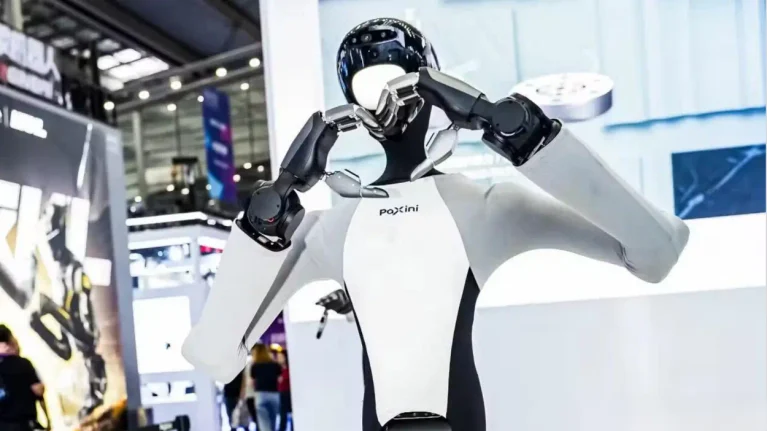


On August 17, Unitree pulled back the curtain on “Chao Ren” — literally “Superhuman” — a humanoid whose spec sheet reads like a track-and-field fever dream: a 2-meter standing jump and a top speed of 12.66 m/s, both beyond anything a human has ever recorded. Three days later, Beijing opens the 2026 World Robot Conference, where the machine is expected to share the floor with a who’s who of Chinese robotics.
The Unitree Superhuman Robot, by the numbers
The numbers Unitree published are deliberately provocative. The robot’s legs are just 0.85 meters long, yet it clears roughly 2 meters in a standing jump — about 20 cm higher than the human standing-jump record of ~1.8 meters. On a straight, it hit a peak speed of 12.66 m/s (about 28.6 mph), edging past Usain Bolt’s peak of ~12.42 m/s during his 100m world-record run.
Chairman Wang Xingxing said the whole machine went from project kickoff to unveiling in just over three months, and he cautioned that it is still early — months of tuning on motor control and stability lie ahead. That timeline is the more telling detail than the jump height. Unitree’s H1 model already reached 10 m/s back in April, flirting with Bolt territory; “Superhuman” simply blows past it. A company that can design, build, and iterate a new humanoid chassis in a single quarter is operating on a hardware clock most automakers can only envy.
A company riding the momentum
Unitree is not showing up to Beijing as an underdog. On August 12, the company said it had produced roughly 18,000 humanoid units (bipedal only, excluding wheeled or partial forms) — a scale that, if accurate, makes it one of the largest humanoid builders on the planet by volume. It is also on the doorstep of public markets: the “humanoid robot first stock” priced its IPO at 150.8 yuan per share, implying a market cap near 61 billion yuan (about $8.4 billion at 7.25), and cleared STAR Market review in a record 73 days. Listing is expected the week of August 18–24. For the longer arc, see our breakdown of Unitree’s IPO against Tesla’s Optimus and Google’s Gemini robotics push.
World Robot Conference 2026: what’s coming
The 2026 World Robot Conference (WRC) runs August 19–23 at the Beiren Etrong International Exhibition Center in Beijing’s Yizhuang economic zone. In its 11th year, the event is co-hosted by the Chinese Institute of Electronics and the World Robot Cooperation Organization under the theme “human-robot symbiosis, production-demand integration.”
Scale is up sharply: more than 300 exhibitors (a 36% jump from 2025), over 2,000 exhibits, 150+ public debuts, and 60+ concurrent sessions, backed by nearly 30 international organizations with international speakers making up about 30% of the main forum. The floor splits into four halls — Innovation, Integration, Manufacturing, and Lifestyle — with the new 20,000 sqm Innovation Hall acting as the humanoid hub for Unitree, UBTECH, Galaxy General, Fourier, and Yuejiang. For the first time the schedule is built around four theme days: August 19 is Launch Day, August 20 Procurement Day, August 21 Developer Day, and August 22–23 Public Open Days.
Two structural additions stand out. A dedicated central state-owned-enterprise delegation appears for the first time — 49 SOEs across 12 scenarios — with SASAC expected to launch a Central Enterprise Robot Innovation Consortium. And a Global Robot Application Exploration Program will hand commercially available robots (humanoids, quadrupeds, dexterous hands) to outstanding global teams for free trial use, a bid to connect supply with early-stage R&D that can’t otherwise afford production-grade hardware. Our earlier coverage of the CRAIC 2026 humanoid showcase sketched the same shift from demo to deployment.
Why it matters: China’s robotics surge
The conference lands on a sector with real heat behind it. CIE chairwoman Xu Xiaolan notes China has been the world’s largest industrial-robot market for 13 straight years, with domestic brands now holding more than half of the local market. Major robotics enterprises booked revenue above 90 billion yuan (about $12.4 billion at 7.25) in the first five months of 2026, up 26.9% year on year. Beijing’s own robotics sector grew from 15 billion yuan in 2023 to 51.8 billion yuan in 2025 — a compound rate above 85%.
Humanoids are the headline act. Chinese manufacturers accounted for roughly 97% of global humanoid shipments in the first half of 2026, according to SAG data — the through-line of our report on China’s 97% share of the global humanoid market. And the carmakers are not sitting out: BYD’s “Xiao Di” service humanoid is headed for dealerships, a bet we detailed in BYD’s two-bets strategy on robots and chips.
Author’s Take“Superhuman” is a spec-sheet flex, not a shipped product — but the three-month development cycle is the real story. It tells you Unitree can iterate hardware at a pace Detroit would envy. Pair that with an IPO and a conference built around a Procurement Day rather than a demo reel, and the direction is clear: Chinese humanoid robotics is moving from “look what we built” to “who’s buying.” The open risk is hype outrunning real deployment — yet the dedicated procurement day and the SOE consortium suggest the buyers are, in fact, showing up.
The Bottom Line: Unitree’s “Superhuman” resets the bar for humanoid athleticism, and WRC 2026 — opening August 19 in Beijing — is where the industry tries to convert that spectacle into purchase orders. For a sector already responsible for ~97% of global humanoid shipments, the week could mark the moment the category stops being a science project and starts being a supply chain.