

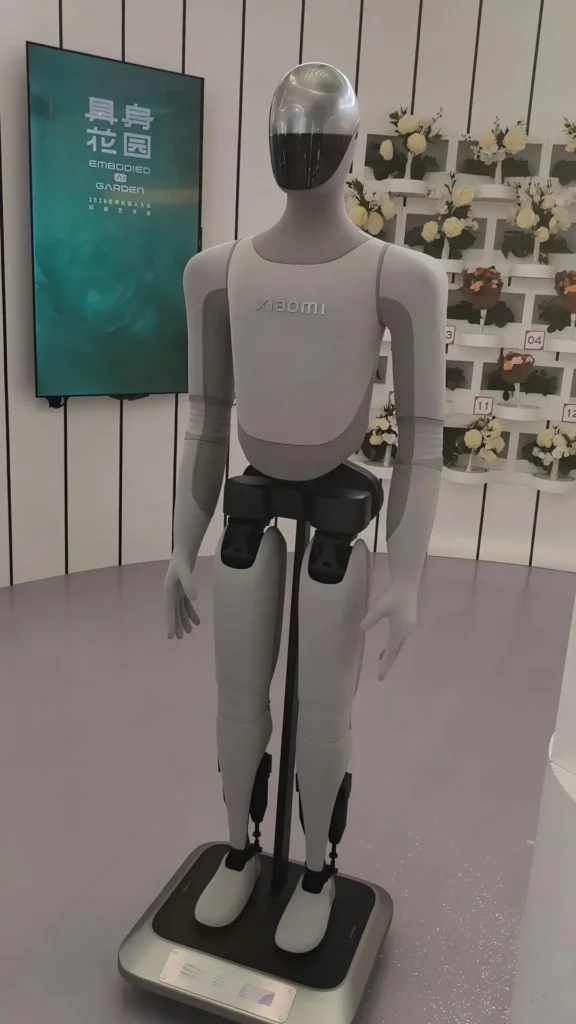
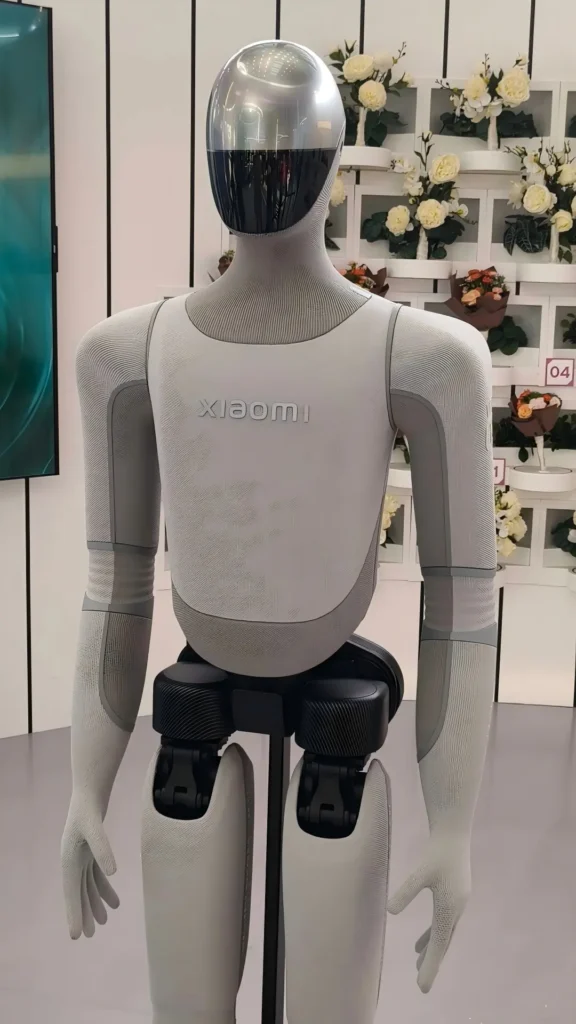
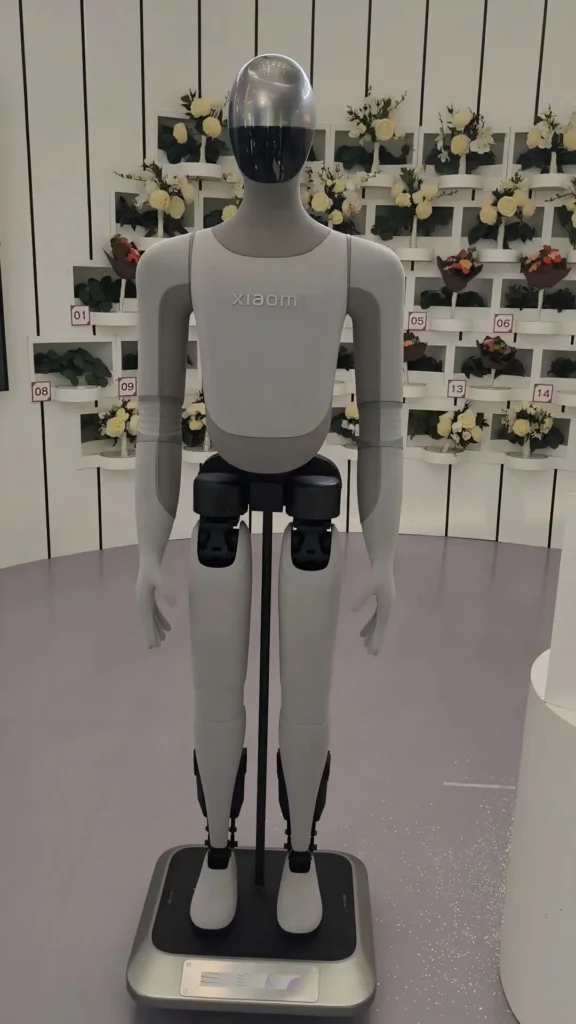
As we previewed, Xiaomi’s humanoid robot made its public debut at the 2026 World Robot Conference in Beijing today — and the machine on the “Embodied Garden” booth is far more interesting than the teaser suggested. It is a full-size humanoid roughly 1.7 meters tall with 66 degrees of freedom, half of them in the hands. President Lu Weibing had confirmed the move on the Q2 earnings call a day earlier; what he did not preview was the strategy behind it — less spectacle than shop floor.
The following three photographs were taken by the author at the Xiaomi Robot Conference exhibition stand.
What Xiaomi revealed
Lu’s framing was deliberately grounded. The industry, he said, should weigh “landability” first — and the most important landing spot right now is the smart-manufacturing production line, where robots can take over parts of manual work. On technology, Xiaomi is betting on universality on two axes: the physical form factor of the body, and the model that drives it. And in a line that separates Xiaomi from pure-play robot firms, Lu stressed the company will not build robots as a standalone business but in concert with its “human-vehicle-home” ecosystem — coordinating across smart factories, smart mobility, and the home. The next-generation unit shown in Beijing stands 1.70 meters, weighs 66 kilograms, and carries 66 degrees of freedom, half of them concentrated in the hands. It is still a prototype; after its China debut it heads to Europe.
The factory-first bet
The reveal caps a year of quiet progress inside Xiaomi’s own plants. In July, Lei Jun said the robots had been “interning” in the car factory for four months, sorting center-console side covers and folding recovery bins with about 90% success. English-language outlet GMT EIGHT, citing the same call, reported Lu saying Xiaomi has worked on general-purpose humanoids for nearly six years, and that in 2026 a key breakthrough let the robots enter the car-factory line, running autonomously for three hours to complete screw-tightening with over 90% success. Xiaomi now says continued iteration has pushed the self-tapping nut-insertion success rate to 98% — close to human levels — and the robot has moved from single-station tasks to multi-robot coordination. Underpinning it is Xiaomi’s in-house Xiaomi-Robotics embodied foundation model, linking vision, language understanding, and motion execution. Lu’s timeline: mass deployment across Xiaomi factories in about five years, with humanoids entering work and life scenes at scale over the next five to ten years. The Q2 numbers behind the call were strong — revenue of 108.9 billion yuan (about $15.0 billion at 7.25) and adjusted net profit of 6.2 billion yuan (about $855 million) — giving the robot push a well-funded parent.
Why Xiaomi took the other road
Most of the Chinese robot names grabbing headlines — Unitree, AgiBot, UBTECH — are robot companies first. Xiaomi is a device-and-car company that treats the humanoid as one more node in a connected ecosystem. That is the same logic we traced across nearly 20 carmakers now building humanoids: the homology between cars and robots — joints, batteries, sensors, drive electronics — lets an automaker reuse what it already mass-produces. Xiaomi simply takes the logic further, refusing to spin the robot out as a standalone business. At WRC, Xiaomi robot unit chief Xiang Diyun told Sina Tech the pivot was deliberate. Since Lei Jun launched the project in 2021, his recurring question has been “what is this actually for?” That question is why Xiaomi halted all external robot PR after 2023 — while keeping R&D spending flat-out — and only let the machine appear publicly after “Tie Da” ran a real factory line for four full hours at 90% success in March 2024. Lei approved the debut, Xiang said, but still calls it an “internship,” because it sits short of the 99% bar for industrial use. Xiang frames the sector’s last decade in three waves: Boston Dynamics’ model-based control through 2020, reinforcement-learning motion control in 2021–2023, and the large-model “brain” race that opened in 2025. Xiaomi’s bet is that the winner is not the best demo but the best engineering translation — and it helps that the company operates in the world’s dominant market, where Chinese makers shipped more than 97% of all humanoids globally in the first half of 2026.
Author’s TakeXiaomi’s move is the least surprising and most telling of the carmaker-robot wave. Unlike Unitree’s track-and-field flex or its market-debut theatrics, Xiaomi showed up with a factory use case and a “we won’t do this alone” caveat. That is the mature read: the winner in humanoids may not be the firm with the best demo, but the one with the best first customer — and Xiaomi owns its factories. The risk is the same one hanging over the whole sector: deployment is years from payoff, and “landability” is easier to say than to ship. But a 1.7m humanoid that already runs a line for three hours at 90% success — and now hits 98% on nut insertion — is further along than most people assume.
The Bottom Line: Xiaomi’s humanoid robot debuted publicly at WRC 2026 today — a 1.7m, 66-degree-of-freedom CyberOne built for the factory floor, not the trade-show stage. Backed by a $15 billion-quarter parent and a five-year deployment plan, Xiaomi is betting the robot’s future is inside its own walls.
- Sources & Further Reading
- IT Home via Tencent — Xiaomi’s next-gen humanoid appears at WRC “Embodied Garden” booth as a “florist”
- Qilu Evening News / National Business Daily — next-gen specs: 1.70m, 66kg, 66 DoF (half in hands)
- Sina Tech — interview with Xiang Diyun: Lei Jun’s “what is it for?” and the pivot
- Securities Times — Xiaomi to debut next-gen humanoid domestically, then Europe
- GMT EIGHT — Lu Weibing: humanoids mass-producible in Xiaomi factories in 5 years
- Weibo — Lu Weibing on Xiaomi robot WRC debut
- Related on China EV Dispatch: Nearly 20 Carmakers Building Humanoids · China’s 97% Global Share