

Chery has become one of the first major automakers to publicly put its humanoid-robot business on a path to a stock listing. On August 19, at the 2026 World Robot Conference in Beijing, Zhang Guibing — Chery’s president of international business and general manager of its robotics unit — told Reuters that AiMOGA Robotics (墨甲, MoJia) has begun preparing for an IPO and is in talks with several potential listing venues. No exchange, timeline, or underwriter has been disclosed.
From a 4S-store headache to an IPO track
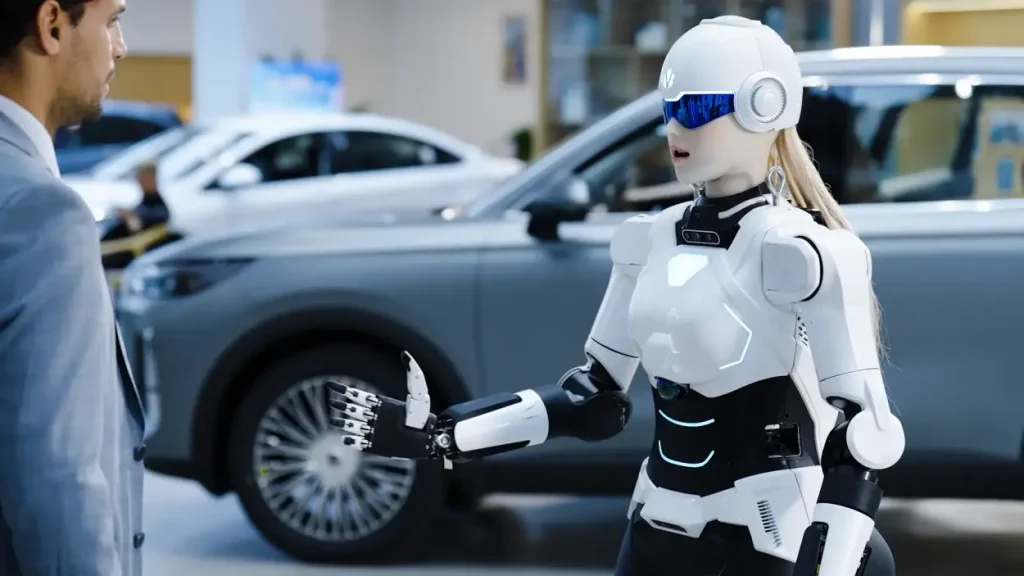
AiMOGA started as an internal Chery project in 2023 and was formally established in January 2025. The spark was practical, not sci-fi: Chery’s overseas dealerships needed to sell cars to customers in dozens of languages, and seasonal labor costs would not flex with demand. “Could a robot take over part of the sales job?” was the question Zhang — a 26-year Chery veteran who has run the company’s overseas sales — posed internally.
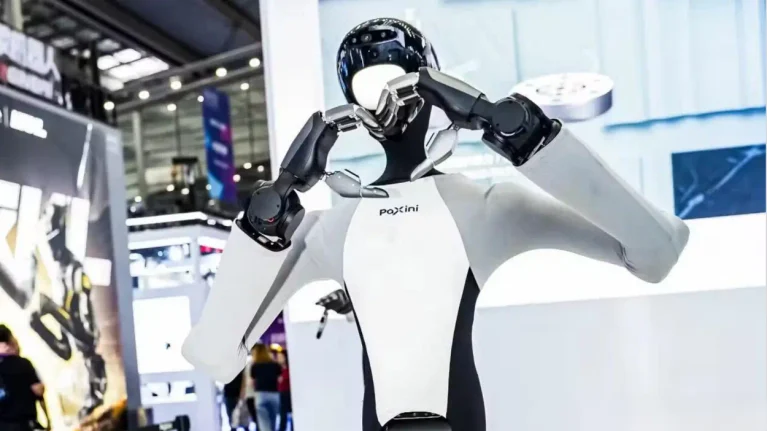
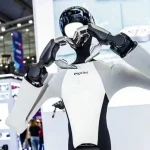
The first 220 bipedal units shipped to overseas dealerships in April 2025, handling greetings, model recommendations and walk-around explanations. From there the roadmap branched: a quadruped robot dog, a police robot, and a care robot. The flagship humanoid, branded MORNING (墨茵), stands 167 cm tall with 41 degrees of freedom and is already used in dealerships, shopping malls and government service desks across more than 30 countries. The robot-dog line has annual capacity of 15,000 units, and dog deliveries passed 1,000 in 2025. A police variant, MoJia ZhiJing, has 110 units deployed in Wuhu and other Chinese cities for traffic control and public-safety messaging.
The numbers that justify a listing
AiMOGA says it has delivered more than 3,000 robots worldwide, about 2,000 of them overseas, across 60-plus countries and regions. The 2027 goal is 10,000 global deliveries and a place among the world’s top-tier robotics firms.
Ownership remains firmly Chery’s: the automaker holds about 76.8% directly and roughly 96% including affiliated entities. An external angel round closed in January 2026 brought in Bethel (35 million yuan, about $4.8 million), Fuchun Dyeing (30 million yuan, about $4.1 million), IDG Capital, Zhiyuan Robotics and Wuhu government funds. Registered capital rose to about 1.42 billion yuan (roughly $195 million) and post-money valuation reached about 2.5 billion yuan (around $345 million).
Technically, AiMOGA leans on what Chery already knows how to build. It describes an “automotive-grade reuse” strategy — high-torque-density servo joints, autonomous-driving SLAM navigation, multimodal cockpit interaction and car-grade manufacturing lifted from the vehicle business. A self-developed system it calls ZhiGou QuanYu (with a MORNING large language model, dexterous-hand algorithms and multi-robot scheduling) is claimed to deliver L3-level embodied intelligence.
Why now: the capitalization wave
The timing is no accident. On the same day Zhang spoke to Reuters, Unitree (宇树科技) — whose “Superman” humanoid we covered at the same conference — began trading on Shanghai’s STAR Market, with its shares jumping nearly fivefold on the first session. Rival Lumos Robotics also told Reuters it is weighing a listing. Capital is flooding into Chinese humanoids, and Chery has form here: it spun off brake supplier Bethel to the Shanghai exchange in 2018 and industrial-robot maker EFORT to the STAR Market in 2020.
Zhang frames the IPO as a way to fund R&D and capacity, tighten governance and transparency, and cushion a likely price war. He likens today’s robotics sector to China’s EV industry a few years ago — a rush of entrants and brutal cost competition to come.
The real test is unit economics
The 2026 World Robot Conference featured more than 300 companies, over 2,000 products and 150-plus launches, and the tone has shifted from dancing and sparring demos toward real tasks: logistics sorting, phone packing, factory handling and home service. The hard constraint is cost. Analyst Georg Stieler estimates 50%–70% of humanoids built this year will feed “data factories” for training-data collection; to beat an 80,000-yuan ($11,000) annual worker within two years, an industrial humanoid’s all-in cost must fall to about 160,000 yuan. MERICS puts today’s typical price at 300,000–500,000 yuan.
That gap is why AiMOGA is betting first on services and public administration — traffic duty, where Middle East and Southeast Asia’s heat and rain make front-line work brutal — rather than racing straight into factories.
The Bottom Line
Chery’s AiMOGA (MoJia) robotics unit has launched IPO preparations after shipping more than 3,000 humanoids and robot dogs worldwide, targeting 10,000 deliveries in 2027. It is one of the clearest signals yet that China’s carmakers are converting robotics from show-floor spectacle into a capitalization game.
Sources & Further Reading
- Gasgoo via Reuters — Chery robotics unit prepares IPO, eyes overseas
- Tencent Securities — AiMOGA valuation, ownership and funding detail
- Global Finance — 2.5B yuan valuation, 25,000-unit ambition
- Related: BYD’s humanoid robot debut and supply-chain bets
- Related: Nearly 20 carmakers are building humanoid robots
- Related: Unitree’s “Superman” humanoid and its IPO-timed reveal