

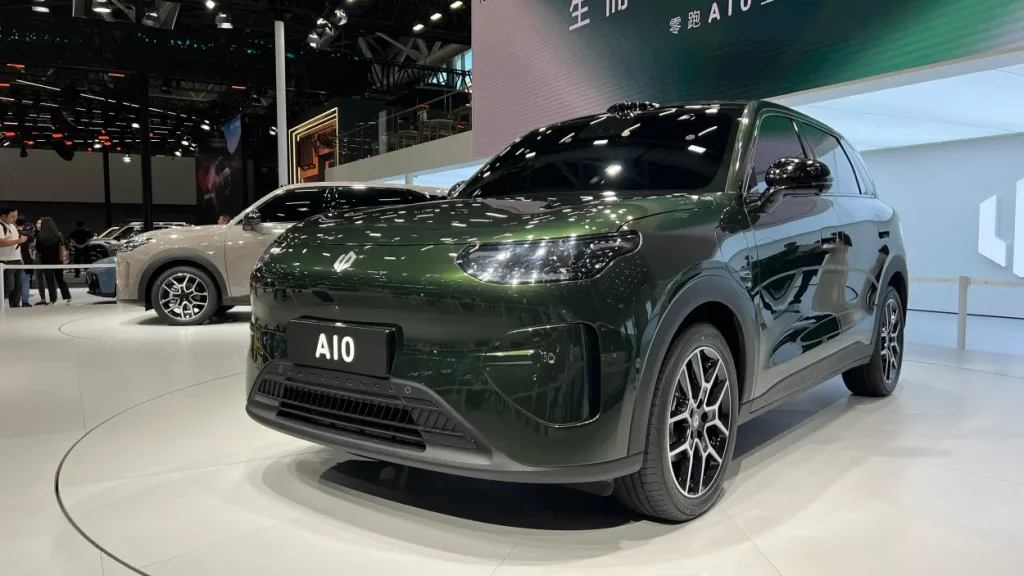
Leapmotor posted its strongest half-year ever — 356,487 deliveries and record revenue of 38.1 billion yuan ($5.3 billion) — but kept just 210 million yuan ($29 million) in net profit, about 589 yuan for every car sold. On the same earnings call, management confirmed it is building a robot business and will disclose the plan “soon,” joining a wave of Chinese carmakers betting on humanoids.
Record sales, razor-thin profit
Leapmotor (HKEX: 9863) reported first-half revenue of 38.11 billion yuan, up 57.2% year on year and a record for the period. Net profit reached 210 million yuan, a sixfold jump from 30 million yuan a year earlier, marking its third consecutive profitable half-year. The top line was driven by volume: 356,487 vehicles delivered, up 60.8%, making Leapmotor the best-selling Chinese new-energy startup by units.
In July, Leapmotor crossed 100,000 monthly deliveries for the first time — 101,267 units, up 102% — the first Chinese EV upstart to do so. Cumulative global deliveries passed 1.6 million by the end of July. By May registrations, Leapmotor ranked fourth among global NEV brands, behind BYD, Tesla and Geely.
The earnings quality, however, is thin. Gross margin narrowed to 11.7% from 14.1% a year earlier, though it recovered to 12.6% in the second quarter. Dividing net profit by deliveries yields roughly 589 yuan ($81) per vehicle. Management cut its full-year profit target from about 5 billion yuan to roughly 3 billion yuan, citing raw-material inflation and an unfavorable product mix.
Overseas is the real bright spot
Exports surged 372.6% to 96,294 vehicles in the first half — already above Leapmotor’s entire 2025 export total and 27% of total sales. In the first seven months, overseas shipments reached 113,863. Leapmotor is localizing assembly on three continents: the C10 is in volume production at Stellantis’ Malaysia plant, a Spanish plant is set to start B10 output in the third quarter, and a Brazilian facility is targeted for late 2027. Management now sees 2026 exports at 150,000–200,000 units and 350,000–400,000 in 2027.
The robot plan, confirmed
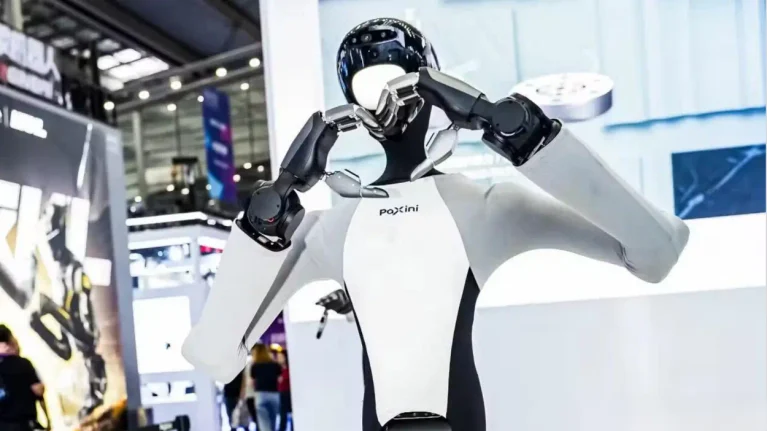
On the August 24 earnings call, Leapmotor executives confirmed the company is laying out a robot business and said a formal announcement will come “soon.” They did not detail the product, timeline or legal structure. The confirmation places Leapmotor alongside nearly 20 Chinese carmakers now developing humanoids, a list that already includes XPeng — whose robotics unit just raised $900 million — and Chery, whose AiMOGA unit has begun IPO preparations.
The robot intent was reinforced the same day by a deepened strategic cooperation agreement with China FAW. The deal spans capital, vehicles, autonomous driving, powertrains, batteries, chassis, lightweight parts and — explicitly — embodied-intelligence robots, a signal that the two partners intend to co-develop the machines, not just talk about them.
Why a volume champion is reaching for robots
Leapmotor’s story is the Chinese EV squeeze in miniature: it wins on scale but barely on margin. Analysts note the 210 million yuan profit rests heavily on non-vehicle income. Carbon-credit monetization — lifted by surging exports — contributed roughly 800–900 million yuan in the first half, management said, with about 500 million in the second quarter alone, while “other income” of around 1.08 billion yuan came largely from government grants. Strip those lines out and the vehicle business runs close to break-even before the company’s 2.32 billion yuan R&D and 1.99 billion yuan selling bills.
That arithmetic is exactly why a robot bet makes sense to Leapmotor’s board. The playbook is the same one BYD has run with its humanoid and battery bets: use the car business’s supply chain — motors, precision electromechanics, AI inference — as the head start a robot startup lacks, and open a second growth curve before the price war closes the first. Leapmotor’s own product pipeline, from the A05 to its Mexico push via Stellantis, shows a company already comfortable operating far from home.
The Bottom Line
Leapmotor’s H1 2026 set records on volume (356,487 deliveries) and revenue ($5.3 billion) but kept only $29 million in net profit — about $81 per car. On the same call it confirmed a robot business plan “to be announced soon,” aligning with FAW on embodied-intelligence robots and joining the carmaker-humanoid race.
Sources & Further Reading
- CnEVPost — Leapmotor stays profitable in H1 as margin and cash flow weaken
- Morningstar / Dow Jones — Leapmotor’s net profit surges on higher revenue
- Gasgoo — Leapmotor H1 profit, FAW cooperation and robot plan
- Red Star Capital — Leapmotor per-car profit and robot confirmation
- ChinaBizInsider — the carbon-credit and subsidy decomposition
- Related: Nearly 20 carmakers are building humanoid robots