
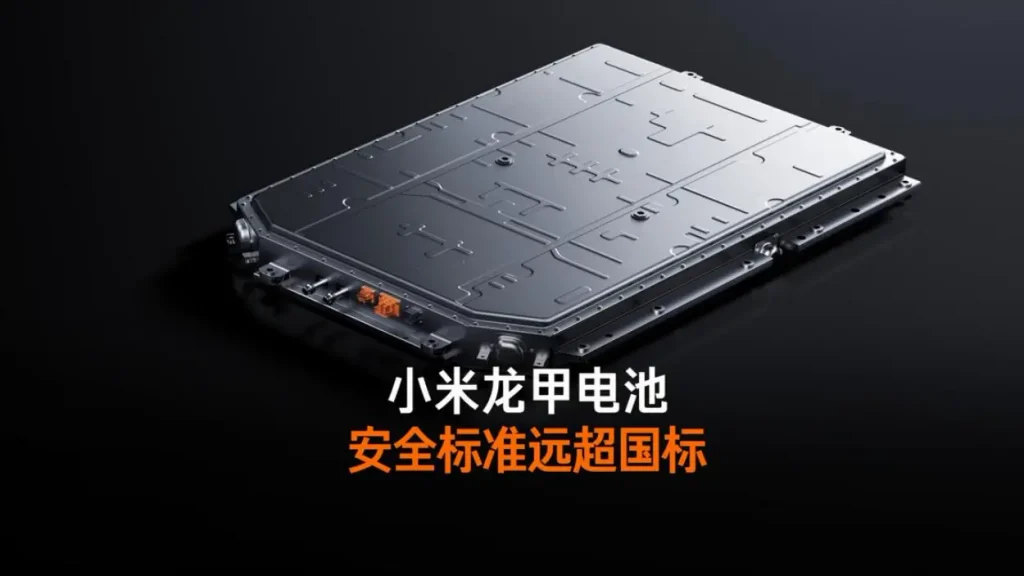
On September 4, 2026, Xiaomi held a “Dragon Armor battery” strategy event with two battery makers, CALB and Sunwoda — and announced a battery that Xiaomi does not manufacture, does not own a factory for, but guarantees for the life of the vehicle. The Xiaomi Dragon Armor battery (龙甲, literally “Dragon Armor”) debuts on September 7 in the Sky Nomad extended-range SUVs, Xiaomi’s first models built around a battery that the carmaker defines down to the electrode tab — and promises to replace with a brand-new car if a defect ever sets one on fire.
The timing is not accidental. Xiaomi Auto’s domestic deliveries slid to 31,267 units in July — sharply below the 50,212 monthly peak of December 2025 — and the auto business was still loss-making per vehicle in the first quarter. The Sky Nomad line is Xiaomi’s volume-and-profit bet, and the Dragon Armor battery is the confidence mechanism Xiaomi is attaching to it: a supply-chain model nobody in China’s EV industry has packaged quite this way before.
Xiaomi Dragon Armor Battery: A Standard, Not a Factory
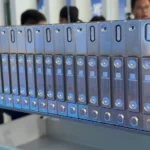
The conventional Chinese model is direct purchase: an automaker buys finished cells from CATL or BYD’s FinDreams and integrates them. Xiaomi’s Dragon Armor approach is different. Xiaomi defines the electrochemistry, the voltage platform, the energy content and the cell format; it leads development of the pack’s mechanical structure, electrical and electronic architecture, thermal management and battery-management software strategy; and it participates deep inside cell development itself. Huang Zhenyu, vice president of Xiaomi Auto, said the Xiaomi team is involved in selecting the four major electrode and electrolyte materials, the electrode-tab form, and internal safety-space optimization — even customising the secondary cold-rolling process on the anode to improve reliability under long-term road vibration and impact, as Tencent News reported from the event.
CALB custom-develops the electrochemical system and materials to Xiaomi’s definition; Sunwoda provides professional cell manufacturing on a dedicated line. The split was telegraphed months ago — CnEVPost reported in May that Sunwoda and CALB would supply Xiaomi’s second model line — but the September 4 event formalised the terms: Xiaomi brings the product definition and quality requirements, the cell makers bring the chemistry and the factories, in what CALB chairman Liu Jingyu described as a “full-chain collaboration” replacing the traditional buyer-seller relationship.
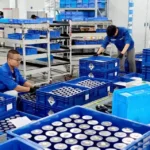
To police quality in factories it does not own, Xiaomi operates what it calls a “shadow factory” mechanism. Xiaomi quality engineers are stationed on supplier production lines, managing six modules — project, process, equipment, operations, process quality and sub-suppliers — down to tier-one and tier-two component and raw-material levels. CALB says the Dragon Armor line carries more than 8,000 quality checkpoints, with full X-ray inspection, CT scanning and AI-based defect determination, and process data archived for 15 years, per the company’s official statement.
Xiaomi Dragon Armor Battery Safety Specs: Heat, Impact, Water, Data
The safety claims, all stated by Xiaomi as internal test results, are engineered to beat Chinese national standards by a wide margin:
- Thermal runaway: a single cell at full charge in a 55°C ambient chamber that goes into thermal runaway does not spread to the rest of the pack — no fire, no explosion. The national-standard test runs at 22±5°C with the battery at ≥95% state of charge.
- Bottom impact: the pack survives a 500-joule strike from a 25-mm impact head with no fire, no leak and no loss of function.
- Water: dual IPX8 and IPX9K ratings — 24 hours of static submersion at one metre, plus 80°C high-pressure hot-water washing.
- High-voltage isolation: a millisecond-level mechanical guillotine cuts high voltage on collision or short circuit, backed by redundant insulating materials.
- Data: Xiaomi’s cloud-based BMS samples cell data at 10 times the frequency of the national standard and collects three times the data volume, with 24-hour vehicle-to-cloud monitoring and AI-based anomaly detection.
- Cycle life: Li Xiaoshuang, vice president of Xiaomi’s auto division, said the Dragon Armor battery’s cycle life “far exceeds” national-standard requirements.
The Xiaomi Dragon Armor Battery Lifetime Promise: Fire Means a New Car
The headline-grabbing part is the “Anxin Guarantee Plan” Xiaomi published alongside the battery. If a vehicle reaches scrapping condition because of a fire caused by an original-battery quality defect, Xiaomi will compensate the owner with a new car of the same configuration and trim. If a battery fire results from a collision or underbody scrape, Xiaomi pays the difference between the comprehensive insurance policy amount and the actual insurance payout.
Two details separate this from marketing boilerplate. First, it is a lifetime commitment — not limited to the eight-year battery warranty period, so a fire in year 15 is still covered. Second, it covers collision and underbody-scrape fires, which most automakers explicitly exclude; the Chinese trade press notes the only other manufacturer with a comparable collision-fire backstop is GAC Toyota, whose policy took effect July 24. Compensating with an entire new car rather than just a replacement battery is rare in the industry.
Accuracy note: The guarantee is narrower than “lifetime for every owner.” It applies only to the original, non-commercial first owner — ride-hailing, rental and second-hand vehicles are excluded — and requires the owner to keep the Xiaomi connected-car service active and have the vehicle maintained at official Xiaomi service centres. None of the safety figures above has been independently verified; they are Xiaomi’s stated test results. Chinese automotive portal Autohome rendered the battery’s name as “Dragonscale” in one report, underscoring that Xiaomi has not published an official English name — “Dragon Armor” is a literal translation of 龙甲.
Why the Xiaomi Dragon Armor Battery Supply Shift Matters
Read the supplier map and a quiet strategy appears. The SU7 uses CATL cells; the YU7 uses BYD FinDreams cells; the Sky Nomad range will use CALB and Sunwoda. Xiaomi has now spread its battery exposure across three independent supply chains — an implicit hedge against the pricing and allocation power of the top two makers, and the same de-risking logic that led Huawei’s HIMA brands to bring in smaller battery suppliers this year.
Sunwoda’s timing could hardly be better. On the same day as the Xiaomi announcement, listed parent Sunwoda disclosed that Li Auto will invest RMB 2.65 billion (about US$365 million) to become its EV-battery unit’s second-largest shareholder at roughly 11.17%. Two of China’s most-watched new automakers are now tying their battery futures to a company best known until recently for phone batteries. CALB, for its part, guided first-half net profit up 100–110% year on year.
The commercial stakes land on September 7, when Xiaomi’s autumn launch event officially prices the Sky Nomad N70 Pro, N70 Max and N90 Max — the models that carry the Dragon Armor battery in 52-kWh LFP and 76-kWh NMC variants, with the flagship N90 Max rated at 464 km of CLTC electric range and more than 1,700 km combined. Presale demand was already tracked closely through the summer, and the pre-sale pricing plus the N90’s design as it neared production are covered in our earlier reporting.
The Bottom Line. Xiaomi Dragon Armor battery is a supply-chain statement disguised as a safety launch: cells built by CALB and Sunwoda to Xiaomi’s specification, policed through a shadow-factory system, and guaranteed for the original owner’s lifetime with a new-car pledge that no volume Chinese EV maker has matched. It debuts September 7 in the Sky Nomad N70 and N90, Xiaomi’s best hope for volume and profit. The model — automaker defines, suppliers fabricate, automaker guarantees — may matter more to the industry than any single test number in the release.
Sources & Further Reading
- Shanghai Securities News (上海证券报·中国证券网) — “Xiaomi announces CALB and Sunwoda as battery strategic partners” (2026-09-04) — primary Chinese-source report on the Dragon Armor event; product-definition and six-dimension safety framing.
- Autohome (汽车之家车家号) — “Xiaomi Sky Nomad launches Dragon Armor battery; defect-caused fire means a new car” (2026-09-05) — Dragonscale naming, guarantee terms, BMS sampling figures, delivery context.
- Tencent News (腾讯新闻) — “Xiaomi Dragon Armor battery: deep cell involvement, dual suppliers, lifetime guarantee” (2026-09-05) — Huang Zhenyu quotes on cell-design participation and anode secondary cold rolling.
- CALB official release via Tencent News (腾讯新闻·中创新航) — “CALB and Xiaomi build a full-chain collaboration model” (2026-09-05) — 8,000+ quality checkpoints, 15-year process archive, Liu Jingyu remarks.
- Tencent News (腾讯新闻) — “Xiaomi’s battery backstop: lifetime new-car promise for fires” (2026-09-05) — IPX8/9K, millisecond guillotine, GAC Toyota comparison.
- Tencent News (腾讯新闻) — “Two boons for Sunwoda: Li Auto becomes second-largest shareholder; Xiaomi strategic cooperation” (2026-09-05) — Wang Mingwang remarks; RMB 2.65 billion / 11.17% investment context.
- CnEVPost — “Xiaomi EV reportedly taps new battery suppliers for second brand to target EREV market” (2026-05-19) — English background: Sunwoda/CALB supply reports predate the September announcement.
- CnEVPost — “Xiaomi shares slide after Sky Nomad SUVs debut” (2026-07-31) — market-reception context for the September 7 launch.
Sourcing note: The announcement was made September 4, 2026 via Xiaomi’s official channels and reported by state-affiliated Shanghai Securities News; English-language first-hand reporting had not appeared as of publication, so Chinese high-authority sources (Xiaomi official statements relayed by Shanghai Securities News, CALB’s official release and Autohome) serve as the primary citations. All safety figures and guarantee terms are manufacturer statements, not independently verified. The battery’s English name is a literal translation of 龙甲; Xiaomi has not published an official English name (one outlet renders it “Dragonscale”). Supply-split percentages reported in May (Sunwoda 60% / CALB 40%) were not confirmed by the September announcement, which disclosed no volume or value commitments. USD conversions calculated at RMB 7.25 to the dollar. Analysis and interpretation are original to EVsays.