
On September 10, 2026, at a venue in Hefei’s Yaohai district, Leju Robotics, China Telecom’s Anhui branch and Huawei unveiled what the three companies call the world’s first SIM card designed for embodied robots — and, alongside it, a 5G-Advanced service plan called “Embodied Wing Link” that starts at 599 yuan (about $83) a month. A robot does not need a phone number. It needs an upload pipe, and a way to be billed for one.
Humanoid Robot SIM Card: What Leju, Huawei and Anhui Telecom Launched
The launch was reported by Sina Finance, carrying a 21st Century Business Herald report. The three partners describe it as the first dedicated telecom product built for embodied intelligence, and as the moment Chinese carriers formally entered what state media calls the sector’s “new infrastructure”.
Leju is the Shenzhen robotics company behind Kuafu, a full-size bipedal humanoid that runs on Huawei’s open-source HarmonyOS and hooks into Huawei’s Pangu models. It is one of a wave of Chinese humanoid makers that now account for the overwhelming majority of global shipments — a dominance we examined when China’s humanoid robot shipments reached 97% of the global total. Its chief executive, Chang Lin, framed the SIM card in unusually grand terms: “the world’s first SIM card for embodied robots is an important beginning of silicon-based life entering human society.” Huawei’s vice president for wireless networks and chief marketing officer, Zhao Dong, was more concrete: issuing the card in Yaohai “has a strong demonstration effect” and will let robots move “from the laboratory into broader spaces”.
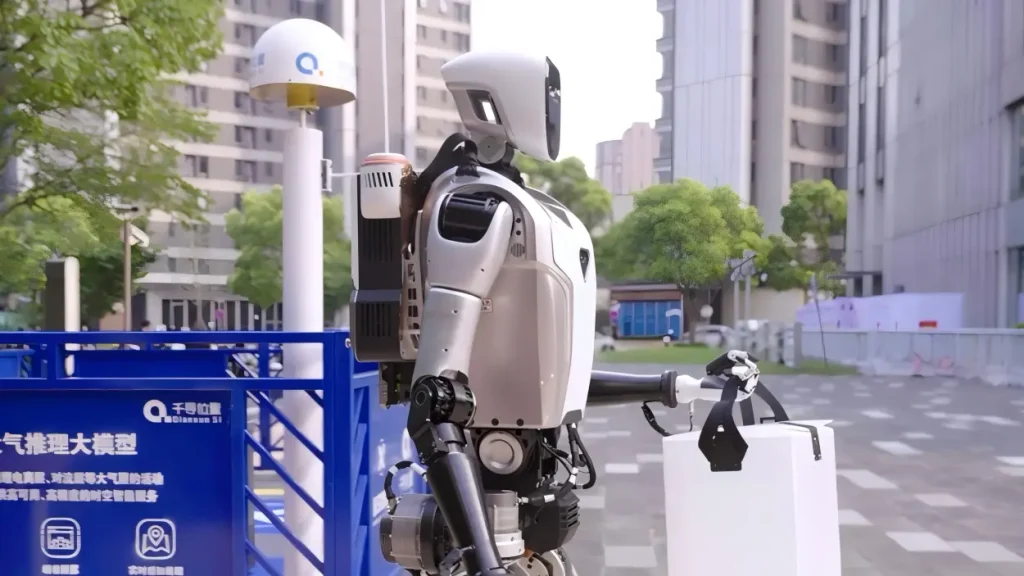
What is actually shipping is a bundle: a dedicated SIM, a 5G-A tariff, priority scheduling on the network, and a live deployment — multiple Kuafu robots patrolling eight main routes at a demonstration park.
Why a Humanoid Robot SIM Card Is Built for Uplink
Consumer phone plans are designed around downloads. Robot plans invert that. The three requirements the partners name are a high share of uplink traffic, low latency for remote interaction, and many concurrent devices in one place — a single warehouse or campus can put a dozen machines on the same cell.
Regular Wi-Fi struggles with exactly that combination: interference, limited uplink bandwidth, higher transmission latency and a low ceiling on simultaneous devices. 5G-Advanced, the half-generation between 5G and 6G, attacks it with uplink-enhancement techniques such as multi-carrier aggregation and supplementary uplink; Telecom-industry analysis published this year puts numbers on it: a single embodied device uploaded about 2 GB an hour in 2025, a figure Huawei expects to reach 10 GB an hour by 2030, while a 720p close-range recognition task needs 8 Mbps of uplink, a 1080p mid-range search task 20 Mbps, and a 4K long-range tracking task 80 Mbps.
That matters because a robot streams what it sees. Continuous video, point-cloud or teleoperation data from several machines is an uplink problem before it is anything else — and, as the deployment below shows, it is also the raw material for something else entirely.
Humanoid Robot SIM Card Pricing: 599 and 999 Yuan a Month
| Plan | Price | Peak uplink | High-speed uplink data | Extras |
|---|---|---|---|---|
| Standard | 599 yuan/month (≈$83) | 300 Mbps | 200 GB | Priority scheduling |
| Enhanced | 999 yuan/month (≈$138) | 500 Mbps | 500 GB | Dynamic network slicing |
Both tiers are customisable by scenario, and the headline 500 Mbps / 20 ms at 95% figures apply to the enhanced tier. To put the price in context: Leju’s Kuafu robots sold for an average of 308,100 yuan (about $42,500) each in 2025, according to its prospectus as reported by The Paper. Connectivity at roughly $83–138 a month is a rounding error against the hardware — which is a hint about where the value in this arrangement actually sits.
The Humanoid Robot SIM Card and Leju’s Data Business
The demonstration deployment is not decorative. According to the Xin’an Evening News, the Kuafu robots run their routes four times a day — twice in the morning and twice in the afternoon. Over months of operation they have accumulated “high-quality data from real scenarios,” which streams back to Leju’s data-collection platform, gets cleaned and labelled, and is fed back into model training. The partners describe a closed loop: patrol work → real-world data collection → data returns to training.
Follow the money and that loop stops looking like a side benefit. Leju’s 2025 prospectus, reviewed in detail by Jiemian News, shows revenue of 258 million yuan (about $36 million) — and data collection was the single largest application segment at 44.94% of revenue, ahead of research and education. Kuafu sold 577 units for 178 million yuan, roughly 12 times the prior year, at an average price that fell about 26% year on year. The company filed for a ChiNext listing on May 19, 2026 — the first applicant under the exchange’s fourth listing standard — seeking 2.6 billion yuan ($359 million) at a post-money valuation of 4.33 billion yuan ($597 million), and has yet to turn a profit. The filing puts Leju in the same queue as Unitree, whose own listing tested the market’s appetite, and it lands inside a broader funding wave: XPeng’s robotics arm raised $900 million at a $6.3 billion valuation this year.
Seen that way, a dedicated SIM card is less a consumer product than a piece of collection infrastructure: it makes every deployed robot a metered, always-on data endpoint. It also gives China Telecom a new subscriber category. When a machine has its own line, a telco’s addressable market stops being the number of people and starts being the number of robots.
What the Humanoid Robot SIM Card Doesn’t Solve
Three caveats are worth keeping in view.
First, “world’s first” is a company framing. The description originates with Leju and its partners and has been repeated by state media; EVsays has not found an independent registry of robot-specific SIM products, and no English-language report of the Hefei launch had appeared at the time of writing. What is verifiable is the deployment, the tariff structure and the specifications.
Second, connectivity does not create use cases. Eight patrol routes in a park is a controlled environment with known routes and stable coverage — a long way from a hospital corridor, a construction site or a home — as we noted when a record-breaking sprint at the World Humanoid Robot Games showed how far demonstration still sits from deployment. Leju’s own filings put industrial manufacturing at just 3.88% of Kuafu revenue in 2025, with most manufacturing projects still at proof-of-concept stage.
Third, the tariff is not yet a business. A 599-yuan monthly plan is meaningful if you are counting thousands of machines and near-zero if you are counting dozens. The relevant question over the next year is not what the plan costs but how many robots carry one — and whether the data those robots gather turns into models that make the next deployment cheaper to run. That is the loop the SIM card was built to close, and it is still wide open.
Sourcing note: This launch was reported by Chinese-language media between September 11 and 14, 2026, including Sina Finance (carrying a 21st Century Business Herald report), People’s Daily’s Anhui channel, China National Radio, Xin’an Evening News and the Shenzhen Longhua government portal; the event took place on September 10, 2026 in Yaohai district, Hefei. No English-language report had appeared at the time of writing. The plan specifications (599/999 yuan, 300/500 Mbps peak uplink, 200/500 GB, 20 ms at 95%), the patrol frequency and the data loop are consistent across those sources. Leju’s financial figures are drawn from its ChiNext prospectus, filed in May 2026, and cover the 2025 financial year. The uplink benchmarks cited come from telecom-industry analysis published in 2026. Descriptions such as “world’s first” and “China’s first” are the companies’ and state media’s framing, not independently verified. Currency conversions use RMB 7.25 per USD. Analysis and interpretation are original to EVsays.
The Bottom Line: A dedicated humanoid robot SIM card sounds like a novelty. It is better read as plumbing for the one input the robotics industry cannot buy in bulk — real-world operational data. Leju, Huawei and China Telecom have wired up eight patrol routes in Hefei and priced machine connectivity at $83–138 a month. The technology is not what will decide whether it works; the willingness of factories, hospitals and campuses to let their floors become training data will.
Sources & Further Reading
- Sina Finance / 21st Century Business Herald — “全国首张!深企具身智能机器人有了专属“SIM卡”” (2026-09-14 18:38) — the report this article is based on — confirming the partners, the plan tiers, the patrol deployment and the data-collection loop.