
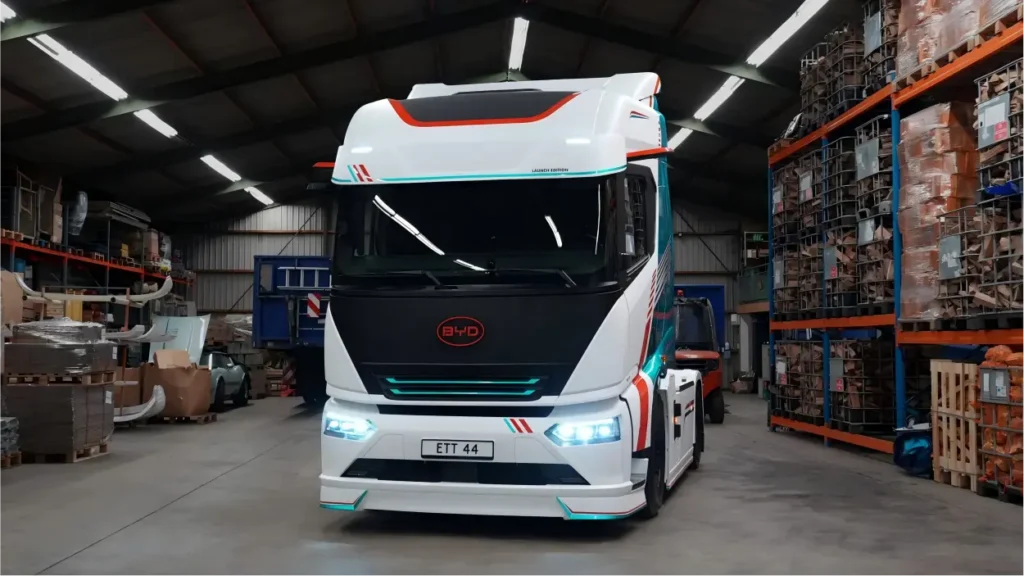
On September 14, at IAA Transportation 2026 in Hannover, BYD Commercial Vehicles staged the global debut of the ETT 44 — a 4×2 battery-electric tractor unit with a 651 kWh Blade Battery, a claimed 600 km of range and megawatt charging that takes it from 20% to 80% in about 20 minutes. It is BYD’s first move into Europe’s long-haul heavy truck market, and its most interesting feature is not the truck.
BYD Electric Truck Debut: What the ETT 44 Actually Is
BYD describes the ETT 44 as a native electric platform developed for European regulations, roads and fleet operating patterns rather than a Chinese model adapted for export — a distinction the company is at pains to make, and one that matters to fleets that have been burned by compliance retrofits. It is a 4×2 tractor designed for combinations of up to 44 tonnes. BYD’s own launch release puts peak output at up to 1,000 PS and the battery warranty at 10 years or 1.2 million kilometres.
| Specification | ETT 44 |
|---|---|
| Format | 4×2 electric tractor unit, combinations up to 44 t |
| Battery | 651 kWh Blade Battery (a 434 kWh variant also cited in Chinese-language coverage) |
| Output | Rated 743 PS; peak up to 1,000 PS |
| Range | Claimed up to 600 km (BYD quotes this at 40 t laden) |
| Charging | CCS2 up to 420 kW (20–80% in about an hour); BYD Megawatt Charging System above 1.5 MW (20–80% in about 20 minutes) |
| Battery warranty | 10 years / 1.2 million km, 70% retained capacity, as standard |
| Safety | Five-star Euro NCAP plus CitySafe; low cab, door vision window, camera eMirrors; L2+ ADAS readiness |
The tractor is the headline, not the whole portfolio. BYD also showed 28-tonne rigid trucks in swap-body and hooklift form, an EYT 2.0 yard tractor rated to 75 tonnes and up to 16 hours of continuous work, the E-VALI light commercial van (still in field testing) and the T35 urban truck, which Automotive World reports is due for production from 2027. The line-up now runs from roughly 3.5 tonnes to 44 tonnes.
The BYD Electric Truck Pitch: Sell the Ecosystem, Not the Truck
The commercial argument BYD is making in Europe is not a spec sheet. It is a bundle: vehicle, battery, megawatt charging, stationary storage, energy management and financing, packaged under what BYD calls Total Cost of Mobility. In Hanover the company displayed the charging system and the storage alongside the trucks, and it already has the infrastructure to point at — including its 10,000th flash-charging station in China, built for passenger cars.
Stella Li, BYD’s executive vice president, framed the technology transfer bluntly: “We have already put FLASH Charging into practice in passenger vehicles. Today, we are bringing this technology to commercial vehicles, starting with our trucks. With 1.5 megawatts of charging power, it can charge from 20% to 80% in about 20 minutes. Less time charging. More time on the road.”
The charging claim is the one that matters commercially. A passenger car can sit on a charger for half an hour; a tractor unit is an income-generating asset, and every hour stationary feeds straight into delivery schedules, utilisation and fleet economics. That is why the industry’s shared target is megawatt charging rather than another 100 km of range — and it is the same engineering problem BYD has been working on in passenger cars, from the megawatt station architecture downward to the high-voltage silicon carbide module and the second-generation Blade pack that make sustained high-current charging survivable.
Then there is the warranty. Ten years or 1.2 million kilometres at 70% retained capacity, fitted as standard, sits well beyond the six-to-eight-year battery coverage typical in the European market — where extended protection has usually been a paid option and, for the incumbents, a service-revenue line. Undercutting that is a commercial attack, not a technical one.
BYD Electric Truck Safety: Five Stars, With a Caveat
The ETT 44 also became the first long-haul electric truck to be rated by Euro NCAP, and it took five stars plus the organisation’s CitySafe award on its first attempt. The breakdown is more instructive than the headline: 89% in Safe Driving, 73% in Crash Avoidance and 80% in Post Crash Safety, according to the published results.
| Model | Safe Driving | Crash Avoidance | Stars |
|---|---|---|---|
| BYD ETT 44 (electric, long haul) | 89% | 73% | 5 + CitySafe |
| Mercedes-Benz Actros F (long haul) | 79% | 82% | 5 + CitySafe |
| Scania G-series (long haul) | 82% | 96% | 5 + CitySafe |
| IVECO S-WAY (regional distribution) | 67% | 20% | 2 |
Read that table honestly and BYD’s result is strong but not dominant. It leads on Safe Driving — Euro NCAP credited the low cab mounting height, a lower door vision window and camera-based digital mirrors — but trails Mercedes-Benz and Scania on Crash Avoidance, which Euro NCAP tied to frontal vehicle-to-vehicle and lane-departure prevention, saying several of BYD’s driver assistance systems “require further refinement.” Scania’s near-96% scores come with their own caveat: much of the equipment behind them is optional rather than standard.
Euro NCAP’s Matthew Avery framed the entry in institutional terms: “Euro NCAP welcomes BYD as a new challenger to the European heavy vehicle market. This long-haul electric truck will cause a stir, with a strong focus on safety and a five-star rating.” The same round also warned fleet buyers to check standard specifications rather than assume a five-star badge comes with the base vehicle.
Where the BYD Electric Truck Sits Against Europe’s Incumbents
On range, BYD is not the leader. Volvo’s extended-range FH Aero Electric, launched in April 2026, is rated at up to 700 km, and Mercedes-Benz’s eActros 600, Scania and MAN are all pushing battery-electric tractors at the same duty cycles. BYD’s claimed 600 km positions it inside the pack rather than in front of it — and claimed figures depend on payload, weather, route and driving style.
The differentiation sits in charging speed and in what comes attached to the vehicle. That is also the axis on which the competition is converging: megawatt charging is now the shared target of every European truck maker, which means BYD’s early lead there is a lead in a race everyone has entered, not a moat. A rival route exists and is being built in parallel — CATL’s heavy-truck battery-swap programme — which trades charging speed for pack exchange. BYD currently operates commercial vehicles in more than 100 countries and 400 cities, so this is an expansion of an existing business rather than a first attempt at heavy vehicles.
The BYD Electric Truck and Europe’s Tariff Wall
There is a structural reason the heavy truck segment is a softer entry point than passenger cars. The European Commission’s countervailing duties on Chinese battery-electric vehicles apply to passenger cars; heavy commercial vehicles fall outside that regime. BYD pays 17% countervailing duty plus the standard 10% on the cars it ships to Europe. Its trucks do not carry that overhang — which makes the freight segment a place where BYD competes on product and service rather than on tariff arithmetic. It is also a segment where the buyer is a fleet manager with a total-cost spreadsheet, not a consumer, and where the installed charging base matters as much as the vehicle.
The Bottom Line: BYD entered Europe’s heavy truck market on September 14 with the ETT 44: 651 kWh, a claimed 600 km, megawatt charging at more than 1.5 MW and a 10-year, 1.2-million-kilometre battery warranty as standard. It won five Euro NCAP stars on its first attempt while trailing Mercedes-Benz and Scania on crash avoidance, and it is not the range leader against Volvo. The wager is not that BYD builds the best truck — it is that fleets will buy the whole system, and that a decade-long warranty changes what a truck is worth to own.
Sourcing note: The ETT 44 was unveiled at IAA Transportation 2026 in Hanover on September 14, 2026, and the Euro NCAP results were published to coincide with the show’s opening. Primary source is BYD Commercial Vehicles’ own launch release; product specification and portfolio detail are corroborated by Automotive World and Interesting Engineering, with additional context from Gulf News and The Brake Report. The Euro NCAP scores and the organisation’s assessment of the ETT 44’s driver assistance systems are taken from the published results round. Currency conversion is not required: no transaction value was disclosed. Analysis and interpretation are original to EVsays.
Accuracy note: Several figures differ between sources and should be treated as claims rather than measurements. The ETT 44’s electrical architecture is given as 851 V by international reports and 1,000 V by Chinese-language coverage; we cite neither as settled. Gross train weight is described as up to 44 tonnes by BYD and Gulf News, and up to 48.5 tonnes by Interesting Engineering. Range of 600 km is BYD’s claimed maximum; BYD’s Chinese release specifies it at 40 t laden, while its English release is less specific. The megawatt-charging range gain is 248 miles in BYD’s English release and roughly 300 km of trunk-line range in its Chinese release. The swap-body version of the 28-tonne rigid is quoted at 540 km in Chinese coverage and 750 km by Automotive World. The claim that heavy trucks fall outside the EU’s countervailing duty regime rests on the scope of that regulation, which covers passenger battery-electric vehicles; we have not verified the tariff line applicable to this specific vehicle. All range, charging and warranty figures are manufacturer claims and have not been independently tested.
Sources & Further Reading
- BYD Commercial Vehicles (official) — “BYD Commercial Vehicles unveils its most comprehensive zero-emission transport portfolio at IAA Transportation 2026” (2026-09-14) — the launch release: ETT 44 specification, the megawatt charging claim, the warranty and Stella Li’s remarks.
- Automotive World — “BYD unveils its widest electric truck range at IAA 2026” (2026-09) — portfolio breakdown, the 10-year/1.2-million-km warranty at 70% retained capacity, and the read on how the warranty pressures incumbent aftersales models.
- FIA Region I — “Euro NCAP awards five-star safety rating to BYD’s new electric truck” (2026-09) — the safety results for the ETT 44 alongside Mercedes-Benz, Scania and IVECO, with Euro NCAP’s commentary.
- Also consulted, without hyperlinks: Gulf News (2026-09) for the Volvo FH Aero Electric 700 km comparison and the 851 V architecture figure; Interesting Engineering (2026-09) for the peak output figures and the 48.5-tonne gross combination figure; The Brake Report (2026-09) for the full Euro NCAP score table and Matthew Avery’s comments.