

A newly published BYD application describes a BYD silicon-carbon anode in which nine added elements are chemically bonded to the carbon and to the silicon, rather than simply sitting inside the carbon’s pores. Whether any of it produces a better cell is a question the filing does not answer.
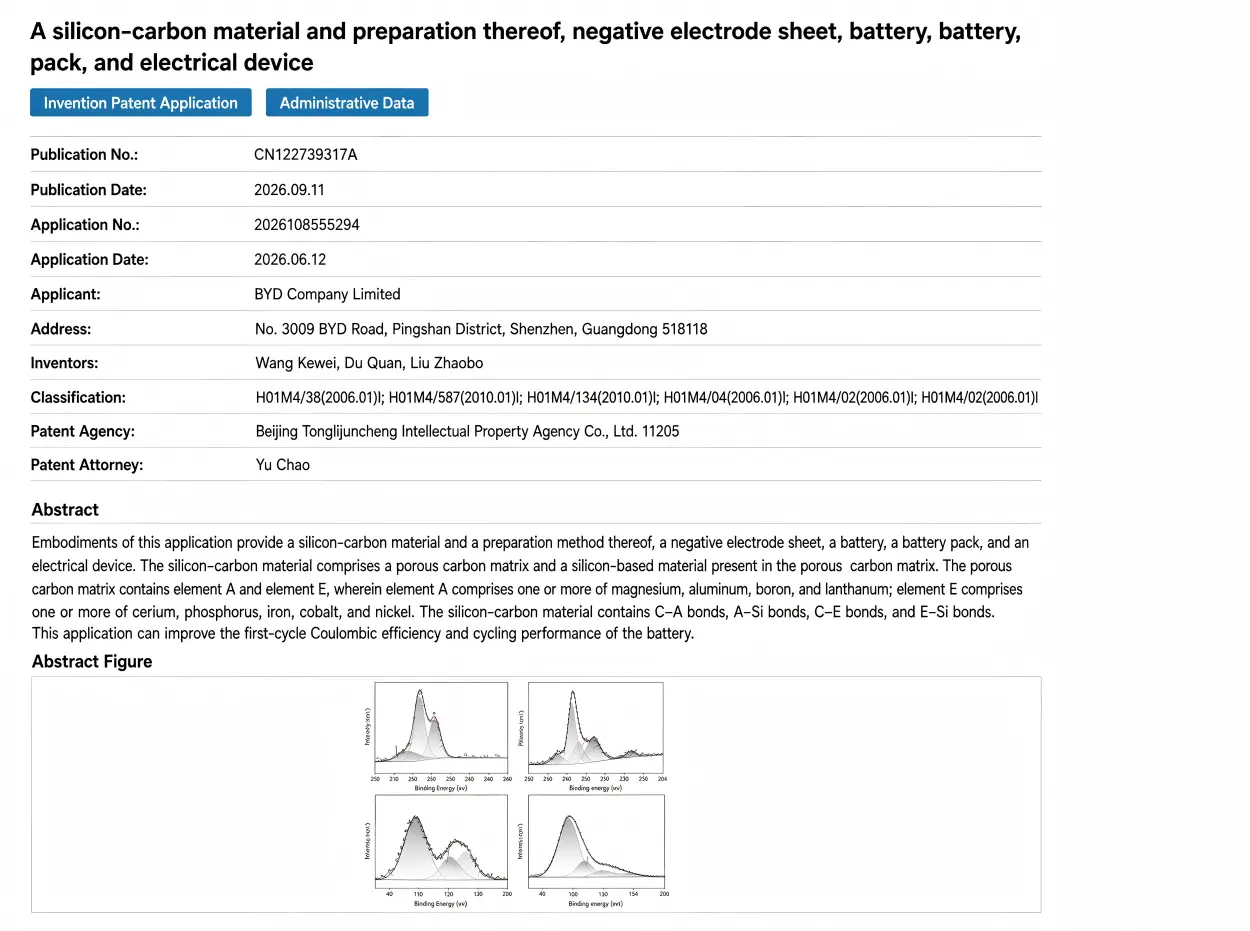
BYD filed the application on June 12, 2026, and China’s National Intellectual Property Administration published it as CN122739317A on September 11, as recorded in the Sina Finance report on the filing. The title runs the whole ladder from powder to product: a silicon-carbon material and its preparation, a negative electrode sheet, a cell, a battery pack and an electrical device. The named inventors are Wang Kewei, Du Quan and Liu Zhao, and the classification codes — H01M4/38, H01M4/587, H01M4/134 — are the classes for silicon, carbon and alloy anode materials.
What the BYD Silicon-Carbon Anode Patent Claims
The abstract is short, and it is about chemistry rather than geometry. The material comprises a porous carbon matrix and a silicon-based material held inside it. The matrix contains two groups of added elements: group A — magnesium, aluminium, boron and lanthanum — and group E — cerium, phosphorus, iron, cobalt and nickel.
| Group | Elements named | Bonds the filing claims |
|---|---|---|
| A | Magnesium, aluminium, boron, lanthanum | C–A and A–Si |
| E | Cerium, phosphorus, iron, cobalt, nickel | C–E and E–Si |
Then comes the part worth reading twice. The application states that the silicon-carbon material contains C–A bonds, A–Si bonds, C–E bonds and E–Si bonds, and that it improves the cell’s first-cycle Coulombic efficiency and its cycling performance.
Read literally, that is a claim about bridges. Each group of elements is described as bonded to the carbon and to the silicon, which places the dopant at the interface between the two rather than alongside them. The filing does not explain why each of the nine elements was chosen, and it does not say which ones the worked examples used — though the material’s own spectra, discussed below, point to boron and cerium.
Why Bonds Are Different From Pores
Silicon is the obvious anode material if you want more energy per kilogram. Its theoretical capacity is roughly ten times graphite’s, and it is abundant. The problem is that a silicon particle swells by around 300% as it takes up lithium and shrinks again when it gives it back, which cracks the particle, breaks the solid electrolyte interphase on its surface, and exposes fresh silicon that consumes lithium building a new one. First-cycle efficiency and cycle life are the casualties.
The industry’s commercial answer has been a housing problem: put nanosilicon inside a porous carbon host, so the pores absorb the expansion and the carbon carries the current. Most capacity-boosting anodes shipping today are made that way, by depositing silane into a carbon scaffold in a chemical vapour deposition reactor. It works. It is also a mechanical fix to an interfacial problem — the carbon holds the silicon in place, but at the boundary between the two there is nothing that stops the silicon from moving relative to its host as it breathes.
This application proposes to put something there. If the dopants do form the four bond types the claim names, the silicon is tethered to the carbon by covalent bonds rather than resting against it, and the interface stops being a boundary and becomes a graded chemical structure. That is the same instinct running through work on the electrolyte side of that interface, and it is the opposite of the direction taken by graphite-free anode designs that remove the host entirely.
The Filing’s Own Spectra Point to Boron and Cerium
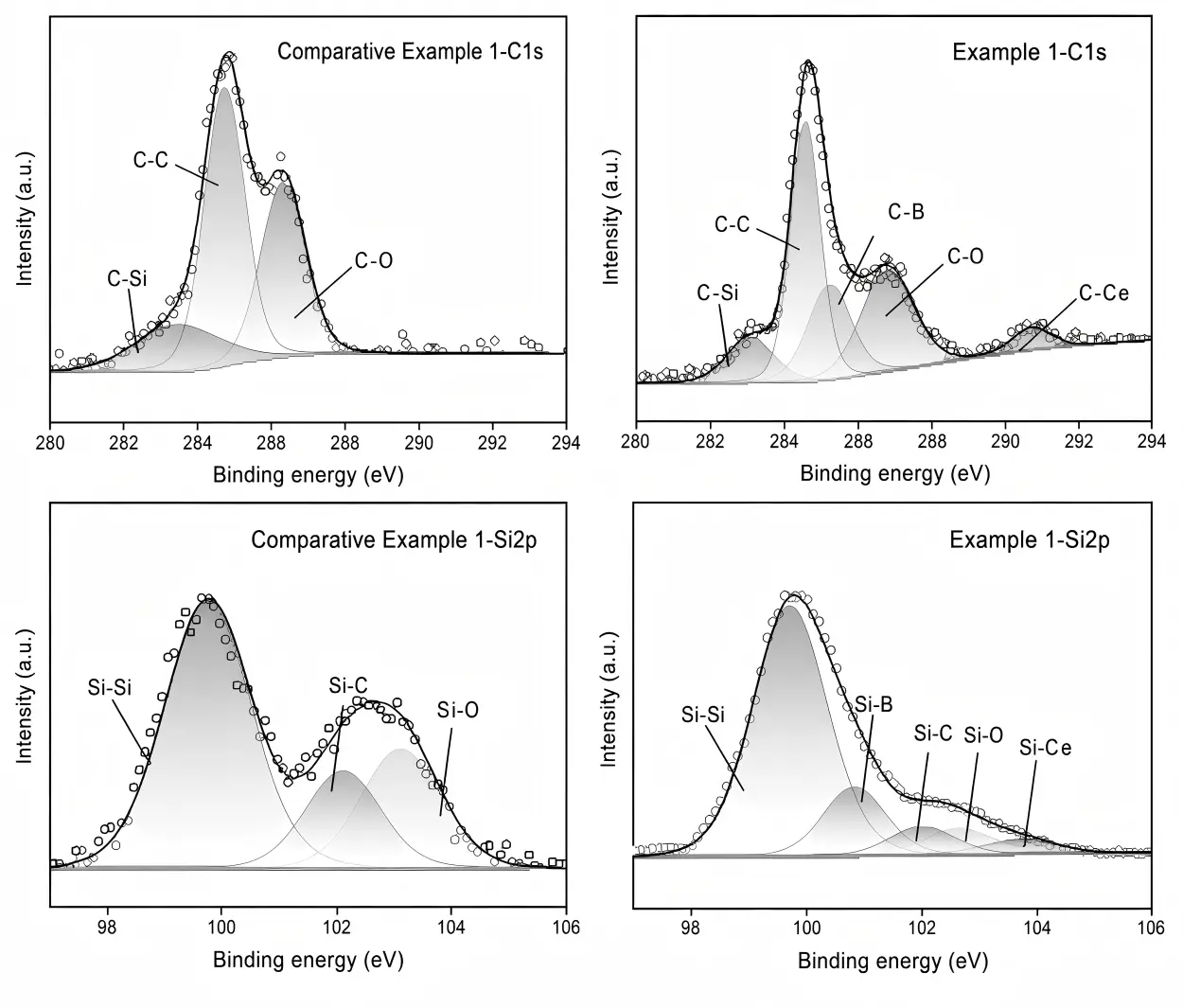
The application’s abstract figure is an X-ray photoelectron spectroscopy comparison, and it is the most concrete thing in the record we can read. It sets a comparative example against Example 1, with carbon 1s spectra at the top and silicon 2p spectra below.
In the comparative example, the carbon spectrum resolves into three components — C–Si, C–C and C–O — and the silicon spectrum into Si–Si, Si–C and Si–O. In Example 1, four further components appear that the comparative example does not have: C–B and C–Ce on the carbon side, and Si–B and Si–Ce on the silicon side.
Two things follow from that. The first is that the doped sample contains bonding states the undoped one does not, on both sides of the interface — which is what the claim asserts. The second is that boron and cerium are the elements the example tested, since those are the bonds the spectra resolve. A dopant that merely occupied pore space would not be expected to produce new XPS components at all. That is our reading of the figure, not a statement in the abstract.
What the BYD Silicon-Carbon Anode Filing Does Not Say
The abstract makes a qualitative claim and stops there. There is no first-cycle efficiency figure, no capacity retention number, no electrode loading, no thickness, no energy density — none of the measurements that decide whether an anode material is useful. The record we could read is the bibliographic page, the abstract and the abstract figure; the specification, the claims and the worked examples behind them are not in it.
Nor is there a product. The filing names no vehicle, no cell format, no plant and no timeline. Nothing in it connects this material to BYD’s second-generation Blade Battery or to any model on sale, and BYD did not announce the application — it surfaced through the intellectual property office’s publication schedule.
And a published application is not a granted patent. The claims can change during examination, and until they are granted the document confers nothing. The publication date above is a disclosure date, not a decision.
Why BYD Would File This Now
The timing is the one thing in the record that is unusual. Filing on June 12 and publication on September 11 is a gap of three months, and the default for a Chinese invention application is eighteen. Companies request early publication when they want a claim on the record sooner than the calendar would give them, and it usually signals that something is moving. That is our reading of the interval, not a statement BYD has made.
The context makes it plausible. Silicon-carbon is the anode route to higher energy density without moving to lithium metal, and it sits next to the solid-state work BYD has already demonstrated publicly, including the vehicle it showed in 2026 and the industry’s 2027 production timelines. Both problems are the same problem at the electrode: how to store more lithium without the material destroying itself.
There is also an odd detail in the company’s recent publication record. The table of BYD filings that carried this application is dominated by vehicle features — a charging interaction method, a wading protection system, a folding steering wheel, a seat assembly, display control. An anode chemistry application is a minority item in that company’s public paper trail, which is reason enough to note it when one appears.
The financial backdrop, from the same report: BYD’s first-half 2026 revenue was RMB 344.815 billion (about $47.6 billion at RMB 7.25 per dollar) with net profit of RMB 12.334 billion (about $1.70 billion), and vehicles and related products accounted for 79.85% of revenue.
Sources & Further Reading
Accuracy note: What we read is the published application record — publication number CN122739317A, application number CN202610855529.4, publication date September 11, 2026, filing date June 12, 2026, applicants, inventors and classification codes — together with its abstract and its abstract figure, as reported by Sina Finance and as published by the China National Intellectual Property Administration. We have not seen the specification, the claims or the worked examples, so no measured cell data, no loading, no thickness and no energy density appears in this article; the application’s benefit statement is qualitative and we have not upgraded it. The reading of the four bond types as interfacial bridges, the reading of the abstract figure as evidence that boron and cerium were the tested dopants, and the reading of the three-month filing-to-publication interval as an early-publication request are all EVsays’ own interpretation and are labelled as such in the text. The theoretical capacity of silicon, its expansion on lithiation, and graphite’s capacity are standard figures for the materials, not measurements from this filing. The first-half 2026 financials are as reported by Sina Finance from company disclosure, and the dollar conversions use RMB 7.25 per USD for consistency with our other coverage. BYD has made no public statement about this application.
Sourcing note: The report of the filing on which this article is based is Sina Finance’s, from its intellectual property tracking desk. The underlying record is the China National Intellectual Property Administration’s publication of application CN122739317A; we read the bibliographic record and abstract as published rather than through the reporter’s summary. The comparative spectra reproduced in the application are the applicant’s own data, not independently produced or verified by us. Chinese-language material was read in the original and rendered into English by us.
- Sina Finance — “BYD applies for a silicon-carbon material patent; the material improves first-cycle efficiency and cycling performance” (2026-09-15) — the publication details, inventors, agency, classification codes and the abstract of CN122739317A, plus the company’s recent filing list and first-half 2026 financials.
- China National Intellectual Property Administration — published application CN122739317A, a silicon-carbon material and preparation thereof, negative electrode sheet, battery, battery pack and electrical device (publication date 2026-09-11) — the underlying record; we read the bibliographic page, abstract and abstract figure. Listed without a link because we could not verify a stable public URL for the individual record.
- EVsays — related coverage: BYD’s second-generation Blade Battery and BYD’s solid-state demonstration for the cell-side context, and additive chemistry at the same interface.