

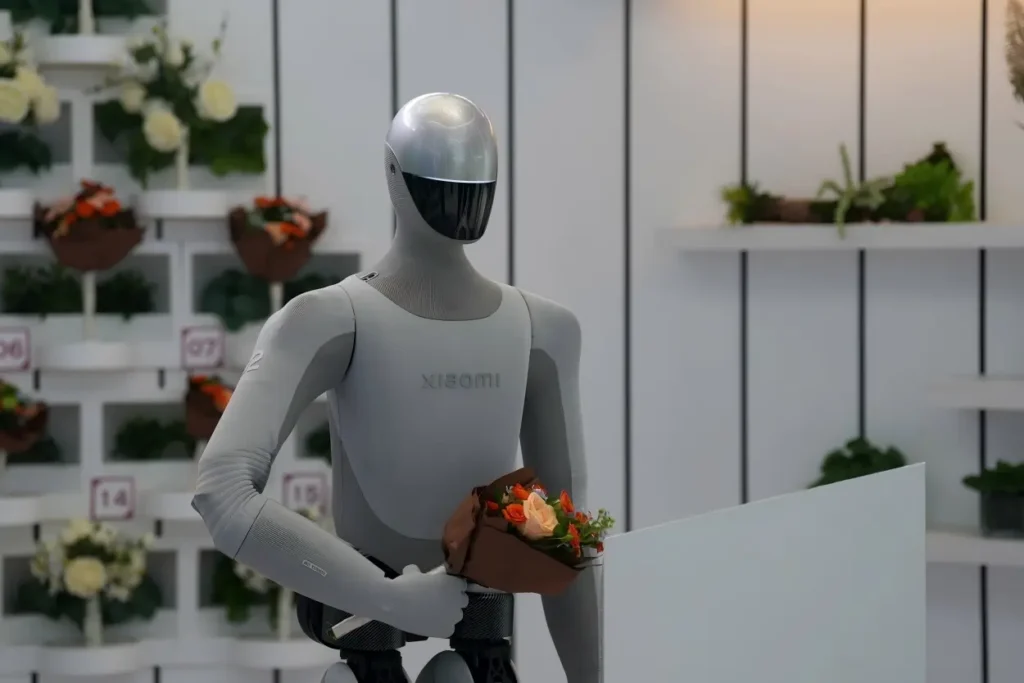
The humanoid robot battery has quietly become solid-state’s first paying customer. Xpeng’s second-generation IRON went on stage in November 2025 as the first humanoid to run on an all-solid-state pack, and small-batch trial production started in Guangzhou in July. GAC’s GoMate gets six hours out of an all-solid-state pack. Zhongqing’s T800 claims the industry’s first cell designed specifically for a robot’s duty cycle. Samsung SDI has put a date on it: mass production in the second half of 2027, with robots named as the likely first commercial application. The reason this happens in robots and not in cars is arithmetic, and the arithmetic also tells you how small the market still is.
Why the Humanoid Robot Battery Is Where Solid-State Lands First
Solid-state’s problem with cars was never performance. It is cost. A car pack is 60 to 100 kWh, so a cell chemistry that costs several times more than LFP moves the price of the vehicle by thousands of dollars. A humanoid robot carries under 2 kWh in total. The same expensive chemistry adds a few hundred dollars to a machine that already sells for tens of thousands — and it buys something the buyer can feel, because a lighter pack means a lighter robot, which means longer runtime or more payload for the same energy.
The requirements point the same way. A robot’s battery compartment is small — Samsung SDI describes it as often limited to the chest — so volumetric energy density matters more than in a car. Motion produces sharp power peaks that a pack has to answer immediately. And a machine that walks around people cannot have a thermal runaway failure mode. Robots are, in other words, the rare application where the customer will pay a premium for exactly the three things solid-state does well and punish none of the things it currently does badly.
Chinese battery makers reached that conclusion before Western carmakers did. CATL has said publicly that solid-state suits applications where energy density dominates, such as drones and robots, better than cars. That framing is now the operating assumption of the whole sector.
Who Is Already Building Robot Batteries
The list of committed programmes is longer than the market’s current size suggests.
| Programme | What is claimed | Timing |
|---|---|---|
| Xpeng IRON (2nd gen) | First humanoid robot with an all-solid-state pack; 82 degrees of freedom, 2,250 TOPS across three Turing chips | Unveiled Nov 2025; trial production July 2026; volume targeted end-2026 |
| GAC GoMate (3rd gen) | All-solid-state pack, 6 hours of runtime | Small-batch production planned for 2026 |
| Zhongqing T800 | Cell described as the first designed specifically for humanoid robots; 4–5 hours | Launched Dec 2025 |
| Funeng Technology | Sulfide all-solid-state pouch at 400 Wh/kg; 8–12 hours of operation | Samples to robot makers from Sept 2025 |
| CALB | Solid-state cell above 450 Wh/kg | Roughly 1,000 units planned for Q4 2026 |
| Joyson + Enpower | Joint venture for embodied-AI batteries; Joyson’s semi-solid pack at 380 Wh/kg, 30 minutes to 80% | JV formed recently; Enpower targets small-batch all-solid-state in 2026 |
Xpeng is the furthest along and the easiest to check, because it is a listed carmaker with a production line rather than a slide. The company began small-batch trial production of the humanoid at its Guangzhou factory on 24 July 2026, with the volume line in final commissioning, and chairman He Xiaopeng has framed the target as the world’s first high-end humanoid robot in large-scale production. That is a company claim, not an audited milestone, and the chemistry of the pack Xpeng will build at volume has not been published in detail.
Samsung SDI’s Two Tracks, and the Only Date in This Market
Samsung SDI has been the most specific about timing. At InterBattery 2026 in Seoul it showed a pouch-type all-solid-state sample for physical AI applications under the theme “AI Thinks, Battery Enables” — notably a pouch, where the company’s electric-vehicle programme has been prismatic. On its second-quarter earnings call on 30 July 2026 it kept the all-solid-state mass production target at the second half of 2027 and said the first commercial application is likely to be humanoids, with customer samples due in the second half of 2026. By late September its position had moved from a sample to a pilot line: a company executive describes the S-Line as being at the customer-evaluation stage, built on a sulfide solid electrolyte and an anode-free design.
The two-track logic is worth restating because it contradicts the way solid-state is usually sold. Samsung SDI expects cylindrical and all-solid-state cells to coexist after commercialisation: cylindrical for mass-market robotics where cost and reliability are established, all-solid-state for humanoids and next-generation mobility platforms where energy density and safety decide the product. In other words, the battery maker does not think solid-state replaces lithium-ion in robots. It thinks it takes the premium end.
The Numbers: a Premium Niche, Not a Volume Market
Here is the reality check. TrendForce expects global humanoid robot shipments to exceed 50,000 units in 2026, up more than 700% year on year, and projects solid-state battery demand from robots growing from 0.05 GWh in 2025 to 74.2 GWh in 2035. The second number is the one that gets quoted. Run the first one and it shrinks fast: 50,000 robots at under 2 kWh each is roughly 0.1 GWh of battery demand in 2026 — which is also a useful sanity check, since it is exactly double TrendForce’s 2025 figure. A single 30 GWh gigafactory line outproduces that several hundred times over.
So the robot battery market is not a volume story and should not be sold as one. It is a premium niche that happens to be the only place where a solid-state cell can be sold today at a price that works for both sides. The ten-year growth rate implied by those two TrendForce figures is about 1,480-fold, and that is only achievable because the base is almost nothing.
The runtime target is the number to watch instead. Today’s transitional robot batteries deliver around two hours, and the industry’s own expectation is that the eight-hour threshold — enough for a working shift — arrives around 2028. That is a battery problem, not an algorithm problem, and it is why an entire robot generation is being designed around the pack rather than the other way round.
What Has to Be Solved Before This Scales
Three obstacles are consistent across the Chinese coverage of this market, and none of them is a chemistry problem.
The first is standards. There is no national standard for robot battery performance testing, which means claims about runtime, cycle life and peak power are not comparable across products. China has moved faster than anyone on solid-state definitions generally — the GB/T 43568-2026 methodology now before the IEC sets a measurable boundary for what counts as all-solid-state — but a robot-specific duty-cycle test does not exist yet.
The second is the robot itself. Humanoid body designs are iterating faster than battery qualification cycles, so packs are being customised per model instead of standardised per platform. That is the opposite of how lithium-ion scaled in cars, where the cell became a commodity and the pack became an engineering exercise.
And the third is that the solid-state routes have not converged. Oxide, sulfide and polymer chemistries carry different interface, processing and cost profiles, and Samsung SDI’s anode-free sulfide approach is not the same bet as Funeng’s sulfide pouch or the semi-solid packs shipping today. Until one route wins volume, every robot programme is making a chemistry bet alongside a product bet.
The Bottom Line: The humanoid robot battery has become solid-state’s first real market, ahead of the car, because a robot carries under 2 kWh and can absorb a cell cost that a vehicle cannot. Xpeng, GAC and Zhongqing have packs in or near production, Funeng and CALB are supplying cells, and Samsung SDI has committed to all-solid-state mass production in the second half of 2027 with robots as the likely first customer. The demand today is roughly 0.1 GWh — a premium niche, not a volume market — and what it buys is the production experience the car programmes will need later.
Notes: Performance figures are manufacturer claims and have not been independently tested, and Xpeng’s “all-solid-state” description of the IRON pack is the company’s own. TrendForce figures are forecasts, and the 0.1 GWh estimate and the growth multiple are our arithmetic. Reporting drawn from Chinese-language trade coverage was cross-checked against company disclosures, and EVsays did not attend the events described. See our editorial policy and correction policy.
Sources & Further Reading
- Yiche / Netcom (网通社) via Ifeng Auto — “多家企业加速布局人形机器人用固态电池,产业化进程提速” (September 2026) — the roster of Chinese robot battery programmes, the Joyson–Enpower joint venture, and the TrendForce shipment and demand forecasts.
- 21st Century Business Herald (21财经) — “机器人的’心脏’,藏着储能电池行业的下一条增长曲线” (2026-08-25) — the case that robots are solid-state’s ideal first commercial market, and the expectation that the eight-hour runtime threshold arrives around 2028.
- EET China / Hangjiashuo Robotics — “三星SDI:全固态电池首单瞄准人形机器人,2027 H2量产” — Samsung SDI’s second-quarter earnings call of 30 July 2026, the second-half 2027 production target, and the shift from prismatic to pouch form factor for robots.
- The Korea Herald — “Samsung SDI to debut batteries for AI humanoid robots, data centers” (2026-03-09) — the pouch all-solid-state sample for physical AI shown at InterBattery 2026 in Seoul, the chest-compartment installation constraint, and the parallel AI data centre battery line-up.
- OFweek (English) — “XPeng IRON Humanoid Robot Mass Production Base Lands in Guangzhou” — the Guangzhou production base, the November 2025 unveiling, and the company’s stated goal of being the world’s first high-end humanoid robot in large-scale production.
- NotebookCheck — “Solid-state battery powers lifelike Iron humanoid robot set to beat Tesla Optimus to mass production” — English trade coverage of the IRON launch and the energy-density comparison behind the solid-state choice.
- EVsays — the same market from the supply side: carmakers building humanoid robots, Xpeng’s robotics funding, the solid-state race to 2027 and the all-solid-state standard now before the IEC.