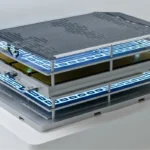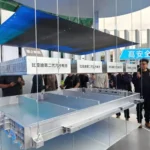

Coating electrodes and then drying the solvent back out of them accounts for more than 30% of the energy a lithium-ion plant consumes. Three competing process routes now exist to delete that step, and on 1 October an Indiana company put the third of them into production. Ateios Systems started a 50 MWh-a-year line at Newberry, Indiana, that changes how battery electrode manufacturing works: it cures the coating with an electron beam instead of heat, and says it is already shipping electrodes made on it.
What Ateios Put Online
Ateios Systems, which the Battery Show North America named its battery manufacturer of the year in 2025, describes its process as the third generation of electrode making, after solvent slurry and dry coating. Its RaiCure platform coats liquid monomers the way a conventional line lays down wet slurry, then cures them in an electron-beam exposure rather than passing them through a drying oven; the monomers crosslink into a high-molecular-weight polymer network that binds the particles together and to the current collector. The company’s own comparison is to photoresist in semiconductor fabrication.
The line runs at up to 30 metres per minute across a 300 mm web, in single-sided, double-sided, continuous or custom-gap configurations. Binder content is under 1%, and Ateios claims its electrodes reach twice the electronic conductivity of conventional PVDF-bound electrodes at that binder level, and 20 to 30% higher specific capacity from the same active material because the binder stays stable above 4.2 volts. It has shipped electrodes at areal loadings of 6 to 8 mAh/cm², supports LCO, LFP, NMC and graphite today, and says silicon, sodium-ion and lithium titanate are in development. Its chief executive, Dr Rajan Kumar, frames the pitch as competing with equipment an order of magnitude larger: “to compete with a GWh-scale coater at one-fifth of the capital and operating cost.”
Two details stand out. The first is that scale-up runs through toll coaters — including Kodak — rather than through Ateios building its own gigafactory, which is an unusual way to commercialise a battery process. The second is that the electrodes have been tested by Intertek at under 20 parts per million of PFAS, the “forever chemicals” that include the PVDF binder this process is designed to replace, and that Ateios says the material can be recovered and returned to the supply chain. Assembly support for customers who want to build and test cells without running their own line comes through the Battery Innovation Center and partner cell manufacturers.
Why the Oven Is the Target
The reason anyone cares about a drying oven is arithmetic. A conventional electrode line mixes active material into a solvent, coats it, then runs the coated foil through ovens long enough to evaporate the solvent and recover it — energy, floor space, capital equipment and a solvent-recovery plant, all for a step whose only purpose is to undo something the line just did.
Chinese industry analysis puts coating and drying above 30% of total lithium-ion manufacturing energy, and the same body of work estimates that removing the solvent step cuts overall manufacturing cost by roughly 18% and energy consumption by more than 30%, while eliminating NMP recovery costs worth about RMB 18 million per gigawatt-hour and cutting volatile organic compound emissions by 99%. LG Energy Solution has put the cost reduction from a dry process at 17% to 30%. The number to hold onto is the first one: one process step, more than 30% of the energy.
Three Routes, One Enemy
| Route | How it removes the oven | Where it stands |
|---|---|---|
| Conventional wet coating | — | The baseline: solvent, ovens, NMP recovery |
| Dry coating | Mixes active material and PTFE binder as dry powder and fibrillates it into a self-supporting film, pressed onto the foil | Tesla commercialised it with Maxwell’s technology; Chinese equipment makers sell complete lines |
| Electron-beam curing | Keeps a liquid coating but replaces the solvent with monomers cured by an electron beam | Ateios is shipping electrodes from the Indiana line |
Dry coating is the route with the most industrial weight behind it. Maxwell’s process, acquired by Tesla, has been the reference implementation, and Chinese trade coverage of the technology reported in February 2026 that Tesla had reached volume application of dry coating — a step the industry had been waiting on since the 4680 cell was announced. South Korea’s LG Energy Solution has a pilot dry-electrode line and is targeting full production in 2028; Samsung SDI is validating cells on a pilot line at its Cheonan plant; in the United States, AM Batteries claims its powder-to-electrode method cuts electrode-manufacturing capital expenditure by 30% and operating expenditure by 60%, and LiCAP Technologies says it has completed and commissioned a 300 MWh roll-to-roll cathode line.
Ateios’ electron-beam approach sidesteps the two hardest problems in dry coating: dry processes need sub-−40°C dew points because PTFE is moisture-sensitive, and they generate fine dust that has to be controlled across a long line. A liquid monomer coating has neither problem. What it needs instead is an electron-beam source and monomers that cure into something mechanically sound, which is why the minimum binder figure is the metric the company leads with.
China Is Already Selling the Equipment
The part of this story that is not being told from Indiana is that the tooling for the first of those two alternative routes is largely a Chinese business already.
Lead Intelligent Equipment — better known as Xiandao Zhineng, the largest lithium-battery equipment maker — supplies integrated dry-electrode lines and is described in Chinese industry research as holding more than 70% of the global market for them. Its dry film-forming equipment integrates fibrillating, film-forming and laminating in one unit, with isostatic pressing to 600 MPa. Qingyan Nake, a smaller specialist, has shipped dry-electrode equipment to more than twenty Chinese customers including BYD, FAW, GAC and Geely, and has delivered lines to a leading Japanese automaker and won an order from a major international battery manufacturer. CATL has tied itself to Lead Intelligent as both shareholder and customer and placed dry electrode on its solid-state roadmap; Qingtao Energy’s 1 GWh solid-state line uses a dry electrode process; Jiugong Technology broke ground on a 100 MWh dry-process solid-state pilot line in December 2025.
Government direction points the same way. China’s battery industry five-year plan, published on 28 September, lists among the equipment it wants developed “high-precision double-sided solvent-free coating” lines — that is, dry electrode equipment, named in a national plan. The same document puts solid-state cells in early volume application by 2030, and dry processing is one of the two manufacturing routes that solid-state production is expected to need.
So the competitive picture is not an American startup against incumbents. It is a cluster of Chinese equipment makers and their battery customers building the first of two oven-free routes at domestic scale, while a small American company attempts the second with a process the first route cannot use.
Battery Electrode Manufacturing: What 50 MWh Actually Means
The capacity figure deserves the same scrutiny the technology is getting.
Fifty megawatt-hours a year is roughly 1,000 electric-car battery packs at 50 kWh each. Against China’s August output of 237 GWh of power and storage cells, this line’s entire annual production is 0.02% — China’s factories make 4,740 times as much in the same period. That is not a criticism. It is what a production-scale pilot looks like. But it does mean this is a supplier to specialist segments — consumer electronics, defence, aerospace, and early mobility programmes — rather than anything a car buyer will encounter this year.
There is also a tension inside Ateios’ own numbers. The company says the line runs at 30 metres per minute on a 300 mm web, and separately that it produces 50 MWh a year. At full line speed, a 300 mm web moving 30 metres a minute passes about 4.7 million square metres of material in a year, which at the loadings Ateios quotes — 6 to 8 mAh/cm², double-sided, at typical cell voltages — would correspond to a capacity in the gigawatt-hour range, not 50 MWh. Our arithmetic suggests the two figures differ by roughly two orders of magnitude, which would mean 50 MWh is the current output of the line rather than its equipment capability. Ateios does not say which it is, and we have asked for clarity in the form of the numbers; anyone quoting “50 MWh a year” as the technology’s ceiling should know the distinction.
What Is Not Proven
No named customer. Ateios says electrodes have shipped to “a customer” at 6 to 8 mAh/cm² loadings, and that it ships stock LCO, NMC811, LFP and graphite electrodes. No buyer is identified and no cell made with these electrodes has been reported as qualified.
No third-party confirmation of the process claims. The five-fold output, one-fifth cost, doubled conductivity and 20–30% capacity gain are all Ateios’ own. The one independent measurement that is disclosed — Intertek on PFAS content — tests a chemical property, not performance.
No answer on where electron beams fit at scale. Nothing in the announcement explains how an electron-beam curing station behaves at the throughput of a gigafactory line, and that is precisely where the comparison with dry electrode equipment, already being sold at gigawatt-hour scale, will be decided.
The Bottom Line: Ateios Systems started a 50 MWh-a-year battery electrode manufacturing line in Newberry, Indiana on 1 October, curing electrodes with an electron beam instead of a drying oven — the step that accounts for more than 30% of a lithium-ion plant’s energy use. The line runs at up to 30 metres per minute on a 300 mm web with under 1% binder, and is shipping LCO, NMC811, LFP and graphite electrodes to unnamed customers. The competing dry-coating route is already industrial: Tesla has commercialised it and Chinese equipment makers, led by a supplier with more than 70% of that equipment market, are selling complete lines. At 50 MWh a year the Ateios line is about 1,000 car packs, or 0.02% of China’s monthly cell output.
Notes: All performance figures — five-fold output, one-fifth capital and operating cost, doubled conductivity, 20–30% higher specific capacity, under 1% binder — are Ateios’ own claims and have not been independently tested by EVsays; the only third-party result disclosed is Intertek’s PFAS measurement, which tests chemistry rather than performance. The 30% energy share, the 18% cost reduction, the RMB 18 million per GWh solvent-recovery saving and the 99% VOC reduction come from Chinese industry analysis and trade coverage rather than from a primary engineering study, and should be treated as indicative. The 1,000-pack and 4,740-times comparisons, and the arithmetic showing a gap of roughly two orders of magnitude between the stated line speed and the stated annual output, are our calculations on the figures published by Ateios; our capacity estimate assumes double-sided coating at the quoted 6–8 mAh/cm² loadings and typical cell voltages, and Ateios has not confirmed which of the two figures represents current output and which represents equipment capability. EVsays has not attended the Newberry facility. See our editorial policy and correction policy.
Sources & Further Reading
- Ateios Systems — “Ateios Brings 50-MWh Electrode Coating Line Online, Ships Next-Gen RaiCore Electrodes” (1 October 2026), distributed via GlobeNewswire — the line capacity and location, the RaiCure process description, the 30 m/min and 300 mm figures, under 1% binder, 6–8 mAh/cm² loadings, the chemistries supported, the Intertek PFAS result, the Kodak toll-coating arrangement, and Dr Rajan Kumar’s remarks. (The full release text was supplied to EVsays for verification.)
- Interesting Engineering — “50-MWh battery line swaps drying ovens for electron beams, runs at one-fifth the cost” (1 October 2026) — the independent write-up of the same announcement, including the trial lead-time comparison of two to four weeks against three to six months, and the material lead-time saving.
- CCTV News (央视新闻) — “什么是‘干法涂布’?一文说清” — the dry-coating process explained step by step, the 18% manufacturing cost reduction and 20% energy density gain, Maxwell’s origin and Tesla’s volume application of the technology in February 2026, and CATL’s inclusion of dry electrode in its solid-state roadmap.
- Chinese industry research and trade coverage (2026) — the figures for coating and drying above 30% of lithium-ion manufacturing energy, more than 30% energy reduction from dry processing, NMP recovery savings of about RMB 18 million per GWh, 99% lower VOC emissions, Lead Intelligent’s share of the dry-electrode equipment market, and the delivery records of Qingyan Nake, Qingtao Energy and Jiugong Technology.
- EVsays — related coverage: China’s battery industry five-year plan, the second-generation Blade battery teardown, the solid-state production race and sodium-ion cells moving into storage.