

On 1 October, a team at the Institute of Metal Research of the Chinese Academy of Sciences published a cobalt-free cathode in Nature Synthesis: a nickel-rich layered oxide carrying about 1% each of magnesium, calcium, titanium and zirconium instead of cobalt. The performance numbers are real but they are not the point. The point is that the team wrote down two rules for choosing those four elements, and cathode development has been guessing at that choice for two decades.
What the Cobalt-Free Cathode Paper Actually Reports
Cobalt is the element that has held nickel-rich cathodes together. Remove it and the cathode becomes cheaper and freer of supply risk, but the lithium ions move more sluggishly, the lattice distorts locally, and the oxygen framework destabilises as the cell cycles. The industry has known this for years, and its response has been doping: add roughly one percent of something and measure what happens.
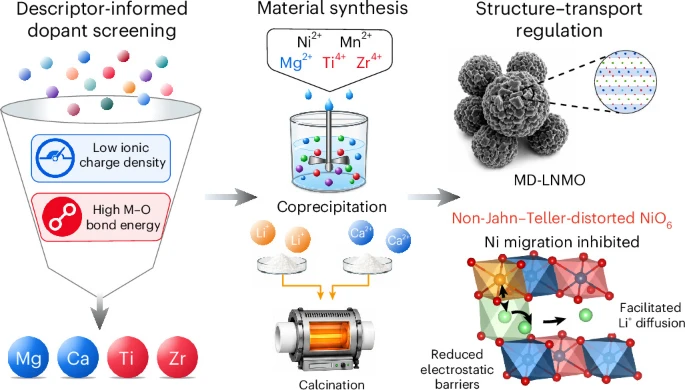
What has been missing is a reason to pick one element over another. The team’s answer is two descriptors, both of which can be read off a periodic table before any cell is built.
The first is a dopant’s ionic charge density. Elements with lower charge density place less electrostatic constraint on a migrating lithium ion, so they speed up transport. The second is metal–oxygen bond strength. Elements that bind oxygen more strongly reinforce the oxygen sublattice and the transition-metal framework, so the structure holds its shape through repeated charge and discharge. Magnesium and calcium were selected for the first job, titanium and zirconium for the second, and all four were introduced together at close to one atomic percent each.
The product is a multi-doped, cobalt-free, nickel-rich layered oxide the team abbreviates MD-LNMO. In the paper’s own tests it delivers an ultra-high-rate capability of 130.9 mAh g−1 at 25C and 25 °C, holds 82.4% of its capacity after 350 cycles at 10C, and returns 112.2 mAh g−1 at 1C when held at −20 °C. A 5.74 Ah pouch cell assembled with the material reached 278.6 Wh kg−1 at −20 °C.
| Measurement | Result | Condition |
|---|---|---|
| Rate capability | 130.9 mAh g−1 | 25C, 25 °C |
| Cycle retention | 82.4% after 350 cycles | 10C, room temperature |
| Low-temperature capacity | 112.2 mAh g−1 | 1C, −20 °C |
| Pouch cell energy density | 278.6 Wh kg−1 | 5.74 Ah Li || MD-LNMO, −20 °C |
| Dopant loading | ~1% each of Mg, Ca, Ti, Zr | Multi-component, cobalt-free |
The work was carried out at the Shenyang National Laboratory for Materials Science, supervised by Li Feng, Cheng Huiming and Wang Chunyang, with An Baigang of the University of Science and Technology Liaoning as a collaborator. Guan Siqi, a joint PhD student, and Yu Tong, an associate researcher, are co-first authors. The institute names China’s National Key R&D Programme, National Natural Science Foundation grants and two provincial funding schemes behind it — which is worth noting, because this is state-funded basic research rather than a company product announcement.
The Three-Minute Number Is a Rate Test, Not a Charging Curve
The institute and Chinese state media describe the result the same way: nearly 80% charge in three minutes. That phrasing travels well and it is the reason the story has circulated. It also invites a comparison that does not hold.
25C is a rate, not a state of charge: it means a full charge or discharge in about two and a half minutes. The 130.9 mAh g−1 is what the cathode still delivers at that rate, and the institution describes that as close to 80% of what the material can hold. So the claim is that the cathode gives up roughly four fifths of its capacity when pushed to a three-minute charge — a materials-level rate test on a small laboratory cell.
A car is a different measurement entirely. Pack-level figures from the manufacturers that build them look like this:
| Charging result | 10% to 70% | 10% to 97% | Peak station power |
|---|---|---|---|
| Geely, Shendun Golden Battery (12C) | 4 min 30 s | 8 min 40 s | 2,250 kW |
| BYD, Blade Battery 2.0 flash charging | 5 min | 9 min | 1,500 kW |
Those are vehicle results, taken from the two companies’ own demonstrations and reported in our earlier look at Geely’s smart charging launch. They include the anode, the thermal management system, the battery management limits and the cable. Putting a cathode rate number next to a vehicle charging number is the most common mistake in coverage of papers like this one, and the two should not be ranked against each other.
One detail in the institute’s own description is worth stating plainly, because it does not appear in the media framing. The 5.74 Ah pouch cell is written as Li || MD-LNMO. In cell notation the double bar separates the two electrodes, and lithium on the left is a lithium-metal counter electrode — not the graphite or graphite-silicon anode a production electric vehicle cell uses. The institute’s release does not say what anode a commercial version would be paired with. That single line changes what the 278.6 Wh kg−1 figure is a statement about.
Why Cobalt-Free Moved From Chemistry to Risk Management
Going cobalt-free used to be a cost argument. As of last year it is a supply argument, and the numbers from the Cobalt Institute’s Cobalt Market Report 2025 explain why.
The Democratic Republic of the Congo produced 73% of the world’s mined cobalt in 2025, down from 77% in 2024, with Indonesia second at 14%. Refining is more concentrated still: China accounted for 79% of refined cobalt output. In February 2025 the DRC suspended cobalt exports, extended the ban, and in October replaced it with a quota system capping exports at 96,600 tonnes a year for 2026 and 2027. The effect on price was immediate: cobalt hydroxide rose more than 300% over the year, cobalt sulphate 266% and cobalt metal 130%, even as total mined production stayed broadly flat at around 270,000 tonnes.
The wrinkle is that cobalt-free chemistry is not new. Lithium iron phosphate contains no cobalt, and it already dominates the low and middle of the market — which is exactly why the price of cobalt collapsed to a nine-year low in early 2025 before the DRC acted. What LFP cannot do is energy density. A cobalt-free cathode that keeps its nickel content is a different proposition: it holds the energy density nickel-rich chemistry is used for, and removes the element that carries the price and the concentration risk. That is the gap this paper is aiming at, and it is the same logic behind sodium-ion’s move into storage — diversify the chemistry, not just the supplier.
The Gap Between 5.74 Ah and a Car Battery
The demonstration cell is 5.74 Ah. A production electric vehicle cell runs from roughly 100 Ah upward, so a commercial version of this cathode has to make a jump of somewhere between 17 and 26 times in capacity before it is inside a car — and it has to do so while keeping the uniformity that high-nickel, multi-doped layered oxides are notoriously bad at holding at scale.
Three other things the paper does not establish.
The first is safety. Nickel-rich chemistry trades thermal stability for energy density, and higher nickel content makes that trade steeper. This paper reports rate capability, cycling retention and low-temperature performance. Thermal runaway behaviour is not among the results — and the defect and consistency thresholds China’s own industry plan sets for the next five years, which we looked at in the new battery industry five-year plan, are a separate hurdle.
The second is cost. Removing cobalt removes a cost input, but magnesium, calcium, titanium and zirconium are not free, and the paper reports no cost per kilowatt-hour, no precursor pricing and no comparison against a commercial cobalt-containing cathode on any commercial metric.
The third is the anode question above. An energy density figure measured with a lithium-metal counter electrode is a statement about the cathode’s ceiling, not about what a finished cell will weigh.
None of that weakens the result. A 350-cycle retention of 82.4% at 10C on a cobalt-free nickel-rich cathode is a genuinely difficult number to reach, and the low-temperature result is the one with the most commercial reach: cold-weather range loss is the specific reason battery-electric adoption stalls in northern China, and a material that returns 112.2 mAh g−1 at −20 °C attacks that directly.
What the Method Changes, and Why It Outlasts the Material
The four elements are the demonstration. The descriptors are the product.
Trace-element doping has been an empirical art for as long as layered oxides have existed, and the reason is that no one had a measurable property that predicted what a dopant would do. Ionic charge density and metal–oxygen bond strength are both readable before synthesis, both testable after it, and — this is the part that matters beyond batteries — both general enough to screen dopants for chemistries the team never built. The abstract frames the shift as moving from empirical or trial-based selection to what it calls a targeted selection regime.
That is a slower kind of progress than a product launch, and it is worth being clear about what it means commercially. This is upstream research. It sits below the storage-cell pricing and platform questions we have covered this month, below the question of who can manufacture at volume, and well below anything a buyer can order. Its half-life is also longer than a launch’s: a rule for picking dopants does not become obsolete when the next generation of cells arrives.
What it does do is add a third direction to a battery industry that has spent this year mostly arguing about the other two — making cells cheaper and making them last longer. This one is about designing the chemistry deliberately. Whether the specific MD-LNMO composition reaches a production line is close to irrelevant to that; the descriptors will be reused regardless.
The Bottom Line: A Chinese Academy of Sciences team has published a cobalt-free cathode in Nature Synthesis that holds 130.9 mAh g−1 at 25C, retains 82.4% of capacity after 350 cycles at 10C and returns 278.6 Wh kg−1 at −20 °C in a 5.74 Ah pouch cell — all measured in a laboratory, with a lithium-metal counter electrode and no cost data. The reusable result is the pair of descriptors used to choose magnesium, calcium, titanium and zirconium: ionic charge density for transport, metal–oxygen bond strength for stability. With cobalt hydroxide up more than 300% in a year on a Congolese export quota, that design rule is worth more than the specific composition it produced.
Notes: The performance figures are the authors’ own measurements and have not been independently replicated; this article was written from the paper’s abstract and the Institute of Metal Research’s own release, because the full text sits behind a subscription. The reading of the 25C figure as a rate test rather than a charging curve, and of the Li || MD-LNMO notation as a lithium-metal counter electrode, is EVsays’. Cobalt market figures come from the Cobalt Institute’s 2025 report, and the vehicle charging figures are manufacturer demonstrations rather than independent tests. EVsays did not attend any event, did not test any product and has no relationship with the researchers. See our editorial policy and correction policy.
Sources & Further Reading
- Guan, S., Yu, T. et al. — “Descriptor-informed multi-component doping enables high-performance Co-free Ni-rich cathodes,” Nature Synthesis (published online 1 October 2026), DOI 10.1038/s44160-026-01152-y — the peer-reviewed source for the design strategy and all performance measurements, including the 130.9 mAh g−1 at 25C, the 82.4% retention after 350 cycles at 10C and the 112.2 mAh g−1 at 1C and −20 °C.
- Institute of Metal Research, Chinese Academy of Sciences (中国科学院金属研究所) — “金属所提出描述符驱动的电池正极材料设计新范式” (30 September 2026) — the institution’s own release: the Mg/Ca/Ti/Zr composition at close to 1% each, the MD-LNMO designation, the 5.74 Ah Li || MD-LNMO pouch cell result of 278.6 Wh kg−1 at −20 °C, the author list and the funding.
- Xinhua (新华社) — “科研人员发现锂电正极材料通用设计规律” (2 October 2026) — the “nearly 80% in three minutes” framing, and the two-descriptor explanation of ionic charge density and metal–oxygen bond strength.
- Cobalt Institute — Cobalt Market Report 2025 — 73% DRC share of mined cobalt, 79% Chinese share of refining, the 96,600 t/yr DRC export quota for 2026–2027, and the price movements in cobalt hydroxide (+300%), sulphate (+266%) and metal (+130%).
- CGTN — “China develops new lithium battery material for faster charging” (2 October 2026) — English-language confirmation of the composition and the headline performance figures.
- People’s Daily — “China develops new lithium battery material for faster charging” (2 October 2026) — English-language summary of the descriptor strategy and the low-temperature result.
- Geely Auto Group and BYD — manufacturer charging demonstrations cited for the vehicle-level comparison (10% to 70% in 4 min 30 s for Geely’s Shendun Golden Battery; 5 min for BYD’s Blade Battery 2.0 on a 1,500 kW charger), as reported in EVsays’ earlier coverage of the Geely Smart Charging launch.