

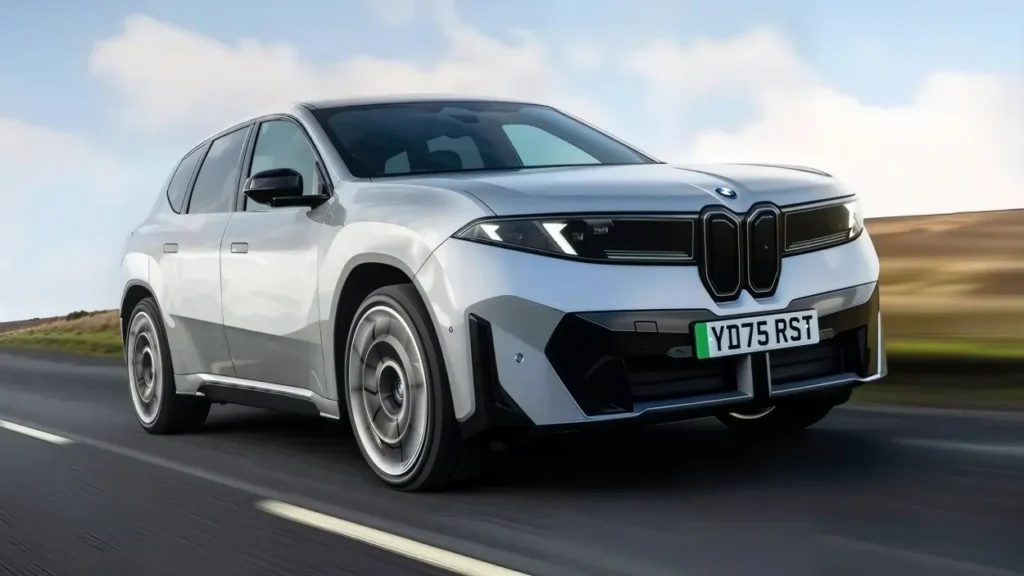
BMW has done something unusual with the iX3 battery: it split one car’s cells three ways by trim level, and handed the hardest version to its second supplier. In China the entry 30L runs a prismatic LFP pack from CATL, the mid 40L runs 46-series cylindrical cells from CATL and EVE Energy together, and the flagship 50L runs EVE cells alone. In Europe there is no split at all — every iX3 is EVE. The car it goes into is the first model on a platform BMW designed for electric drive from the start rather than adapting a combustion architecture, and the whole thing runs on Chinese cells.
What the iX3 Battery Split Actually Is
The new iX3 is the first series-production model on BMW’s Neue Klasse platform, and the first BMW in years built on an architecture designed around electric drive rather than a combustion floorplan with a battery added to it. Its battery is a sixth-generation (Gen6) pack built from 46 mm cylindrical cells — a format BMW moved to after two decades of using prismatic cells.
What suppliers do with that format is where the story is. The allocation has been reported by Tonghuashun Finance citing broker research, and neither the carmaker nor its suppliers has published it:
| Version | Cell | Supplier |
|---|---|---|
| 30L (entry) | Prismatic LFP | CATL, sole |
| 40L (mid) | 4695 NMC cylindrical | CATL + EVE Energy, dual source |
| 50L (flagship) | 4695 NMC cylindrical | EVE Energy, sole |
| Europe (all versions) | 46-series cylindrical | EVE Energy, sole |
Read that table against the industry’s usual hierarchy and it inverts. CATL is the largest battery maker in the world by a wide margin, it signed a cylindrical supply agreement with BMW worth more than €10 billion in 2022, and it built dedicated cell plants on two continents to serve it. On this car it has the entry trim, and only that as a sole supplier. The top trim and the entire European market went to a company that most buyers outside China have never heard of.
BMW has structured this as a two-supplier contest over the same cell format rather than a single award. That keeps the two Chinese manufacturers bidding against each other on cost and yield for the life of the platform, and it means neither can hold the programme hostage. It also means the flagship product of a German premium brand depends on cells from one Chinese company, in one country, with no second source in the European market at all.
Why 85% of Early Orders Carry the Cylindrical Cell
The trim split is not a corner of the range. Chinese sales data reported alongside the supply arrangement puts the 50L at about 40% of early orders and the 40L at roughly 45% — which means 85% of the cars ordered so far carry a cylindrical pack, and only about one in seven takes the LFP entry version.
The specification explains the interest. BMW says cell-level volumetric energy density is up about 20% over the previous-generation prismatic cell, without the pack growing. The pack is a cell-to-pack design with no modules, which is where a lot of that gain is realised. It runs an 800 V architecture with a peak DC rate of 400 kW: BMW quotes 10 minutes of charging for 372 km of WLTP range, and roughly 21 minutes for 10 to 80%. The European iX3 50 xDrive is homologated at up to 805 km WLTP.
The Chinese-market numbers are larger but are not comparable. Chinese coverage puts CLTC range at 919 km for the 50L, 702 km for the 40L and 630 km for the 30L — CLTC and WLTP are different test cycles and the gap between them is routinely 20% or more. BMW engineers also drove a 50L from the Shenyang plant to Beijing without charging: 1,030.2 km, arriving with 5% remaining, at an average of 9.8 kWh per 100 km. That is 28% further than the car’s own 805 km WLTP rating, on a route that is not a homologation cycle — which says more about how a real car behaves at steady speed than about the rating being conservative.
Why EVE Won the Hard Cell: 43 Millimetres, Then 46
The engineering story behind that allocation is a cylinder diameter. BMW and EVE argued over 43 mm before settling on 46 mm — a 7% change in diameter that reshapes the thermal path, the structural stiffness of a steel can and how much of a pack’s volume the cooling hardware takes. It is the kind of decision that takes years and produces no press release.
EVE’s position in the programme predates it. The company has been developing cylindrical cells since 2014, entered BMW’s evaluation in 2017 and formally began joint development in 2020, with volume delivery in China in 2025. That is a four-to-five-year qualification cycle against a Chinese industry norm of two to three years, and the gap is where the moat is: BMW’s stated requirements were an energy density near 280 Wh/kg, 15-year full-lifecycle reliability, and defect control at PPB level.
PPB means parts per billion. It is the number that sounds like marketing until you look at what it demands in practice. The previous industry standard was PPM — parts per million — so BMW’s requirement is 1,000 times tighter: no more than one defective cell in a billion. EVE’s vice president He Wei has described the hardest part of making these cells at volume as controlling metal shavings during welding; a shaving left inside a cell causes a micro-short, and a micro-short is a consistency failure that shows up in the pack, not in the lab.
There is a structural point underneath all of this that gets lost in the supplier headlines. BMW defines the cell chemistry, the cell specification, the pack design and the battery management software. CATL and EVE develop and run the manufacturing. This is not BMW buying a Chinese battery; it is BMW keeping the intellectual property in Munich and renting two factories in China to compete against each other on execution. The competitive asset being sourced is process yield, not chemistry.
The Number That Decides Whether Any of This Matters
Both suppliers are growing inside the programme, but the trajectories are not symmetrical. EVE’s chairman Liu Jincheng has said the company is now BMW’s largest battery supplier by installed volume, and put the ramp at 150,000 vehicles this year rising to 300,000 next year — a doubling in twelve months. That is roughly the same scale as the 206 GWh of storage cells EVE committed to Fluence, except that those go into containers rather than cars. EVE shipped 35.76 GWh of power batteries in the first half of 2026, up 66.47% year on year, and Chinese coverage puts cumulative installations of its 46-series cells at more than 360,000 vehicles.
CATL’s position is not weak, it is simply different in shape. The 2022 cylindrical agreement was one of the largest cell contracts ever signed, it added a 20 GWh plant each in China and Europe against it, and its Hungarian base at Debrecen — next to BMW’s own vehicle plant — began cell production in September 2026, on a site planned for up to 100 GWh. BMW is also already inside the alliance CATL formed with Google and Xiaomi to write global battery standards, which makes the top-trim decision a competitive result inside a working partnership rather than a rupture. CATL also holds roughly 34% of the overseas battery market according to Chinese trade coverage, first by a distance. What it lost here is the top trim, not the programme.
The market response so far is worth noting as a demand signal rather than a supply one. European trade coverage says the iX3 has taken about a third of BMW’s new European BEV orders, that one in two X3-family orders is the electric version, and that total orders are approaching 100,000 units. If EVE’s European allocation holds, every one of those cars is on EVE cells.
What BMW and EVE Have Not Confirmed
The trim-by-trim allocation has been reported by Chinese financial and trade media citing broker research, and neither BMW nor EVE Energy has published it. The 40% and 45% order shares are attributed to sales data in the same reporting, not to a company filing. The 280 Wh/kg figure is BMW’s requirement to its suppliers, not a verified specification of the production cell, and no independent test data on the production pack has been published.
It is also worth separating what is a BMW disclosure from what is not. The 46 mm format, the 800 V architecture, the 400 kW peak, the 20% volumetric gain and the 805 km WLTP figure come from BMW’s own press materials. The Chinese range figures, the order mix, the supplier split and the installation counts come from Chinese-language reporting. Only one of those two lists can be checked against the manufacturer.
The 46-series format also sits inside a policy conversation that runs well beyond this car. China’s battery industry plan for the 15th five-year period names large-format cylindrical and high-nickel chemistry among the manufacturing capabilities it wants, in the same document that sets a 15,000-cycle lifetime target and a 2030 date for solid-state scale-up. BMW’s flagship is a customer for one of those priorities, not a cause of them — but it is a useful reminder that the specification was written in Munich and the capacity to build it was built in China.
The Bottom Line: The iX3 battery is the clearest case yet of a premium European platform being split by trim rather than by supplier. CATL builds the entry LFP car, EVE Energy takes the flagship 50L outright and the entire European range, and a reported 85% of early orders sit on the cylindrical versions. The gain for BMW is a genuine two-supplier contest over a 46 mm cell that few manufacturers can make at PPB quality. The risk is that its European flagship now has exactly one supplier, and that supplier is in China.
Notes: The trim-by-trim supplier allocation and the 40%/45% order split come from Chinese-language trade and financial reporting citing broker research; neither BMW nor EVE Energy has confirmed them, and the installation counts are company or trade figures rather than audited data. Performance specifications — the 46 mm format, 20% volumetric gain, 800 V architecture, 400 kW peak charging, 10 minutes for 372 km and the 805 km WLTP range — are BMW’s own figures and have not been independently tested by EVsays. The 28% figure comparing the 1,030.2 km drive against the 805 km WLTP rating, the 1,000x PPB-to-PPM comparison, the 7% diameter step from 43 mm to 46 mm and the four-to-five-year qualification cycle against a two-to-three-year norm are our calculations from published figures. CLTC and WLTP ranges are not comparable and are presented separately. EVsays did not attend any BMW or EVE Energy event, has not driven the iX3 and has not tested any battery. See our editorial policy and correction policy.
Sources & Further Reading
- BMW Group PressClub — “The start of a new era. The new BMW iX3” (press kit T0452355EN) — the manufacturer’s own disclosure of the sixth-generation eDrive system, the 46 mm cylindrical cell, the 400 kW peak charging rate, the 805 km WLTP range and the >30% lifecycle carbon reduction.
- BMW Group PressClub — “The new BMW iX3 now available in Singapore” — dimensions, boot capacity, the four-computer electronics architecture and the Debrecen production location.
- Tonghuashun (同花顺财经) — “206GWh改写储能格局,宝马红旗双双落定” (2026-10-07) — the trim-by-trim supplier allocation, the 40%/45% early-order split, EVE’s H1 2026 shipments, the 280 Wh/kg requirement, the PPB standard, and He Wei’s comment on metal-shaving control in welding.
- Tencent Securities (腾讯证券) — “不走捷径的宝马新世代,为一块电池花了近10年” (2026-09-30) — the history of the BMW–EVE relationship, the 43 mm versus 46 mm diameter debate, and the >€10 billion 2022 CATL cylindrical agreement.
- Sina Auto (新浪汽车) — “宝马ix3新世代平台车型的电池寿命是多久?” (2026-10-03) — the CLTC range figures per trim, the Shenyang-to-Beijing 1,030.2 km run at 9.8 kWh/100 km, the CTP pack architecture and the 9-series high-nickel cylindrical chemistry.
- Chinese self-media and trade platforms (今日头条 — “延续提升30%:宝马第六代电池中德协同” and “宝马第六代动力电池五大环节本土化闭环”) — the 4695 and 46120 format designations, the capacity of EVE’s cylindrical line, the Debrecen co-location plans and the Shenyang localisation timeline. These are aggregated accounts and were used only for detail corroborated elsewhere.
- EVE Energy — company newsroom — corporate disclosures and background on the company’s cylindrical cell programmes.
- BMW Group — Electromobility technology pages — the Gen6 eDrive claim of 30% more range and faster charging than the previous generation.