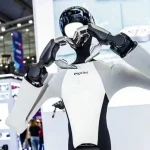


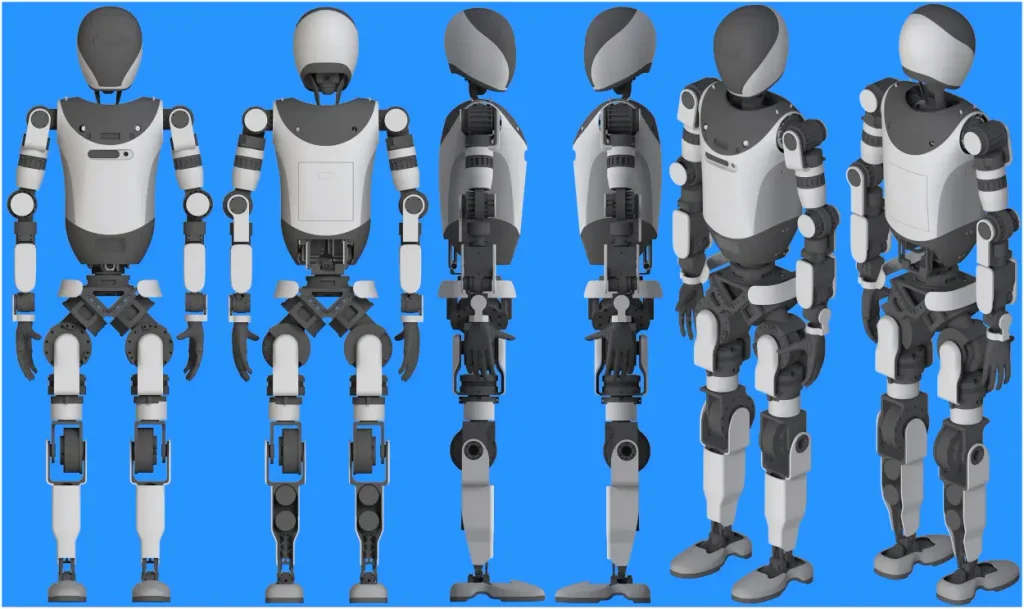
BYD’s first published intellectual property filing on its humanoid robot is not an actuator patent, a reducer patent or a control patent. It is a humanoid robot patent of the appearance kind: a Chinese design registration, CN310247768S, granted on 6 October and made public three days later. Its eight views show a machine in two tones with a smooth, featureless head and, more unusually, every joint on open display — shoulders, elbows, wrists, hips, knees and ankles all left as visible hardware rather than hidden behind bodywork. The document protects how the robot looks. It says nothing about how it works.
What the Humanoid Robot Patent Actually Shows
The registration carries no abstract and no claims, because a design patent does not have them. It has eight drawings and one page of notes, and the notes do the entire legal work of describing what is claimed: a robot used for walking, balance and interaction, applicable to service, education or industrial settings. Everything else has to be read off the drawings.
| View | What it shows |
|---|---|
| Front | Light dome head with a dark band across the lower face area; a dark shoulder yoke; a white shield-shaped chest and abdomen plate over a dark body; a five-fingered dark hand on each side |
| Rear | Same two-tone split, with a rectangular recessed panel across the upper back |
| Both sides | Deep front-to-back head shell; arm hanging with the hand in a relaxed open pose; prominent exposed knee actuator and ankle linkage |
| Top | Head crown from above; shoulders as lateral cylindrical pods with ribbed actuator stacks behind them |
| Bottom | Soles of both feet, carrying a distinct diamond grip pattern |
| Two perspectives | Three-quarter front and three-quarter rear, showing the arrangement rather than any single part |
Three things stand out from the set, and they are consistent across every view.
The head has no face. There is no display, no eye cluster, no mouth. Several current humanoids use the face as a screen; this one is a closed shell with a dark band. That is a practical choice as much as an aesthetic one — a seamless shell is cheaper to repair after a knock in a showroom than a display, and it sidesteps the fixed-expression problem that makes static robot faces read as uncanny.
The pelvis is an open truss, not a housing. This is the most distinctive element in the whole registration. At the hips the drawings show a cross-braced cage of link rods and pivots, fully in the open, with the leg actuator pods bolted to it. Almost every humanoid concept on the market wraps the hip mechanism inside a moulded shell. Leaving it exposed is a deliberate visual claim: this is machinery, and you are meant to see that it is machinery.
The colour scheme is part of the claim. A light shell over a dark frame, repeated at every joint — white covers the volumes, black marks the pivots. It reads as a maintenance diagram: the white parts are skin, the black parts are the things that move and the things that get serviced.
One thing the drawings cannot show is whether the delivered robot looks like this. BYD showed a robot called Xiaodi at a Zhengzhou retail experience centre in August, and Chinese media report that the July silhouette poster matched this registration. EVsays has reviewed the drawings; we have not seen the machine in person.
A Design Right, Filed 89 Days Before Anyone Was Told
The dates in the registration are more informative than the pictures. The application was filed on 30 April 2026 and granted on 6 October 2026 — 159 days, which is fast, and normal for a design registration, since there is no substantive examination of novelty to sit through.
Line that filing date up against what BYD said in public and it becomes the most interesting fact in the document. The design was filed on 30 April. Executive vice president Stella Li first spoke publicly about a robotics plan in May. The June wave of leaks — a code name, a seventh-generation prototype, 150 machines in factories and a target of deploying 20,000 units internally in 2026 — was denied by the company. The teaser silhouette went up on 28 July, 89 days after the filing. The robot appeared in public in early August.
In other words, the shape the company revealed as a concept in July had already been locked and filed in April. What looked like a teaser was a registration drawing.
The second thing the filing’s existence says is about where BYD’s robot IP is — and is not. BYD has filed technology patents on vehicles and cells; we covered one on silicon-carbon anodes in September that went into how a coating binds silicon to carbon. On the robot, the first document the public can read is about the outside. The claims BYD makes for the machine — more than 80% of core components developed in house, hand repeatability of one millimetre, part commonality above 60% — have no published patent behind them that we can find.
What BYD Has Confirmed, and Only in Its Own Filings
The robot’s technical story so far exists mainly in BYD’s investor relations records, which are the closest thing to a primary source the programme has.
On 9 September, BYD told investors it participates in embodied intelligence in several ways, and pointed to a strategic cooperation agreement signed with PaXini Tech, a tactile-sensing and humanoid company, at its global headquarters on 25 August. The framing was the useful part: BYD offers its own vehicle and component manufacturing lines, its factory environments and its supply chain as the robot’s test ground, and takes the real-condition data back to train the model.
On 15 September (filing 2026-25), it put the strategy in one sentence: smart cars and humanoid robots are both important directions within embodied intelligence; the market is large but technically hard; and for now the company has chosen open cooperation, working with robot companies and opening its factory floors so that real physical-world data can be collected jointly.
That is a coherent position, and it is also a deliberately modest one. BYD is not claiming to have solved the robot. It is claiming to own the two things it already has at scale — manufacturing and factory-floor data — and to be buying the rest through partnership and equity. Xiaodi’s published specification is a service robot: 1.61 metres, 58.5 kilograms, 31 degrees of freedom, gripper repeatability of about a millimetre, gesture and voice interaction, and 360-degree surround sensing for obstacle avoidance in a showroom. Stella Li has said the target is two to three units in every dealership, handling greeting, model explanations and demonstrations — and that they will not replace salespeople in the actual negotiation.
The Number That Reaches Every Store
The “two to three per store” figure is the one that scales, and nobody appears to have multiplied it out.
BYD’s Chinese retail network stood at 3,461 stores in the second quarter of 2026 — 1,814 under the Dynasty network and 1,647 under Ocean, according to channel research by the consultancy Jielanlu. That includes both full sales-and-service sites and smaller 2S outlets.
Two to three robots in each of those stores is 6,922 to 10,383 robots. At the long-term unit cost target Chinese trade coverage attributes to BYD — under RMB 200,000 each — that single internal use case represents RMB 1.38 billion to 2.08 billion of hardware, before any home-market sale. That is not a huge business next to BYD’s vehicle revenue, and it is not meant to be. It is a sizeable, captive first order that pays for the production ramp, and dealerships are a far more forgiving deployment environment than a factory line: no cycle time, no safety case for heavy machinery, and a steady supply of real interaction data with the public.
The company has said publicly that its factories come first, then stores, then homes, with a long-term home unit under the RMB 200,000 mark. The store phase is the bridge, and China’s battery industry plan for the 15th five-year period lists batteries for intelligent robots as a target category, which is the policy backdrop the robot battery market is being built against.
What Is Still Rumour
Two things worth separating from the record.
The first is that the widely repeated “31 degrees of freedom” does not fully reconcile with the breakdown published alongside it. The components usually given are seven in the hands, six in the legs, three in the waist and two in the neck — which adds to 18, not 31. It reaches 31 only if the hand and leg figures are per side: 2×7 plus 2×6 plus 3 plus 2 equals 31. That reading works, but it then leaves the entire arm chain — shoulder, elbow and wrist on both sides — uncounted. Either the breakdown is transmitted incompletely, or a significant part of the robot is not in it.
The second is the set of figures BYD has denied. The code name “Yao Shun Yu”, a seventh-generation prototype, roughly 150 prototype machines already working in Shenzhen and Changsha, and a plan to deploy 20,000 units internally during 2026 all circulate widely in Chinese coverage. They were reported as fact in a September industry round-up that EVsays reviewed. BYD publicly denied them in June. We can find no company disclosure supporting any of them, and the design registration does not mention any of them either — it claims a shape, not a fleet.
The Bottom Line: BYD’s first public humanoid robot patent is a Chinese design registration, CN310247768S, filed on 30 April 2026 and granted on 6 October, covering a two-tone machine with a featureless head and every joint — hips included — left exposed rather than covered. It is a statement about appearance only: no actuator, reducer, control or battery claim is disclosed in it. The filing date lands 89 days before BYD’s July teaser silhouette, meaning the shape was fixed before it was shown. At two to three robots in each of BYD’s 3,461 Chinese stores, the first deployment is worth 6,922 to 10,383 units, or RMB 1.38 billion to 2.08 billion of hardware at the company’s target price. The engineering claims are still claims.
Notes: The design description in this article is EVsays’ own reading of the eight drawings and the page of notes in Chinese design registration CN310247768S, which we reviewed; bibliographic details — the registration number, filing and grant dates, designers, agent and classification — are as published by the China National Intellectual Property Administration and reported by Chinese media. A design registration protects appearance only and discloses no technical content, so no part of this article should be read as confirmation of the robot’s actuators, controls, performance or cost. Xiaodi’s specification, the component breakout and the RMB 200,000 unit-cost target are company or Chinese trade-press figures and have not been independently tested by EVsays. The 6,922 to 10,383 unit range, the RMB 1.38 billion to 2.08 billion hardware figure, the 89-day and 159-day intervals and the degrees-of-freedom reconciliation are our calculations from published figures, and the second of those rests on a unit cost BYD has not confirmed. Denied figures are labelled as denied. EVsays did not attend any BYD event, has not seen the robot in person and has no relationship with BYD. See our editorial policy and correction policy.
Sources & Further Reading
- China National Intellectual Property Administration — design registration CN310247768S, product name “embodied intelligence robot”, patentee BYD Company Limited; application number 202630215763.1, filing date 30 April 2026, grant publication 6 October 2026; designers Tu Xiaoping, Fan Yun, Li Dong and Zhang Youwen; agent Beijing Tongli Juncheng; classification LOC(15) Cl.15-99. The eight drawings and the accompanying note reviewed by EVsays are from this publication.
- Sina Finance / Kuaikeji — “BYD humanoid robot design patent revealed” (9 October 2026) — the bibliographic set and the observation that this is the first formal publication of BYD’s own robot exterior design.
- BYD Company Limited — Investor Relations Activity Record, filing 2026-25 (15 September 2026, CNINFO) — the company’s own statement that smart cars and humanoid robots are both important directions within embodied intelligence, and that it has chosen open cooperation with robot companies and its factory floors as the data source.
- Xinhua Finance (新华财经) — “BYD: Investor Relations Activity Record, 9 September 2026” — the 25 August strategic cooperation agreement with PaXini Tech and BYD’s account of what each side brings.
- Jielanlu channel research, second quarter of 2026, as reported by Sina (新浪) — BYD’s Dynasty network at 1,814 stores and Ocean network at 1,647 stores, comprising 896 and 814 full sales-and-service outlets respectively, for a total of 3,461.
- Chinese trade coverage of Xiaodi’s specification and BYD’s commercial plan (August–October 2026), including Shenzhen Special Zone Daily and motor-industry outlets — the 1.61 metre height, 58.5 kilogram mass, 31 degrees of freedom, millimetre-level gripper repeatability, component commonality and the target of two to three units per dealership. These are aggregated accounts and were used only for details corroborated elsewhere.
- EVsays — BYD and PaXini: Turning Car Factories Into Robot Training Grounds — the original coverage of the partnership that sits behind BYD’s embodied-intelligence account.
- EVsays — Humanoid Robot Battery: Solid-State’s First Real Market Is Not a Car — why robot power packs, not car packs, are the first commercial outlet for solid-state cells.