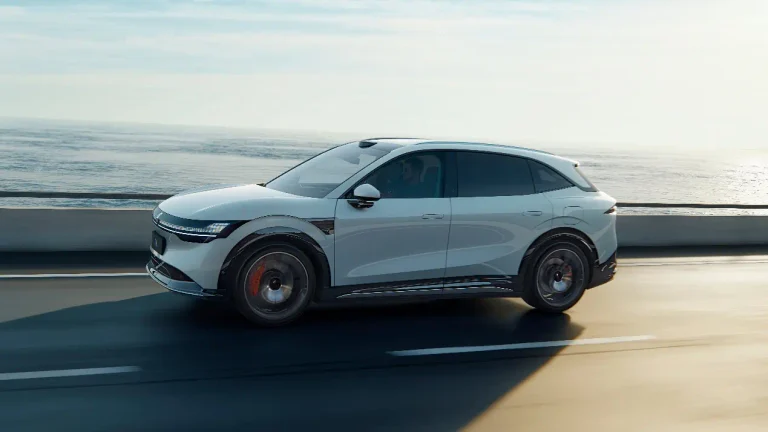

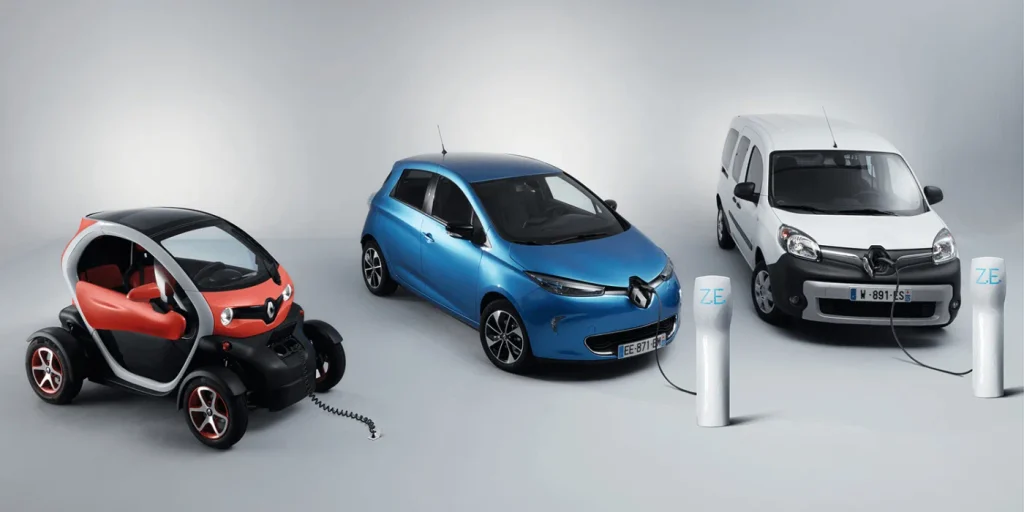
Renault has confirmed that it is moving its entire European electric passenger range onto LFP battery chemistry — the cheap, cobalt-free chemistry European carmakers spent a decade treating as a city-car compromise. The announcement was published on 6 October, six days before the Paris Motor Show opened, and it covers the Twingo at 27.5 kWh, the Renault 5 at 37 kWh, and the Megane and Scenic at 67 kWh each, with the Renault 4 to follow. Two numbers sit either side of that decision. Renault’s own estimate is a 20% cut in battery cost. And 98% of the world’s LFP is produced in China.
What Renault Actually Announced
The domestic framing is affordability. Renault describes the program as a gradual roll-out of LFP across its entire range of passenger cars to improve the price-to-range ratio. The order is Twingo and Megane first, then Scenic and Renault 5, then Renault 4.
| Model | LFP pack | Status |
|---|---|---|
| Twingo E-Tech electric | 27.5 kWh | On sale |
| Renault 5 E-Tech electric | 37 kWh | Adding the chemistry |
| Megane E-Tech electric | 67 kWh | Updated, shown at Paris |
| Scenic E-Tech electric | 67 kWh | Adding the chemistry |
| Renault 4 E-Tech electric | Not disclosed | To follow |
One clarification that most of the coverage skipped: this is not LFP replacing nickel-manganese-cobalt across the board. It is LFP becoming the entry point of every model line. Renault’s French price list for the updated Renault 5 still sells the 40 kWh and 52 kWh versions, both NMC, alongside the new LFP entry car — a Five trim with a 36.5 kWh LFP pack, an 80 kW motor and 305 km of WLTP range, listed at EUR 18,810 after a EUR 6,180 French purchase incentive, or roughly EUR 24,990 before it.
The updated Megane is the car that puts numbers on the strategy. Renault says the new 67 kWh LFP battery gives up to 500 km of range and that DC charging performance improves by 25%, taking a 15–80% charge to 24 minutes. The car also gains a new intelligent driving mode, Renault’s “Smart Mode”, Gemini as the voice assistant, and new functions inside OpenR Link with Google. That last item is delivered to cars already on the road: Renault says Gemini reaches existing OpenR Link vehicles as an over-the-air update, so owners do not need a workshop visit. The Twingo picks up a 0.7 m² panoramic glass roof, which Renault says filters 99.9% of UV.
Every LFP car keeps the Fireman Access system — the patented opening that lets firefighters flood the cells directly in a fire. It is an unusual feature to standardise on the cheap chemistry rather than the expensive one, and Renault’s materials are explicit that it carries over unchanged.
The Two Plants Behind Renault’s LFP Battery Cells
The supply arrangement was set out by Ampere, Renault’s electric and software unit, on 1 July 2024, and it has not changed since. Ampere said it would build an integrated value chain on the European continent with two LFP suppliers, and named them: LG Energy Solution, from its plant in Poland, and CATL, from its plant in Hungary. The two companies, Ampere said, would “cover battery needs for this technology until 2030”.
Both plants are inside Europe. Neither belongs to a European company. LG Energy Solution’s Wrocław factory is, by the company’s own description, the largest EV battery factory in Europe, and LGES holds 16.7% of the battery market outside China against 8.6% worldwide. CATL’s Debrecen site is planned for up to 100 GWh and is the company’s largest manufacturing base outside China.
Renault’s two other cell partners stay on NMC: AESC Envision at Douai, inside Renault’s own ElectriCity hub in France, and Verkor at Dunkirk. Ampere assembles the packs itself, in the battery shop at the Douai plant. Read the supplier list as a whole and the structure is clear: the expensive chemistry is sourced from plants sited in France, and the cheap chemistry from plants owned in Korea and China.
The technical piece Renault does own outright is the pack. Ampere and LG Energy Solution developed cell-to-pack together, which Renault calls a world first for pouch-type cells. Removing the module housings means more cells in the same volume, which is how a chemistry with a volumetric energy-density penalty is made to fit a car designed around a denser one.
98% of the World’s LFP Is Made in China
This is where the affordability story and the industrial story diverge. Transport & Environment’s State of European Transport 2026 reproduces a supply-chain breakdown from the IEA’s 2025 work. It gives China’s share of each stage separately, and the pattern is not uniform:
| Stage | China | Europe | US | Rest of world |
|---|---|---|---|---|
| Manganese processing | 95% | 3% | — | — |
| Graphite processing | 95% | 5% | — | — |
| Phosphoric acid processing | 73% | 5% | 6% | 16% |
| Lithium processing | 70% | — | 2% | 28% |
| Cobalt processing | 78% | 3% | 18% | — |
| LFP chemistry | 98% | — | — | 2% |
| Precursor cathode active material | 95% | — | — | 5% |
| Anode material | 93% | — | — | 7% |
| NMC chemistry | 65% | — | — | 35% |
| Battery cell assembly | 80% | 7% | 8% | 5% |
Source: IEA (2025), reproduced in Transport & Environment, State of European Transport 2026.
Two rows matter more than the others. LFP chemistry is 98% Chinese — the highest concentration of any stage in the table, ahead of graphite and manganese processing — and Europe’s share rounds to zero. And cell assembly, the stage Europe has spent the last five years building gigafactories for, splits 80% China / 7% Europe.
That last row is the one to hold onto. Making a pack in Douai from cells made in Poland is localisation of assembly. It is not control of a supply chain, because the material inside those cells is overwhelmingly produced somewhere else. The same structure sits under BMW’s flagship electric car, where a German premium platform runs on cells from two plants inside Europe, one of them Chinese-owned and planned for up to 100 GWh.
What a 20% Battery Cost Cut Is Actually Worth
Renault’s stated figure is a 20% reduction in battery cost from combining LFP with cell-to-pack, and it says LFP will deliver about half of Ampere’s target of cutting costs 40% before its next generation of vehicles. Both are targets, published by the company, not audited results.
Twenty percent off the pack is not twenty percent off the car, and the difference is worth stating plainly. On the usual industry range of a battery representing 30–40% of an electric car’s bill of materials, a 20% cut in pack cost lands at roughly 6–8% off the vehicle. On a EUR 25,000 hatchback, that is EUR 1,500 to EUR 2,000 — real, and not transformative on its own. This is why Renault pairs it with a cost-cutting roadmap rather than presenting LFP as a solution by itself.
The volume math behind the cheap end of the range is also worth doing. LG Energy Solution’s July 2024 contract was for 39 GWh of LFP packs over five years, described as enough for 590,000 vehicles. Divide one by the other and you get 66.1 kWh per vehicle, which means the headline volume assumes almost every car gets the 67 kWh pack. Renault’s actual range starts at 27.5 kWh. The same 39 GWh would fit about 582,000 cars at 67 kWh, or 1.05 million at 37 kWh, or 1.42 million at Twingo size. Those figures are our arithmetic, and they are the reason the “590,000 vehicles” number should be read as a pack-size assumption rather than a committed mix.
The Megane numbers check out in the same way. A 15–80% charge on a 67 kWh pack moves 43.6 kWh, and doing it in 24 minutes implies an average of about 109 kW across the window — a credible figure for a 400 V-class compact, and consistent with the 25% improvement Renault claims over the outgoing car.
Why a City-Car Chemistry Now Does 500 km
LFP’s historic weakness is volumetric energy density, and that weakness is why it lived in short-range cars. Cell-to-pack attacks it directly by deleting the module housings and using the volume they occupied. Combined with a bigger pack — 67 kWh is a large LFP pack for a compact — the result is a claimed 500 km, or 7.46 km per kWh on Renault’s WLTP figure.
That moves LFP out of the segment it was designed for. The chemistry is no longer a specification you accept on a cheap car; it is a specification Renault is putting on the facelifted version of its mainstream compact. The same shift is visible elsewhere: the Renault 5 line now opens with a 36.5 kWh LFP car at 305 km, and Chinese plug-in hybrids and EVs built around LFP have been pushing European pricing down from the other direction for two years.
The competitive context is not subtle. Chinese automakers took 84% of the growth in European registrations in the first eight months of 2026, and the entry versions are where the volume sits. Meanwhile the same pattern has appeared in Japan, where Suzuki’s cheapest EV runs on cells reported to come from BYD’s supply chain. Renault switching its whole passenger range to LFP is not an isolated strategy. It is the European instance of a pattern now running through every incumbent that cannot build a cheaper pack fast enough to compete on its own.
Author’s Take: The interesting part of this announcement is what Renault did not say about its suppliers. Putting LFP cells into Poland and Hungary is a genuine industrial step, and it is a better answer than importing finished packs. It is not independence. The cathode powder, the precursor material and the anode in those cells are produced overwhelmingly in one country, and the two plants doing the work are owned in Korea and China. Renault is buying time at the bottom of its range — time that has value only if Europe’s own cathode and precursor capacity exists by the time these cars are replaced. On the numbers in the table above, it will not, and the LFP packs going into Renaults this decade will still contain 98%-Chinese chemistry when the cars are scrapped.
What Renault Has Not Disclosed
Which supplier makes which pack. The 2024 framework names LG Energy Solution and CATL as the two LFP partners, but Renault has not said which model gets cells from Poland and which from Hungary, or in what proportion.
Prices for most of the LFP cars. The French entry Renault 5 is priced. The Scenic, the Renault 4 and the LFP versions of everything else are not, so the customer-facing effect of the chemistry switch is still unknown outside one model and one market.
Volume. The agreement covers Renault’s LFP needs until 2030. It is a supply framework, not a committed quantity, and nothing in the announcement converts the 20% cost figure into a stated price reduction for buyers.
The E-Space Concept’s powertrain. Renault showed a 4.70 m electric family car in a black paint it calls “black rubé” and disclosed no battery, motor, output or range. It is a design study, and Renault says only that it could be assessed for production.
Battery cost per vehicle. Renault does not break out what it pays for cells in its results, so the 20% is a company target that cannot be checked against its accounts.
The Bottom Line: Renault has put LFP battery chemistry across its entire European electric passenger range, from a 27.5 kWh Twingo to a 67 kWh Megane that claims 500 km and a 24-minute 15–80% charge. The company’s own estimate is a 20% battery cost reduction, worth roughly 6–8% off the vehicle. The chemistry, however, is the most geographically concentrated link in the battery chain: China produces 98% of the world’s LFP and assembles 80% of all battery cells, and Renault’s two LFP supply plants are Korean- and Chinese-owned even though both stand inside Europe. The switch makes Renault’s cars cheaper to build. It does not make them less dependent.
Notes: Range, charging, capacity and equipment figures are manufacturer claims and have not been independently tested by EVsays. The 39 GWh arithmetic, the differing vehicle counts at each pack size, the 6–8% vehicle-cost estimate and the 109 kW implied charging average are our calculations from published figures. The supplier framework is Renault and Ampere’s July 2024 announcement and has not been restated model by model; the announcement date of 6 October 2026 and the Paris Motor Show opening of 12 October 2026 are as published. Supply-chain shares are IEA (2025) figures reproduced by Transport & Environment, which is a campaign organisation; we cite its data, not its policy positions. Renault’s 20% and 40% cost figures are company targets. EVsays did not attend Renault’s press conference, has not driven these cars and has received no information from Renault or its suppliers beyond public materials. See our editorial policy and correction policy.
Sources & Further Reading
- Renault Group — “E-Space Concept: Renault reinvents the voiture à vivre and sets a date for the 2026 Paris Motor Show” (6 October 2026) — the LFP roll-out across the E-Tech electric range, the per-model pack capacities, the updated Megane’s 67 kWh pack, 500 km, 15–80% in 24 minutes, Fireman Access, and the Twingobay roof.
- electrive — “Renault embraces LFP batteries” (2 July 2024) — Ampere’s LFP and cell-to-pack strategy, LG Energy Solution’s Polish plant and CATL’s Hungarian plant as the two LFP suppliers, the 20% battery cost reduction, and the NMC partners AESC Envision and Verkor.
- Renault Group / Ampere — LFP and Cell-to-Pack announcement, 1 July 2024. Renault Group’s Dutch media site carries the full release text (media.renault-group.nl); the group’s global English page for this release was not reachable for verification at the time of publication.
- Transport & Environment — State of European Transport 2026 (25 March 2026) — the battery supply-chain chart sourced to IEA (2025), including China’s 98% share of LFP, 95% of precursor CAM and 80% of battery cell assembly.
- Transport & Environment — State of Transport 2026 presentation (PDF) — the slide carrying the supply-chain shares reproduced in the table above, page 9.
- Ideal Investisseur — “Renault 5 E-Tech: New Range Starting from EUR 18,810, Range Up to 430 km” — the French entry Five version’s 36.5 kWh LFP pack, 80 kW motor, 305 km WLTP range and price after the EUR 6,180 purchase incentive.
- EnergyTrend — “LG won a large order for lithium iron phosphate batteries” — the five-year LG Energy Solution contract of 39 GWh of LFP packs, described as sufficient for 590,000 vehicles.