



BYD’s executive vice president, Stella Li, told French television on 12 October that France is on the shortlist for the company’s next European car plant, and gave the reason in one line: “France is on the shortlist because your energy is very competitively priced.” That sentence is the news. A BYD France plant would be the company’s second vehicle factory in Europe, and the deciding input BYD chose to name was not subsidies, land or labour — it was electricity.
What a BYD France Plant Would Actually Be
The statement was made on the sidelines of the Paris Motor Show, in an interview with BFM Business, and reported by Reuters. Li said BYD is “closely examining” options for a plant in France, that the group intends to build two more plants in Europe beyond Hungary, and that France could be one of the locations.
The status is thin and should be described as such. No city, no investment figure, no capacity, no start date and no decision. What has moved is the shortlist, not the project. Hungary remains the concrete item: BYD’s first European passenger-car plant, at Szeged, starts output in the fourth quarter of 2026.
France is not a cold start. BYD sells through three dealer groups — Bymycar, Emil Frey and Bodemer — and had 90 sales and service outlets in the country as of 1 January 2026. Li framed the question as one of belonging: she said she wants French buyers to see BYD as a company that has integrated locally, not as an importer.
Everything else in the announcement is a plan rather than a commitment, which matters because the previous version of this story came from a BYD adviser and had the same shape: a four-site outline, no numbers attached, and a site decision promised before the end of the year.
The Shortlist Is Being Run on Power Prices
The first version of this strategy, reported in September, was a three-item shopping list: cheap industrial sites, competitive energy, flexible labour. What changed on 12 October is that a specific country was named and one of the three items was promoted above the others. Li did not mention incentives or tariffs. She mentioned the price of electricity.
That is a decision-relevant shift for anyone watching European industrial policy, because it moves the argument out of the subsidy column, where every government competes on the same axis, and into the energy column, where the spread between European countries is wide and structural. It also explains the shape of the shortlist as BYD’s adviser described it in September: Italy has been told it is plan B on operating economics, Germany was dismissed on cost, and Spain and France are the two being played against each other.
One caution on this point. EVsays has not independently verified that French industrial electricity prices are more attractive to a car plant than Spanish, Italian or German equivalents. Li’s claim is a company statement made to a French broadcaster at a French trade show, which is not the same thing as a delivered price comparison. What can be said with confidence is that the company chose to make energy price the public criterion for a BYD France plant, and that a government reading the interview now knows what to bid on.
What a European Factory Is Actually For
The reason BYD wants production inside the bloc is not capacity. It is rules. The European Union imposed additional duties on Chinese-built electric vehicles in 2024, and Chinese manufacturers responded by routing volumes through hybrids, which do not attract the same additional duties — Chinese hybrid exports to the EU reached about USD 7.5 billion in the first half of 2026, roughly three times the level of a year earlier, according to Chinese customs figures cited in trade coverage. Brussels and Beijing have since agreed to limit imports of Chinese hybrids, with implementation details still being settled, and the European Commission is preparing requirements on the use of locally produced components.
Read together, those three things point in one direction: a car assembled in China and shipped to Europe is exposed to a shifting set of instruments, while a car assembled in Europe is not. That is the logic behind local assembly, and it is also the logic behind putting a battery plant on the same continent — a vehicle factory that imports packs still has a localisation problem. It is the same pressure that is reshaping the European market from the other side: Chinese automakers took 84% of the growth in European registrations in the first eight months of 2026, which is precisely why the rules are tightening.
The Scale BYD Is Talking About
Two numbers from the same round of Paris interviews are more concrete than the plant itself, and neither appears in the company’s written materials.
| Target | Now | Change |
|---|---|---|
| 40,000 European employees by 2030 | Close to 10,000, rising past that shortly | 4× |
| 3,000 European flash-charging stations by end-2027 | — | See below |
| Two further vehicle plants plus one battery plant | One plant (Hungary), starting Q4 2026 | 4 sites in total |
The charging figure is the one to hold next to the home market. BYD opened its 10,000th flash-charging station in China in late August and has said it wants 20,000 by the end of 2026. Its European target is 3,000 by the end of 2027 — 15% of the Chinese goal, delivered a year later. The network that makes the charging claims in BYD’s marketing credible is, for now, overwhelmingly Chinese.
The headcount number deserves the same treatment. Going from roughly 10,000 European employees to more than 40,000 in four years is a fourfold increase, and it is a statement about manufacturing, since dealer networks and sales offices do not scale that way. It is also the figure most likely to be quoted back at BYD by the governments it is currently asking to compete for the site.
The Atto 8 Numbers, and What They Say About the Strategy
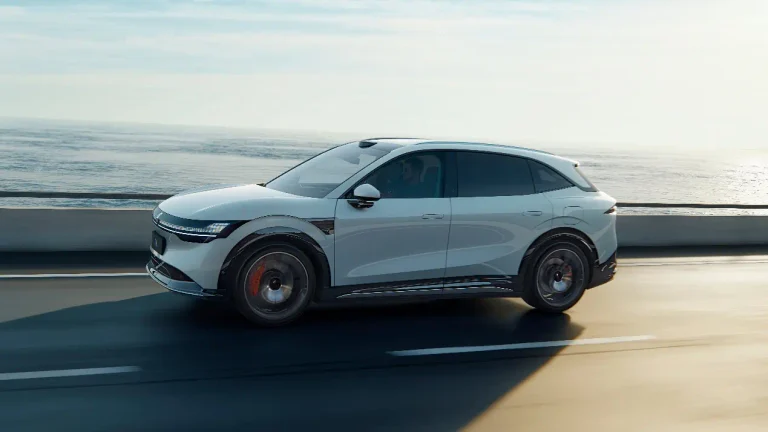
The same show provided the technical frame. BYD’s new European Atto 8 is a seven-seat electric SUV with a 115 kWh pack, 652 km of WLTP range, and it is the first BYD in Europe to carry the second-generation Blade battery. BYD says it charges from 10% to 97% in nine minutes on a compatible charger.
Two pieces of arithmetic follow from those figures, and both are ours. Moving 87% of a 115 kWh pack means 100.0 kWh delivered in nine minutes, which is an average of about 667 kW across the window — a figure that cannot be reached without a peak above 1 MW, consistent with the megawatt-class station architecture BYD has published.
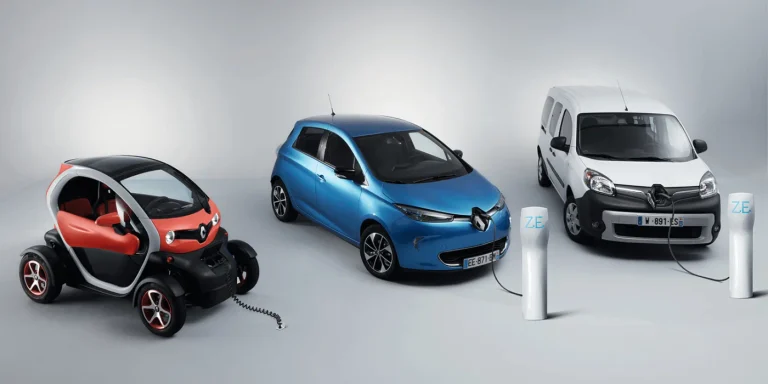
The second is what the car does per unit of energy. At 652 km from 115 kWh, the Atto 8 returns 5.67 km per kWh, or about 17.6 kWh per 100 km. That is the profile of a large SUV, not an efficiency play, and it is worth setting against Renault’s updated Megane E-Tech, which claims 500 km from a 67 kWh LFP pack — 7.46 km per kWh. The two are not the same class of vehicle, so this is not a like-for-like comparison; it is a description of two different European strategies. Renault is buying range with a cheaper chemistry and a lighter car. BYD is buying range with a bigger battery and a charging network, and its pitch to European buyers is speed of refuelling and interior space rather than kilometres per kilowatt-hour.
What BYD Has Not Said
Where in France. No city, no region, no site. The September reporting indicated a preference for acquiring and refurbishing an underused existing factory rather than building greenfield, and nothing in the October statement confirms or contradicts that.
How much. No capex, no capacity in GWh or vehicles, no employment figure tied to the French site specifically. The 40,000 number is European, not French.
Whether it is one plant or two. Li said BYD intends to build two more plants in Europe and that France is a candidate. That leaves open whether France gets the second site, the third, or both.
What Türkiye is for. BYD has a plant project at Manisa, outside the customs union. With local-content rules coming into force inside the bloc, the role of a non-EU site in a European strategy has not been explained.
Anything written down. The 40,000-employee and 3,000-station figures come from Li’s interviews at the show. They are not in a press release, a filing or a disclosed plan.
Author’s Take: The interesting part of this announcement is not that BYD might build in France. It is the criterion. An automaker with a stated intent to spend on three more European sites told a national broadcaster that the deciding variable is the price of electricity — not the size of the incentive package, not the labour agreement, not the tariff shield. Taken at face value, that reframes what a government is bidding. France can offer nuclear-backed generation and industrial sites; it cannot offer Chinese construction costs or Chinese cycle times, and BYD’s Hungarian plant is already going to be the test of whether European labour productivity closes that gap. Watch the site decision, which BYD’s adviser said would come before year-end. But watch the reasoning attached to it just as closely: if the winner is announced on energy price, that is a different kind of European industrial policy than the one Brussels has been writing.
The Bottom Line: On 12 October at the Paris Motor Show, BYD’s executive vice president Stella Li put France on the shortlist for a BYD France plant and named the deciding input as competitively priced energy. BYD already has Hungary starting output in the fourth quarter of 2026 and says it wants two more plants plus a battery plant in Europe, alongside 40,000 European employees by 2030 — four times its current headcount — and 3,000 European flash-charging stations by the end of 2027, which is 15% of what it plans in China, delivered a year later. There is still no city, no investment figure, no capacity and no date. The news is the shortlist and the criterion, and the criterion is a power price.
Notes: The account of Li’s remarks comes from a BFM Business interview at the Paris Motor Show on 12 October, as reported by Reuters; EVsays did not attend the show and did not speak to BYD. The 40,000-employee and 3,000-station figures come from Li’s interviews at the event and are not in BYD’s written disclosures. Vehicle figures are manufacturer claims and have not been independently tested. The 667 kW average, the 5.67 km/kWh efficiency figure and the 15% comparison against BYD’s Chinese charging target are our calculations from published numbers, and the Renault comparison is across different vehicle classes. EVsays has not verified the relative industrial electricity prices in France, Spain, Italy and Germany; that claim is BYD’s. Trade-flow figures for Chinese hybrid exports to the EU are Chinese customs data cited in secondary coverage. See our editorial policy and correction policy.
Sources & Further Reading
- Reuters via Euronext — “China’s BYD studying plans for factory in France, executive tells BFM” (12 October 2026, Dominique Patton) — Li’s statement that France is on the shortlist, the direct quotation on energy pricing, the two additional European plants and the Hungary timeline.
- BFM Business — interview with BYD executive vice president Stella Li, Paris Motor Show, 12 October 2026. The original broadcast source for the quotation on French energy prices. EVsays was unable to locate a stable article permalink for the interview and cites it here by outlet and date.
- BYD Europe — company product and market pages for the European range, including the Atto 8.
- EVsays — “BYD Says Europe Will Need Three Assembly Plants and One Battery Factory” (18 September 2026) — the earlier version of this plan, the Spanish, French and Italian site picture, and the stated preference for acquiring an existing factory.
- EVsays — “BYD Opens 10,000th Flash-Charging Station in China” (28 August 2026) — the Chinese charging build-out and the 20,000-station target used for the 15% comparison.
- EVsays — “BYD Megawatt Flash Charging Station Architecture Explained” — the station-side specification behind the implied charging power.
- EVsays — “LFP Battery: Renault Switches Its Whole European Range” (12 October 2026) — the Renault efficiency comparison used above.




[…] a 115 kWh, 652 km seven-seat SUV carrying the second-generation Blade battery — which is the same show, same segment, same argument. Chinese brands are moving their driver-assistance features into Europe on their own timetables. […]