

The China regional power market covering Guangdong, Guangxi, Yunnan, Guizhou and Hainan moved from trial to formal operation on 24 October, after sixteen months of continuous settlement. In the first nine months of 2026 it cleared almost 900 TWh — more than 70% of electricity sold across the five networks, roughly Japan’s annual consumption — with 290,000 registered participants and coal, hydro, nuclear, wind, solar and gas all bidding under one rule set. The number that should interest anyone following electric vehicles is not the volume. It is the floor: in Guangdong the market may now clear at minus 50 yuan per MWh, a price that pays flexible load to take electricity off the grid.
What the China Regional Power Market Covers
The five regions do not share a grid in the way a single province does, and that is the point. Until now each province cleared its own market and treated imports as a planning arrangement. From 24 October, all five clear against the same rules and produce a single regional price, with inter-provincial links priced as transmission capacity rather than as a fixed schedule — the auction decides who gets to use the line and how much, and the price reflects how congested it is.
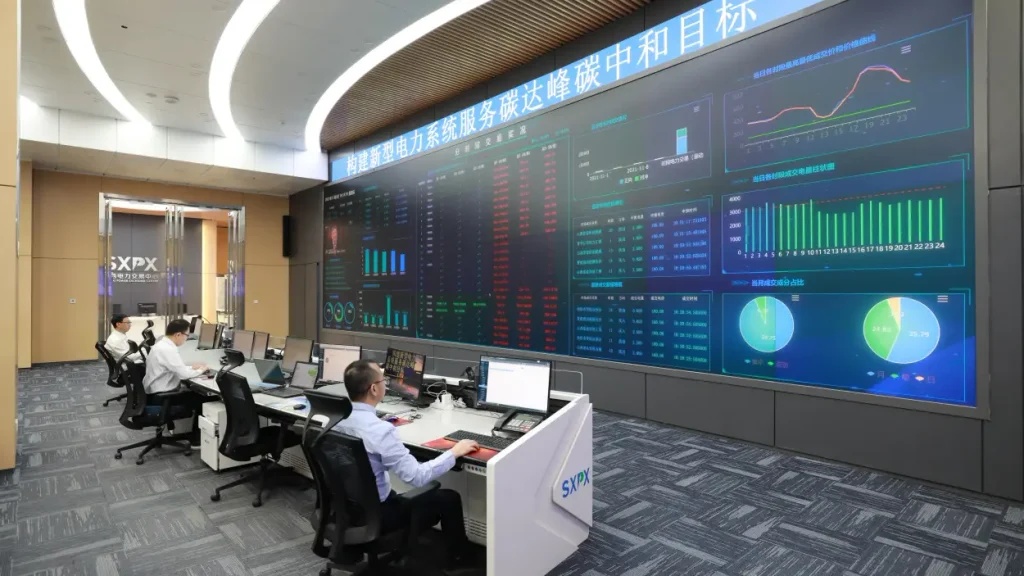
Technically, the market clears in 15-minute intervals on a domestic solver, Tianquan, according to China Southern Power Grid. That matters less for its nationality than for what it enables: a 15-minute gate with five provinces in the model is a different computational problem from five separate hourly markets, and it is the reason a battery can chase a price that moves four times an hour instead of once a day.
The trial was not a formality. According to the grid operator, the market ran continuously through typhoons, a winter cold snap, a summer heatwave, a sudden flood-to-dry swing on the hydro systems, and the Spring Festival period when solar output is high and demand collapses. Those are the four conditions that break power markets, and the fact that the trial survived all of them is the actual argument for formal operation.
The Numbers Behind 900 TWh
| Metric | Figure |
|---|---|
| Traded volume, January–September 2026 | ~900 TWh |
| Share of electricity sold on the five networks | above 70% |
| New energy share of incremental sales | 40% |
| Largest single-day cleared volume | above 4 TWh |
| Registered participants | above 290,000 |
| Regional new energy utilisation rate | above 95% |
| Cross-grid trades with State Grid areas | above 19.4 TWh, a record |
| Regulating resources versus 2021 | more than 5× |
| Green certificates bought by companies from Hong Kong, Macao and Taiwan, China | 1.28 million, across 200-plus firms |
| Laos new energy in the market | first participation; over 1 TWh of clean energy traded |
Two of those need arithmetic attached. Nine hundred terawatt-hours across 273 days is about 3.3 TWh a day on average, so the 4 TWh peak day ran roughly 21% above average — a modest swing by the standards of a market this size, and a sign that most of the volume is still scheduled rather than cleared on the day.
The second is the cross-grid figure. 19.4 TWh is 2.2% of the 900 TWh traded inside the region. The headline about south-western hydro reaching the Yangtze Delta and north-western wind and solar reaching the Greater Bay Area is real, and it is still a rounding error against the volume that never leaves the five regions. A regional market is a big step towards a national one; it is not the same thing.
The Price Floor Is Negative, and That Is the Point
For the China regional power market, the more consequential change is not the volume but the band. The market’s operating parameters, set in the implementation plan issued by China Southern Power Grid and the Southern Regional Energy Regulatory Bureau on 20 September, allow each region a different band. The spread is where the story lives.
| Region | Clearing price floor | Clearing price ceiling |
|---|---|---|
| Guangdong | −50 yuan/MWh | 1,800 yuan/MWh |
| Guangxi | 0 yuan/MWh | 1,125 yuan/MWh |
| Yunnan | 0 yuan/MWh | 1,032 yuan/MWh |
| Guizhou | −6 yuan/MWh | 1,124 yuan/MWh |
| Hainan | −57 yuan/MWh | 1,260 yuan/MWh |
A negative floor exists because some generation cannot switch off. Hydro in flood season has to spill or run, nuclear has to stay critical, and solar at midday produces whether or not anyone wants it. A floor below zero gives the market a legal way to say “take this electricity and we will pay you”, which is cheaper than curtaining a wind farm or spilling a reservoir. Three of the five regions chose to allow it; the two hydro-heavy ones that did not — Guangxi and Yunnan — set their floors at zero and rely on curtailment rules instead.
Guangdong’s ceiling of 1,800 yuan/MWh (USD 248 at 7.25) is the highest in the region, and it sits 36 times the magnitude of its floor. That ratio is the arbitrage window a storage operator actually trades. A 100 MWh battery that bought at the floor and sold at the ceiling would gross 185,000 yuan (USD 25,500) on a single cycle, before efficiency losses, fees and the small detail that the two extremes almost never occur in the same day. It is a theoretical number, and it is also the reason capital is willing to build batteries in Guangdong rather than in Yunnan.
Where Batteries and EVs Actually Queue
Here the official language deserves to be read slowly. Independent storage and virtual power plants are admitted to the market, but in stages: they first participate by volume without bidding, settling at the spot price, and only later pilot price-and-volume bidding as conditions allow. Being in the market and being able to set the price are two different privileges, and storage currently has the first.
Electric vehicles are not named at all. The route for an EV fleet is through a virtual power plant or an aggregator registered as a market entity, which is why the 50 GW of vehicle-to-grid capacity China is targeting for 2030 depends on this file more than on any car. A V2G charger with nowhere to sell is a hardware demo. A V2G charger inside a 15-minute clearing market with a negative floor is an asset with a revenue line.
For contrast, look at how the same business is paid in the United States: Sunrun and Tesla earn most of their virtual power plant revenue from capacity payments, not from energy arbitrage. China is building the opposite: an energy market first, with capacity and ancillary products still being added. The grid operator says the next step is to open reserve, ramping and other ancillary services, and to bring storage and adjustable load into them at scale — the “four-dimensional value” of energy, regulation, environment and capacity.
What Has Not Changed
Five price bands are still five price bands. Each region’s floor and ceiling are set by its own pricing authority, which means the market clears a regional price but cannot fully arbitrage away the differences between provinces. That is deliberate — it protects consumers in poor provinces from paying coastal prices — and it also caps how much a battery can earn from geography alone.
The wires remain the binding constraint. Inter-provincial capacity is now auctioned rather than allocated, which improves the signal, but it does not add a single kilometre of transmission. The 770 MVA flexible DC transformer installed in Guangzhou and the grid-enhancing technologies the IEA expects to unlock 330 GW are the hardware half of this story; the market is only the software half.
And residential tariffs are not set here. They remain regulated, so the immediate effect on a household bill is zero. The effect on an EV owner arrives indirectly, through whatever a charging network or an aggregator is willing to pay for the right to control when the car charges.
The same transition is already queuing elsewhere. Ten days ago the National Energy Administration convened the Yangtze River Delta market meeting, where Anhui and Fujian moved their spot markets into formal operation, the region shared about 40 GW across provincial borders at peak, and 2.4 TWh of wind and solar curtailment was avoided in the first nine months. The southern market is first, not unique.
Author’s Take: The interesting product here is not cheaper electricity. It is a legal price signal that can go below zero, cleared every fifteen minutes, across a footprint the size of Japan’s annual demand. Everything the electrification story needs — storage revenue, demand response, V2G, flexible charging — is a bet on that signal existing.
But read the sequencing, not the press release. Storage gets volume-only participation first, price bidding later. That is the correct order for grid safety and the wrong order for anyone hoping to finance a battery on day one. The door is open; the gap is narrow; and the first operators through it will be the ones who already hold dispatch-controlled assets rather than the ones with the best software.
The Bottom Line: The China regional power market entered formal operation on 24 October with 900 TWh cleared in nine months and 290,000 participants. Its real novelty is the price architecture — a 15-minute gate, a Guangdong band running from minus 50 to 1,800 yuan/MWh, and a staged door for storage and virtual power plants. For electric vehicles, that band is the difference between V2G as a demonstration and V2G as a business.
Sources & Further Reading
- China Southern Power Grid — “南方区域电力市场正式运行 全国统一电力市场体系建设取得重大突破” (24 October 2026) — the formal operation date, the 900 TWh nine-month volume, the 70% share, the 290,000 participants, the 4 TWh peak day, the 95% new energy utilisation rate, the 19.4 TWh of cross-grid trades, the 5× expansion of regulating resources, the Laos participation, the green certificate purchases, and the quotations from Li Minhong, Huang He and Xie Jingdong.
- China Southern Power Grid and the Southern Regional Energy Regulatory Bureau — 南方区域电力现货市场正式运行实施方案(2026年), Southern Grid Dispatch Document No. 16 of 2026, issued 20 September 2026 — the five regional price floors and ceilings, the 15-minute clearing interval, the Tianquan solver, the staged participation of independent storage and virtual power plants, and the treatment of inter-provincial transmission capacity. Cited by name and document number.
- National Energy Administration — “国家能源局召开长三角电力市场建设推进会” (22 October 2026) — the parallel Yangtze River Delta market, the formal operation of the Anhui and Fujian spot markets, the 40 GW of peak inter-provincial support and the 2.4 TWh of avoided curtailment.
- EVsays — China sets a 50 GW V2G target for 2030 — the vehicle-to-grid programme that needs a spot market to sell into.
- EVsays — Sunrun and Tesla’s 580 MW residential virtual power plant — how the same business is compensated in a capacity-market system.
- EVsays — the 770 MVA flexible DC transformer in Guangzhou — the hardware that makes cross-region flows controllable.
- EVsays — grid-enhancing technologies and 330 GW of headroom — why the wires, not the rules, are the long-run constraint.
Notes: All volume, participant, utilisation and cross-grid figures are China Southern Power Grid’s own, published at the market’s formal operation, and have not been independently audited; the price floors and ceilings come from the implementation plan issued on 20 September and may be adjusted. The daily-average, peak-to-average, cross-grid share, 36-times spread and 100 MWh cycle figures are our own calculations. EVsays has not traded in this market. Our editorial policy and correction policy apply.