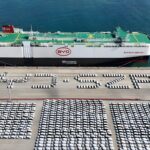


On Friday the District Court of The Hague handed Jaguar Land Rover an injunction that stops ten BYD companies from importing, producing, offering, selling, storing or delivering the Ti7 anywhere in the European Union. The BYD Ti7 EU ban takes effect one week after the order is served. Design cases between carmakers are rare in Europe, and a finding this early in a dispute is rarer still — the judge reached it before any full trial. It also lands on a market where the vehicle has never been sold. The Ti7 is not on sale in the EU. BYD told the court it has no concrete plan to launch it there, and the judge accepted that no European customer can place an order. The country where the Ti7 does go on sale is Britain, with customer deliveries from January — and Britain sits outside the order, because the same judgment declares the Dutch court has no jurisdiction over BYD’s UK subsidiary.
Three numbers frame what JLR actually won. At €100,000 a day, the €10 million ceiling on penalties is exhausted in 100 days. Converted at €1.17 to the pound, that same ceiling buys 178 Ti7s at the £47,995 BYD charges in Britain. And of the €55,200.50 in legal costs JLR claimed under the Dutch intellectual-property cost regime, the court awarded €2,685.12 — 4.9 cents on the euro. All three figures are our arithmetic, drawn from the penalty clause and the published price list.
What the judge found
JLR went into the case with six registered EU designs for the current Defender, the L663 that reached showrooms in September 2019. The judge needed one. He found infringement of Uniemodel 1, registered as 005248580-0004, applied for on 25 April 2018 and entered on 27 April — a year before the production car was revealed. The other five were left undecided, because one was enough to support the order.
The test under EU design law is not whether every panel matches. It is whether the later product creates a different overall impression on the informed user. The judge identified the features that carry the Defender’s impression: rounded, prominent shoulders and rounded corners; the signature panel forming the C-pillar area; wheel-arch cut-outs with rounded corners; a continuous glazing band; the proportions, and through them the whole silhouette. He found those dominant features almost identical on the Ti7.
BYD’s defence was a list. Lamps, grille, bumpers, bonnet treatment, a darker A-pillar, the roof line, the absence of alpine windows, an interruption in the shoulder line, wheel-arch cladding, the wheels, the treatment of the rear-mounted spare. Separately and together, the court held, none of it was prominent enough to move the overall impression. The published dimensions make the comparison easy to understand and were not what decided it: BYD’s own Argentine launch material lists the Ti7 at 5,016 mm long, 1,995 mm wide and 1,865 mm high on a 2,920 mm wheelbase, while Land Rover’s own technical data puts the Defender 110 at 5,018 mm with the tailgate-mounted spare in place — 4,758 mm without it. Two millimetres apart, on paper, but only if you count the spare.
The exhibit was BYD’s own press release
The strangest part of the judgment is why the court thought a ban was needed at all. BYD argued, truthfully, that the Ti7 is not marketed in the EU, that there is no euro price, and that customers cannot order one. Dutch courts do not grant injunctions against harm that cannot happen.
Then the judge cited BYD’s own British launch material from 31 July 2026, published by BYD’s UK press office: “The seven-seat arrangement for the Ti 7 has been developed specifically for the European and UK markets.” The court also noted that BYD had promoted the car through European channels and had declined to promise it would stay out of the EU for the foreseeable future. A company that says it has no plan, while telling journalists the car was engineered for Europe, gave JLR the imminence it needed.
That is a lesson with wider application than one SUV. The document that convinced the court was not a leaked engineering file, not a seized email. JLR’s bailiffs had raided BYD’s offices in Schiedam and Hoofddorp in August and taken digital files; nine days before this ruling, on 11 November, a different judge in the same court ordered JLR to arrange destruction of that material, calling the seizure unnecessary at that stage. The design case did not need it. Marketing copy was enough.
The BYD Ti7 EU ban has 100 days of teeth
The penalty clause is the part worth reading twice. For every day, or part of a day, that a defendant remains in breach, the order sets €100,000. At JLR’s election the court will instead apply €25,000 per infringement. Either way the total stops at €10 million. That is a ceiling on the whole order, not on each company, and it applies across ten defendants in eight EU countries.
Run the clock. A hundred days at the daily rate and the penalty is spent. If the order were served in mid-January — the point at which the British cars reach customers — the ceiling would be reached around late April. After that the marginal cost of staying in the market is zero until JLR brings fresh proceedings. Compare the exposure: if BYD sold 10,000 Ti7s a year in the EU at the British price, that is roughly €562 million of revenue, and €10 million is 1.8% of it. As a deterrent the clause behaves less like a wall and more like a toll.
None of which means BYD will test it. The order also exposes the individual subsidiaries to contempt-style enforcement, and a company building a European dealer network has more to lose than a fine.
Britain was never in scope
BYD (U.K.) Co. Limited was the fifth defendant. The court declared itself without jurisdiction over the claims against it, finding that the company could not reasonably have expected to be summoned in The Hague. JLR also failed to show that the continental subsidiaries were behind the British offer, since the website selling the car is run from the UK. Claims tied to the UK registered designs were dismissed on the same ground.
So the British programme continues untouched. BYD’s UK media office confirmed in July that the Ti7 starts at £47,995 on the road in a single Excellence AWD specification, with 408PS from a 1.5-litre turbocharged petrol engine working with electric motors, a 35.6 kWh Blade battery and up to 74 miles of electric running. Cars reach showrooms in November; customer deliveries begin in January 2027. Early buyers put down a £500 deposit, which BYD matches with another £500. Design rights are territorial. A Dutch judgment stops at the EU border, which is precisely where the Ti7’s launch does not stop.
For the earlier phase of this dispute — the August raid and the destruction order — see our report on why a Dutch court made JLR destroy its own evidence. For the car itself, our Ti7 specification breakdown covers the Chinese-market version that started all of this.
Hungary is the one clause with teeth
The BYD Ti7 EU ban covers ten of the eleven BYD entities named in the case. The ninth is BYD Auto Hungary Kft, the company behind the Szeged plant that the judgment says is intended to start building cars from the end of 2026. The judge addressed it directly: if BYD puts the Ti7 on the EU market, it is not inconceivable that Hungarian production supplies it; BYD neither rebutted that inference nor gave any undertaking about it. Should the plant not build the Ti7 while the order stands, the judge added, the ruling does no harm to it.
That is the only operative sentence with real reach, and it is narrower than it sounds. It bars one model from one factory for as long as the injunction survives. It does not stop Szeged from building the Dolphin, the Seal, the Atto or anything else destined for European showrooms.
Author’s Take: JLR has won a case about a car that isn’t for sale, in a currency of damages it cannot spend, against a defendant that will appeal. Read the docket and the victory looks thinner still: nine days before this ruling the same court told JLR to destroy the files it had seized, and this week it awarded the company 4.9% of the costs it asked for, with the fee cut by one eleventh because one of eleven defendants was outside the court’s reach. What JLR actually bought is a sentence of law — that the overall impression of a boxy, upright, spare-wheel-on-the-tailgate SUV can belong to one company in Europe — and that sentence is worth more to the next plaintiff than to this one. The interesting question is not whether BYD appeals. It is whether the European courts have just handed every Chinese brand with a Defender-shaped project a price list: change the C-pillar, change the wheel arches, or pay.
What JLR asked for and didn’t get
The judgment is unusually explicit about the parts that failed. JLR sought a ban reaching the United Kingdom, access to the seized documents, disclosure of BYD’s distribution arrangements, a public correction on BYD’s websites, and penalties imposed jointly on all defendants. It got the injunction and the costs order.
| Request | Outcome |
|---|---|
| EU-wide ban on importing, producing, selling, storing, delivering the Ti7 | Granted against ten BYD entities |
| Ban covering the United Kingdom | Refused — no jurisdiction over BYD UK; continental entities not shown to run the UK offer |
| Access to documents seized in August | Refused — JLR’s interest already served by the injunction |
| Disclosure of distribution channels | Refused on the same ground |
| Public corrective notice on BYD’s sites | Refused — the car was never marketed in the EU |
| Penalties imposed jointly and severally | Refused — an injunction does not lend itself to joint liability |
| €55,200.50 in legal costs under the IP cost regime | €2,685.12 awarded at the standard liquidated rate |
The cost ruling deserves its own line. JLR claimed full compensation under article 1019h of the Dutch civil procedure code. The court found the specification incomplete — it ran only to 26 August and included work on the August seizure — and fell back to the liquidated tariff: €155.67 for the summons, €735 in court fees, €1,605.45 in lawyer’s fees, plus €189 in follow-up costs. Then it cut the lawyer’s fee by one eleventh for the defendant outside its jurisdiction. The defendants pay jointly, with interest, within 14 days of demand.
Rotterdam, 25 November, is the case with longer reach
A second Dutch action is already listed. In Rotterdam, JLR is pursuing copyright infringement and slavish imitation over the same vehicle, with a hearing set for 25 November. Those claims run on different tests and a different clock. A registered EU design lasts five years at a time, renewable to a maximum of 25 — from an April 2018 filing that reaches, at most, 2043, subject to renewals the judgment does not address. Copyright runs far longer.
The Hague judge was careful to say what he was not deciding. He ruled on one registered design. He did not rule on copyright, on the five other registrations, or on the allegation that BYD bought a Defender and took it apart. That last claim is the one JLR can no longer support with the seized files, which is why the Rotterdam hearing matters more than the headline from The Hague: it is the only forum where the question is not what the Ti7 looks like, but how it came to look that way.
Whether the BYD Ti7 EU ban survives an appeal is a separate question from whether it changes anything in January. JLR must open main proceedings within six months, by around 20 May 2027, or the injunction lapses. BYD says it will appeal and that the Ti7 “is the result of BYD’s own independent design work and infringes none of JLR’s rights.” For context on the scale at stake, BYD’s European registrations more than doubled to over 280,000 vehicles in the first nine months of 2026, according to ACEA data cited by Reuters — a figure that outsells Ford, Tesla and Nissan on the continent. The Ti7’s contribution to that number so far is zero.
The Bottom Line: A Chinese SUV has been found to infringe a European design right, and that finding will outlast this case whatever happens on appeal. But the order’s commercial reach is narrower than its headline: the BYD Ti7 EU ban covers a market with no Ti7 sales, exempts the market where the Ti7 launches in January, binds one factory against one model, and caps its own penalties at a level the clock exhausts in 100 days. JLR won the argument and bought an option. BYD keeps the British launch and loses the Hungarian option on its most Defender-shaped model. The next Chinese brand weighing a boxy SUV for Europe now knows the cost of losing — and, reading the same numbers, the cost of winning.
Notes: The 20 November 2026 ruling is a preliminary-relief judgment (kort geding), not a final decision on the merits, and BYD has said it will appeal. Figures for the penalty structure, the defendant list, the awarded costs and the Hungarian plant are taken from the judgment and the court’s press release; UK pricing, specification and delivery timing come from BYD’s own UK press office. The 100-day, 178-vehicle and 4.9% calculations are ours, using an exchange rate of €1.17 to the pound, and will move with the rate. EVsays was not in the courtroom and has not inspected either vehicle. For how we handle corrections, see our correction policy; for our sourcing standards, our editorial policy.
Sources & Further Reading
- District Court of The Hague — press release on the Ti7 injunction, 20 November 2026 (in Dutch).
- District Court of The Hague — judgment ECLI:NL:RBDHA:2026:34365, case C/09/712003 / KG ZA 26-956 (in Dutch).
- BYD UK — Ti 7 UK pricing and specification, 31 July 2026.
- BYD Argentina — Ti7 launch and dimensions, 16 October 2026 (in Spanish).
- Land Rover — Defender model range and official dimensions.
- Reuters, Nick Carey, 20 November 2026 — report on the ruling, including JLR and BYD statements and ACEA registration data. Not linked: the wire copy circulates through syndication pages we could not verify as first publication. Also consulted: The Straits Times and Lianhe Zaobao (Chinese-language coverage of the judgment).