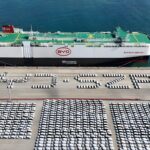


LG Energy Solution Poland has spent a decade building what the company calls Europe’s largest electric-car battery plant at Biskupice Podgórne, outside Wrocław: PLN 25 billion invested, 6,500 employees, and an output that accounts for roughly 2% of everything Poland exports. On 20 November, in a post marking the site’s tenth year, it announced the next stage. The next stage is not cars. The plant has added production lines for grid storage, and the first customer is the Polish state utility PGE, which is taking a 981 MWh system for its Żarnowiec project — 262 MW of reserve capacity assembled from 204 containerised units on the same campus.
By our arithmetic, three figures frame how far this has actually gone. The site was designed for about 86 GWh a year of cells, according to the Korean outlet BusinessPost. The PGE contract covers about 1 GWh through 2027, per the same reporting. That is 1.2% of what the plant was built to make — and the company has declined to say how much capacity has been switched.
What LG Energy Solution Poland said, and what it left out
The official announcement is careful. It says the site “has also added energy storage system (ESS) production lines”, and that the Żarnowiec project is the landmark example. It gives the project’s power and energy ratings, the fact that every battery and DC-Link container is made locally “from electrodes and cells to complete storage units”, and the strategic framing: the expansion “broadens the plant’s role from an EV battery production base to a key contributor to Poland’s—and Europe’s—energy transition”.
It does not give a converted capacity figure. It does not give a line-level investment figure. It does not name the chemistry. Those three omissions matter, because the stories that followed filled them in from other sources.
BusinessPost reported in October that the plant was built for nickel-based pouch cells with a designed capacity of about 86 GWh a year, and that since November 2025 part of those lines had been converted to lithium iron phosphate for storage. An LG Energy Solution official told the outlet that a larger conversion was under consideration but that nothing had been decided. East Asia Brief reported on 20 November that selected pouch-cell assembly lines were being moved from nickel-cobalt-manganese to LFP, with a separate allocation of high-voltage mid-nickel pouch capacity kept for volume-segment cars.
So the accurate description is narrower than the one circulating in Chinese-language coverage this week, which reads as though the plant has been turned over to storage. It has not. Part of one product line has moved, the chemistry on that part has changed, and a second chemistry has been carved out to protect the car business. The EV side was not abandoned; it was split.
A decade of building other people’s batteries
The ten-year history is worth holding in view, because it explains why this pivot is awkward. LG Group arrived in Poland in the 1990s with consumer electronics. The battery investment began in 2016 under LG Chem, and the first phase of the Wrocław plant was finished in 2017 — at a time when large-scale cell manufacturing barely existed in Europe. The site grew into the continent’s biggest, ranked eighth among Poland’s 500 largest companies in 2023 according to Rzeczpospolita, and was named one of the country’s best employers by Forbes Polska in 2024.
It also became a small town. The campus has its own fire station, medical centre and kindergarten, which is where the local nickname “Little Korea” comes from. Polish engineers trained there later helped build LG Energy Solution’s plants in the United States — a detail that cuts both ways for Warsaw, since the skills exported to America were built with Polish public support.
The money is the part to watch. PLN 25 billion of cumulative capital expenditure against 86 GWh of designed capacity works out at roughly USD 71 million per GWh at the company’s own conversion of USD 6.1 billion — about 29% below the USD 100 million per GWh that Ford is spending at its Marshall, Michigan LFP plant. Neither number is a clean unit cost: LG’s figure is a decade of cumulative spend, Ford’s is a single project. But they are close enough in scale to make the point that Europe’s battery capacity was bought at a competitive price, and is now underused.
3.7 hours, not four
The PGE system is the tell. At 981 MWh over 262 MW, Żarnowiec runs for 3.74 hours at full power — not the round four that most European tenders are written around. That is not an accident of sizing. The project is contracted to deliver “flexible operating reserve” to the national grid, which is capacity-market work: you are paid for being available, not for discharging for a fixed duration. The site holds a 17-year capacity-market contract from 2029 and a connection agreement, with PLN 1.5 billion of project value, construction started in September 2025, completion scheduled for the second quarter of 2027, and non-repayable grants from Poland’s National Recovery Plan behind it.
Each of the 204 DC-Link units carries 4.81 MWh. They are 45-tonne enclosures that combine modules, liquid-cooling loops and independent thermal fire barriers — the packaging format, not the cell, is where the engineering sits. Deliveries to site began in April 2026 and principal installation finished in the third quarter.
Why Poland, rather than a cheaper location? Two reasons, and only one is cost. The first is that the grid need is real: Warsaw is adding wind in Pomerania and wants storage next to it. The second is regulatory. The EU battery passport and regional-supply rules are turning local cell production from a cost advantage into a condition of doing business inside the single market. A factory in Lower Silesia that can make both chemistries is worth more than a cheaper factory that makes one.
The 1.2% problem
Now put the two capacities of LG Energy Solution Poland side by side. An 86 GWh plant. A storage order of roughly 1 GWh. Even if the conversion were ten times larger than the disclosed contract, it would still be a rounding error against the car business the site was built for.
Set that against the market. SolarPower Europe put European battery storage installations at 36 GWh in 2025, up 48%, with more than 50 GWh expected in 2026 and 138 GWh by 2030 — and utility-scale projects took more than half of new additions for the first time last year. Europe’s entire annual storage market is currently smaller than this one plant’s designed capacity. That is the real constraint on the pivot: Wrocław cannot sell storage at car volumes, because Europe does not yet buy storage at car volumes.
What it can do is keep the lines busy. That is the honest reading of the announcement. This is utilisation management dressed as strategy, and LG Energy Solution is not hiding it particularly hard — the official post says the diversification responds to “a shifting market”.
What storage did to the numbers
Storage is already moving the income statement at LG Energy Solution Poland, even if it cannot yet move the volume. Third-quarter revenue rose 27.6% from the second quarter to KRW 9.6 trillion (about USD 6.9 billion), with operating profit of KRW 756 billion and a 7.8% margin. Energy-storage shipments rose more than 60% quarter on quarter, the storage order book stood at 160 GWh, and management guided to roughly 40% more storage shipments in the fourth quarter. Against a global ESS target of more than 70 GWh, that backlog is about 2.3 years of work.
The bottom line is less flattering. Currency-derivative losses and impairments left a net loss of KRW 296.9 billion for the quarter. Storage growth has not yet been enough to cover the cost of being a battery maker in a year when car demand fell.
The only line going up
That is the context for the pivot. GlobalData expects global light-vehicle production to fall 2.1% this year to about 90.96 million units. Volkswagen, Mercedes-Benz and BMW have all cut 2026 earnings guidance in recent weeks, citing costs and Chinese competition. European carmakers are also moving their own products toward cheaper LFP chemistry, which squeezes the suppliers built around nickel cells — the exact product mix Wrocław was designed for.
Storage is the one segment with a growth curve that does not depend on consumers deciding to buy a car. Hence the open media day on 26 November, when the company will walk European industry delegates through the converted LFP floors. Hence also the 46-series cylindrical capacity due from 2029, which points the other way entirely: bigger cells for the next generation of European car platforms.
Author’s Take: The most interesting thing about this announcement is not that a battery plant made room for storage. It is how small the room had to be. LG Energy Solution has taken one of the most capital-intensive industrial assets in Europe — a decade, PLN 25 billion, 6,500 people, 2% of a country’s exports — and its answer to a demand slump is a contract worth about 1% of the plant’s nameplate. That is not a transformation. It is a hedge, and a small one. What makes it worth writing about is the arithmetic on the other side: Europe installed 36 GWh of storage last year and this single factory can make 86. The bottleneck was never cells. It was projects, permits, grid connections and offtake — and no amount of retooling in Lower Silesia fixes any of those.
The same week, in Canada
Wrocław is not an isolated decision. NextStar Energy, the Stellantis–LG Energy Solution joint venture in Windsor, Ontario, said last week that production starting this month will prioritise energy-storage cells over electric-vehicle cells, adding LFP to a site built for EVs. Its chief executive, Danies Lee, pointed to data centres and grid stability as the demand driver. The same company, on two continents, in the same week, moved its first output away from cars.
For the Chinese side of the same trade, our report on CATL’s 10 GWh sodium-ion storage deal in Europe covers the chemistry argument; for why LFP became the default in this market, see Renault’s LFP decision in Europe.
The Bottom Line: LG Energy Solution Poland has started making grid batteries at Europe’s largest car-battery plant, and the contract behind it is about 1% of what the plant can produce. That ratio is the story: the storage market is growing faster than the car market, but it is still smaller than one factory. LG Energy Solution gets utilisation, a 17-year capacity contract for its customer, and a proof point for the 26 November media day. It does not get a second car business. Watch three things: whether the converted volume is ever disclosed, whether the Żarnowiec system delivers on schedule in the second quarter of 2027, and whether the 46-series lines arriving in 2029 pull the site back toward cars.
Notes: Capacity, conversion timing and contract volume come from Korean press reporting, not from LG Energy Solution, which has not disclosed how much capacity was switched or the chemistry by line; the company’s own 20 November post confirms the storage lines, the local content and the Żarnowiec figures but not the converted gigawatt-hours. Project value, schedule and the capacity-market contract are from PGE and LG Energy Solution Polska statements. The per-gigawatt cost comparison and the 1.2% and 2.3-year figures are our calculations and depend on treating cumulative ten-year spend as if it built current capacity. EVsays has not visited the plant and has not verified line-level output. For how we handle corrections, see our correction policy; for our sourcing standards, our editorial policy.
Sources & Further Reading
- LG Energy Solution — LG Energy Solution Wroclaw Marks 10 Years in Poland, 20 November 2026.
- LG Energy Solution Polska — PGE begins construction of the Żarnowiec storage facility, with statements from PGE and LG Energy Solution Wrocław.
- East Asia Brief — LG Energy Solution pivots Polish EV battery plant toward ESS, 20 November 2026.
- BusinessPost (Korea) — October 2026 reporting on the site’s designed capacity and the November 2025 start of LFP conversion. Not linked: Korean-language original behind a paywall; figures reached us through secondary citation.
- Energy-Storage.News — third-quarter storage shipment growth and the 160 GWh order backlog. Cited via secondary reporting.
- SolarPower Europe — European battery storage installation data for 2025 and forecasts to 2030, published June 2026. GlobalData light-vehicle production forecast via trade press.
- PGE Polska Grupa Energetyczna — Żarnowiec project information, including the 17-year capacity-market contract.