

The Big Picture
- The event: Xiaomi held its second-ever tech event on July 30, unveiling the Kunlun architecture for its SkyNomad (澎程) EREV SUV line. The livestream hit 1 million viewers instantly.
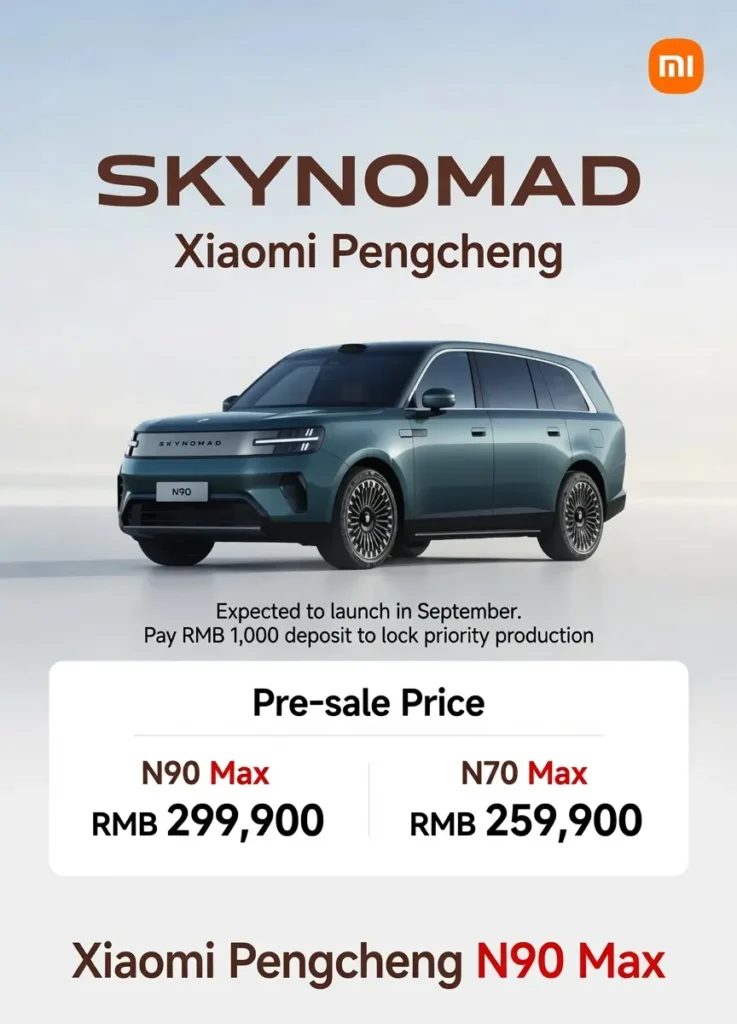
- The cars: N90 Max (7-seat flagship, 5,285mm, up to 1,705 km combined range) and N70 Max (5-seat, 505 km EV-only range). Both built on a 2.9-meter pure flat floor with sliding rails.
- The timeline: No pricing or launch date tonight. Showroom cars arrive this week. Sales expected mid-to-late August, with the factory reportedly holding 10,000+ pre-built units for launch-day delivery.
The Architecture: Why “Kunlun” Matters
Xiaomi calls it Kunlun — a name meant to evoke the mountain range that divides China’s geography, and a deliberate signal that this architecture divides Xiaomi’s product line. SU7 and YU7 sit on one side: driver’s cars, performance-first, pure electric. SkyNomad sits on the other: family space, utility-first, range-extended. Two brands, one company, zero overlap.
The Kunlun platform’s headline feature is a 2.9-meter pure flat floor — no transmission tunnel, no battery hump, just a continuous surface from the dashboard to the tailgate. To achieve this, Xiaomi’s engineers moved the rear motor, battery pack, and fuel tank into a layout that clears the cabin floor entirely. The angle is 2.95° — essentially level. Combined with a boxy interior shape (Xiaomi calls it “square architecture”), the cabin offers 4.4 m² of usable floor area on the N90 Max. That’s not interior volume — it’s walkable, usable square footage.
The N90 Max also supports an “extreme rearward” position for rows two and three, which expands second-row legroom to 1.55 meters and cargo space to 1,831 liters. A set of sliding rails runs the length of the floor. Front seats rotate 180°. The center console slides aft to serve the second row. Xiaomi’s pitch: a vehicle that transforms from a seven-seat family hauler to a mobile office to a camping suite without bolt-on accessories.
The following images were taken by the author at the press conference.
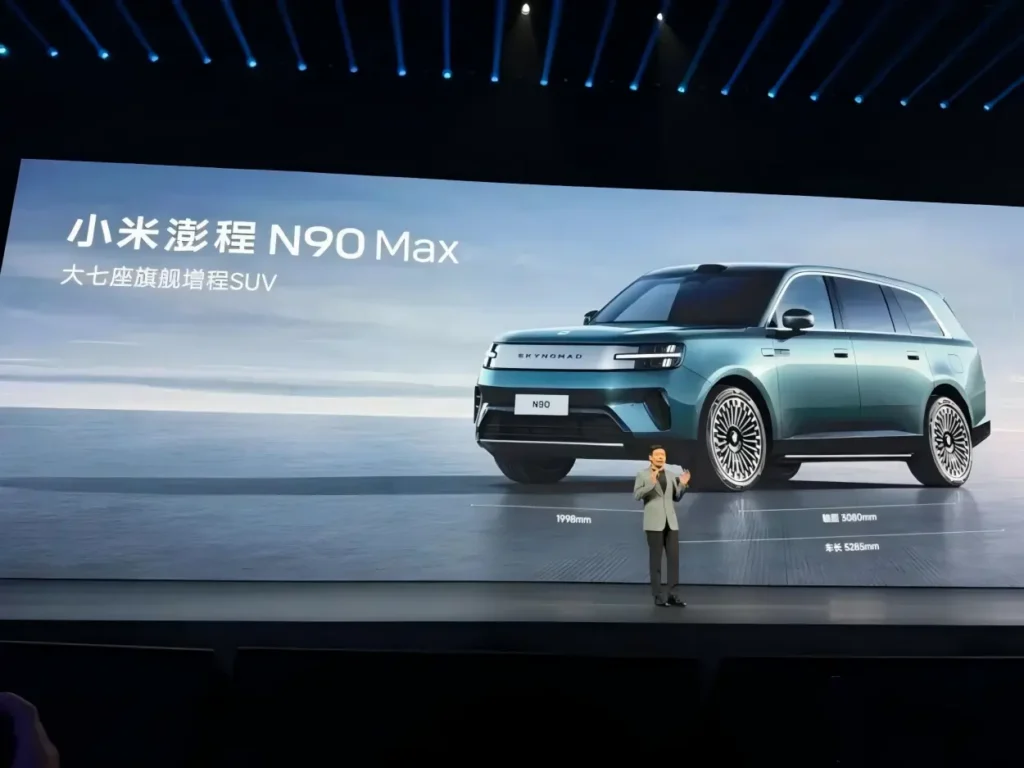
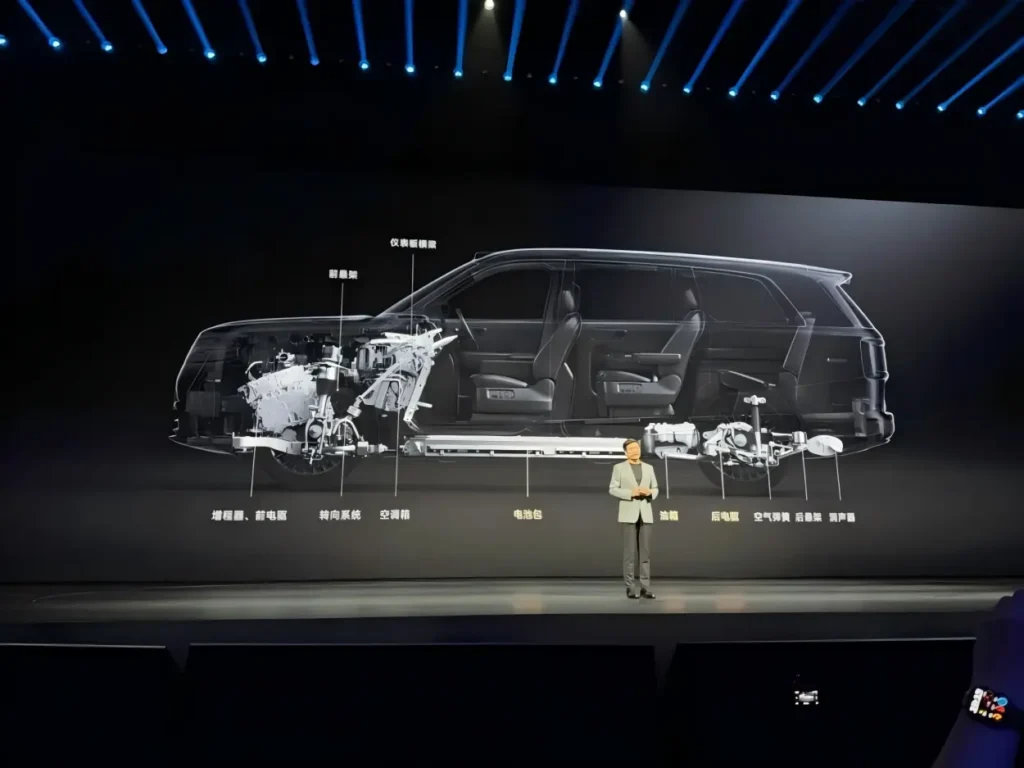
The Numbers: N90 Max vs. N70 Max
| N70 Max | N90 Max | |
|---|---|---|
| Seats | 5 | 7 (2+2+3) |
| Length / Wheelbase | 4,960 / 2,950mm | 5,285 / 3,080mm |
| EV Range (CLTC) | 505 km | 505 km |
| Combined Range | ~1,500 km | 1,705 km |
| Fuel Consumption | 5.7L/100km | 6.26L/100km |
| Battery | Up to 76 kWh (Long March Dragon Armor system) | |
| Range Extender | 1.5T 4-cyl (DongAn M15DRE, 112kW net, 44.3% thermal efficiency) | |
| Drivetrain | RWD or AWD | AWD |
| New Colors | Distant Mountain Green, Butterfly Valley Blue, Volcanic Ash | |
| Service Interval | 3 years / 30,000 km (range extender only) | |
The N90 Max’s 1,705 km combined range is the highest Xiaomi has ever quoted for a vehicle — and it claims it’s the best among any EREV SUV currently on the market. The battery system, named “Dragon Armor” (龙甲), is a Xiaomi-led design: the company specified the cell, designed the pack, and manages quality control across the supply chain. The 76 kWh pack feeds a 505 km CLTC EV range — usable as a pure-electric commuter for most owners, with the range extender as a long-trip safety net.
Safety: The “Armor Cage” and 2,200 MPa Steel
Xiaomi’s safety presentation was unusually specific for a tech preview. The “Armor Cage” (铠甲笼式车身) on the N90 Max uses 90.4% high-strength steel and aluminum, with 16 points reinforced with 2,200 MPa ultra-high-strength steel. The side structure is a single-piece hot-formed door ring spanning 3.3 meters long and 1.5 meters tall — covering all three rows and both A-through-D pillars. Xiaomi claims this increases side-impact load capacity by 19% compared to conventional multi-piece welding.
This is a direct response to the segment’s anchoring anxiety: a vehicle that carries seven people at highway speeds for 1,700 kilometers needs to survive a collision like a vehicle that carries seven people at highway speeds for 1,700 kilometers. Xiaomi is preempting the question before anyone asks it.
Why Xiaomi Is Doing This Now
The SU7 and YU7 have delivered 700,000+ cumulative units — a number Lei Jun cited during tonight’s keynote. That’s a pure-EV sedan/crossover portfolio that proved Xiaomi could execute on manufacturing. But it left a gap the size of a family living room: China’s largest and most lucrative passenger vehicle segment — mid-to-large SUVs for families — had no Xiaomi product.
SkyNomad fills that gap. The program started in early 2023, spent three and a half years in development, and logged 4.28 million kilometers of real-world testing across 566 test vehicles through 626 days — including -41°C in Heihe, 53°C in Turpan, and 5,380-meter altitude in Tibet’s Ngari region.
The timing is loaded. EREV wholesale volumes fell 13.1% in H1 2026, Li Auto’s deliveries dropped 5.1% from its full-year target pace, and the segment’s largest players are trading market share in a shrinking room. But Xiaomi has been telegraphing this pivot for months — spy shots of the N90 surfaced in June showing a full-size EREV SUV with a factory pop-up tent, and Lei Jun’s Weibo has been building anticipation with teasers since early July. Xiaomi is entering with a product that tries to change the game: not “a better Li Auto,” but “a different way to use the space inside an SUV.”
Author’s Take
The 1,705 km combined range number will get the headlines, but the Kunlun architecture’s flat floor is the real product story. Most EREV SUVs — including the Li Auto L9 and Aito M9 — have some degree of floor intrusion from the battery and drivetrain. It’s a packaging compromise that every automaker makes. Xiaomi refused to make it. A 2.9-meter continuous flat floor paired with rotating front seats and sliding rails isn’t a feature — it’s a product philosophy. It says the interior isn’t something you sit in; it’s something you use.
Whether that philosophy translates into sales depends on what Xiaomi charges for it. If N70 Max lands at ¥220,000-250,000 and N90 Max at ¥300,000-350,000 — which is where most predictions cluster — Xiaomi enters the segment with a true architectural advantage, not just a spec-sheet one. If the pricing overshoots, the flat floor becomes an expensive party trick. The 10,000+ pre-built units waiting at the factory suggest Xiaomi thinks the pricing will work. The next 30 days will tell us if they’re right.
The Bottom Line
Xiaomi’s SkyNomad line opens with two EREV SUVs built on the Kunlun architecture: a flat-floor, sliding-rail, rotating-seat platform that turns an SUV interior into 4.4 m² of programmable space. The N90 Max delivers 1,705 km of combined range in a seven-seat package. The N70 Max does 505 km of EV-only range in a five-seat package. Pricing and launch date are still unknown, but 10,000+ units are pre-built and showroom cars are arriving this week.
Xiaomi spent three and a half years on this architecture and logged 4.28 million test kilometers. The question now is whether Chinese families will buy a living room on wheels from a phone company — and whether Li Auto and Aito should be worried.
Sources & Further Reading
- Jimu News / Tencent — “Xiaomi Pengcheng Tech Event: N90 Max 1,705 km Range, Flat Floor Details” (July 30, 2026)
- Tencent News — “Kunlun Architecture: Dragon Armor Battery, Armor Cage Body” (July 30, 2026)
- Sina Auto — “Xiaomi Pengcheng Tech Event Full Preview” (July 27, 2026)
- Pacific Auto — “N70/N90 Full Specs Analysis” (July 27, 2026)