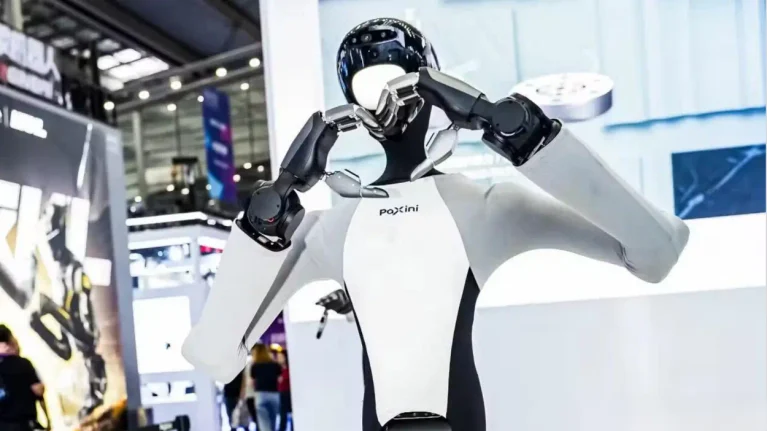


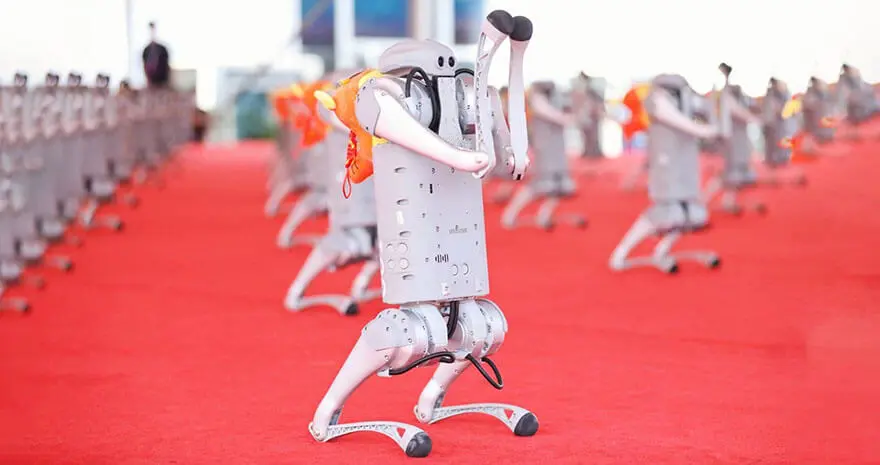
Beijing opens WRC 2026 on August 19, drawing 300+ exhibitors and 2,000+ displays to Beijing E-Town.
China’s robotics sector hit 900 billion yuan ($125 billion) in revenue through May, with humanoid exports surging 210%.
State authorities will launch a central-enterprise robotics alliance, pushing the industry from lab demos to factory floors.
Event at a Glance
| Item | Detail |
|---|---|
| Dates | August 19–23, 2026 |
| Venue | Beiren Etrong International Exhibition & Convention Center, Beijing E-Town |
| Theme | “Human-Robot Symbiosis, Industry-Demand Integration” |
| Exhibition area | 52,000 sqm across four halls |
| Exhibitors | 300+ (up 36% from 2025) |
| Displays | 2,000+ items (up 27%) |
| Debut products | 150+ (up 21%) |
| Parallel events | 60+ (doubled year-on-year) |
| International support | Nearly 30 organizations, including UNIDO, IFR, IEEE RAS |
| Contest participants | 10,000+ competitors, 6,000+ teams, 20+ countries |
Four Theme Days, Four Audiences
For the first time, each day of the conference targets a specific audience, according to the Beijing Municipal Government. August 19 is Release Day, reserved for major product launches and strategic announcements.
August 20 serves as Procurement Day, pairing suppliers with buyers across manufacturing, healthcare, and logistics. Organizers are framing it as a bridge between prototype and purchase order.
August 21 is Developer Day, bringing together programmers and engineers for technical workshops. The final two days, August 22–23, open to the general public.
SASAC to Launch Central-Enterprise Robot Alliance
The State-owned Assets Supervision and Administration Commission (SASAC) will announce the formation of a central-enterprise robotics innovation alliance on-site, according to organizers.
The alliance aims to pool resources from state-owned companies across energy, telecom, and manufacturing, building what officials describe as a “technology co-developed, scenarios shared, results mutually beneficial” ecosystem.
Separately, the conference will launch a Global Robotics Application Exploration Program, calling on leading manufacturers to submit mass-produced humanoid robots, quadruped robots, and dexterous hands for free trials by innovation teams worldwide.
A Robot Cooking Street and BCI Battles
In a bid to pull robotics out of the purely industrial, the conference will debut a Robot Shopping Street. Robotic chefs will prepare co-branded meals and beverages on-site, while mascot-themed merchandise goes on sale.
The World Robot Contest finals run concurrently. The Brain-Computer Interface competition will showcase mind-controlled humanoid robots, quadruped robots, and unmanned vehicles, with public experience sessions and a new WRC record challenge.
The contest draws more than 10,000 competitors from over 6,000 teams across 20-plus countries, covering coexisting-cooperative-cognitive robot challenges and youth design categories.
Who’s Exhibiting
The four exhibition halls, each 13,000 sqm, are segmented by function:
- Smart Innovation Hall (C): Humanoid robot makers including Unitree, Xinghaitu, UBTECH, Galbot, Cloud Deep, Fourier, and Accelerate. Regional innovation centers from Beijing, Shanghai, Zhejiang, Hubei, Guangdong, and Sichuan. The central-enterprise pavilion also sits here.
- Smart Integration Hall (B): International component brands including AMD, SMC, Infineon, Realtek, Robotis, NSK, Schaeffler, maxon, Faulhaber, and Harmonic Drive, alongside Chinese firms like Leju, Songyan Power, and Qianxun Intelligence.
- Smart Manufacturing Hall (A): Industrial and service robot companies including Luoer, CITIC Heavy Industries, Haier, Flexiv, Rokae, Clouduv, and Pudu.
- Smart Entertainment Hall: Public-facing demonstrations, consumer robots, and the robot cooking street.
Nearly 50 humanoid robot companies will show products, organizers said, with international brands ABB, KUKA, Festo, NVIDIA, and Qualcomm also confirmed.
Beijing E-Town as a Robotics Hub
The permanent host venue, Beijing E-Town, has built a robotics supply chain exceeding 20 billion yuan ($2.8 billion) in scale, housing more than 300 robotics and embodied-AI companies.
The district’s “1+X+N” industrial system centers on embodied-intelligence robots, with full-chain coverage of key components and a pipeline of end-product companies. The National Embodied Intelligence Robot Innovation Center is headquartered here.
Beijing’s broader robotics revenue grew from 15 billion yuan in 2023 to 51.8 billion yuan in 2025, an 85% compound annual growth rate. The city hosts more than 30 humanoid robot companies, accounting for over 20% of the national total.
Author’s Take
The WRC’s shift from spectacle to procurement is the real story. A dedicated Procurement Day and a SASAC-backed enterprise alliance signal that China is pushing humanoid robots past the demo stage and into real production lines — a transition that BYD and Xpeng are already testing in their own factories.
Source: World Robot Conference official site · Beijing Municipal Government