
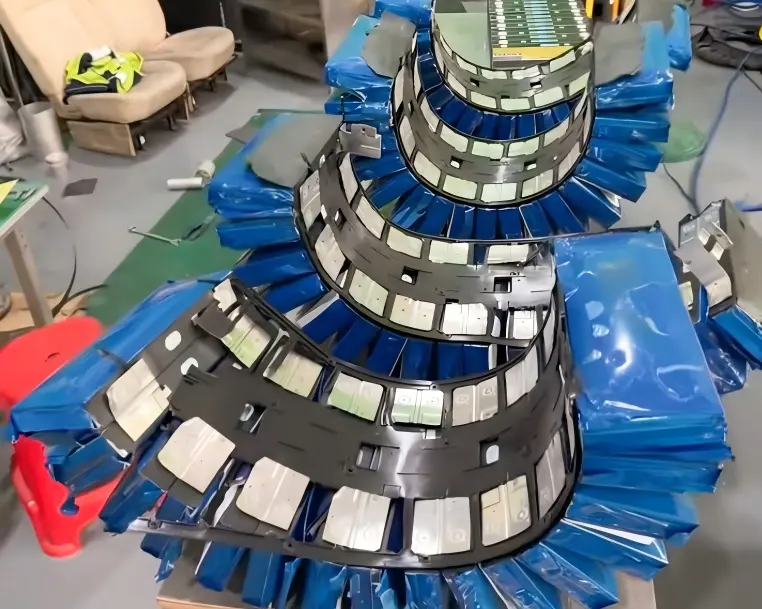
The “banana battery” saga has moved from damage control to root-cause search. On Aug. 10, cell maker CALB confirmed it is running a joint fault analysis with GAC Aion and talking to regulators. GAC Aion says it has filed a recall application, but as of Aug. 10 no official recall notice had been published. Roughly 213,000 vehicles are estimated to carry the affected 177Ah LFP cells.
The swelling, leaking battery packs that Chinese ride-hail drivers started calling “banana batteries” have forced the two companies behind them into a new phase. For weeks the response was warranty extensions and free repairs. Now both GAC Aion and its supplier CALB say they are finally trying to answer the question owners actually care about: why did this happen?
From damage control to root-cause search
CALB told China Business Journal on Aug. 10 that it is “jointly carrying out fault analysis and risk screening” with GAC Aion and is “maintaining timely and effective communication” with regulators and industry authorities to “restore the facts as soon as possible.” The wording matters. Until now, CALB had only acknowledged battery-system faults “under specific operating conditions” and opened a direct service channel. It had not published a final root cause and had not admitted a defined manufacturing defect.
GAC Aion, for its part, has framed the episode around owner protection rather than blame. Its July 18 apology letter extended the battery warranty on affected models from 8 years / 150,000 km to 8 years / 300,000 km, promised free testing and pack replacement for abnormal units, and added downtime subsidies for ride-hail drivers off the road more than five days.
The recall filing is moving — but slowly
GAC Aion’s after-sales head first told media on Aug. 5 that a recall application process has been launched. The company stresses that a recall is a strictly regulated act in China: an automaker cannot declare one on its own and must file a plan with the State Administration for Market Regulation. As of Aug. 10, no official recall announcement had been published.
That gap is the heart of the controversy. Owners and several industry commentators argue that a commercial warranty upgrade is not the same as a statutory recall, which would require disclosing the defect cause and notifying every affected vehicle. One consumer-rights platform put it bluntly: a “filing application” should not become a buffer that delays a mandatory recall.
Regulatory authorities have launched an investigation
This is no longer just a two-company problem. On July 24, the Ministry of Industry and Information Technology’s equipment department conducted an on-site inspection at GAC Aion, focused on production consistency and safety, and pulled battery samples for testing. With a regulator inside the loop, the eventual outcome — root-cause report, possible formal recall, or both — will carry official weight rather than being left to corporate statements alone.
What we know about the fault
The affected component is CALB’s 177Ah LFP prismatic cell, fitted mainly to AION S vehicles built in 2022–2023, largely used as ride-hail cars. Drivers reported swollen and leaking cells, insulation faults, and sudden power loss, typically after 150,000–250,000 km — just past the original warranty cliff. Third-party teardowns pointed to internal manufacturing defects after ruling out crash or flooding, though neither company has confirmed that finding. Industry estimates put the affected population at about 213,000 vehicles (a third-party figure, not an official count). We covered the outbreak itself in July — see our earlier report on CALB battery defects in the Aion S.
Why owners are still uneasy
Even with service channels open, some owners say dealers refused coverage by citing normal cell-voltage deviation — a metric one battery expert noted cannot capture swelling. And because the recall’s legal subject is the automaker, not the cell supplier, GAC Aion is on the hook for costs first; it can then seek recourse from CALB under procurement contracts. If a batch defect is ultimately confirmed, CALB could face significant downstream claims. The cell maker has also reportedly tightened internal manufacturing controls and stopped supplying this cell to the AION S line.
Author’s Take
The interesting shift here is semantic but real. “We’ll repair it” became “we’ll find out why.” For a supply chain this concentrated, a root-cause report from the automaker and its tier-1 cell supplier — under regulator eyes — is worth more than another warranty extension, because it sets the precedent for how China’s EV industry handles batch battery failures as fleets age. The open question is timing: a probe with no published deadline, paired with a recall “application” that isn’t yet an order, leaves 200,000-plus drivers in limbo. That limbo, not the repair itself, is what erodes trust.
The Bottom Line: CALB and GAC Aion have moved from patching packs to investigating causes, and a recall filing is in motion — but until a formal recall notice lands and a root cause is published, the 177Ah “banana battery” story stays unresolved for the owners still driving on swollen cells.
Sources
- CALB response to China Business Journal (Aug. 10, 2026) — joint fault analysis and regulator communication — qq.com
- 36Kr / Next-Gen Auto Lab, “GAC Aion confirms recall application process launched” (Aug. 5, 2026) — 36kr.com
- GAC Aion & CALB July 18 warranty / service announcements, reported by Sina — sina.cn
- Related: CALB battery defects in the Aion S — China EV Dispatch (July 19, 2026)
- Background (English): CALB 177Ah Battery Faults: What GAC Aion Confirmed — BYDToday