

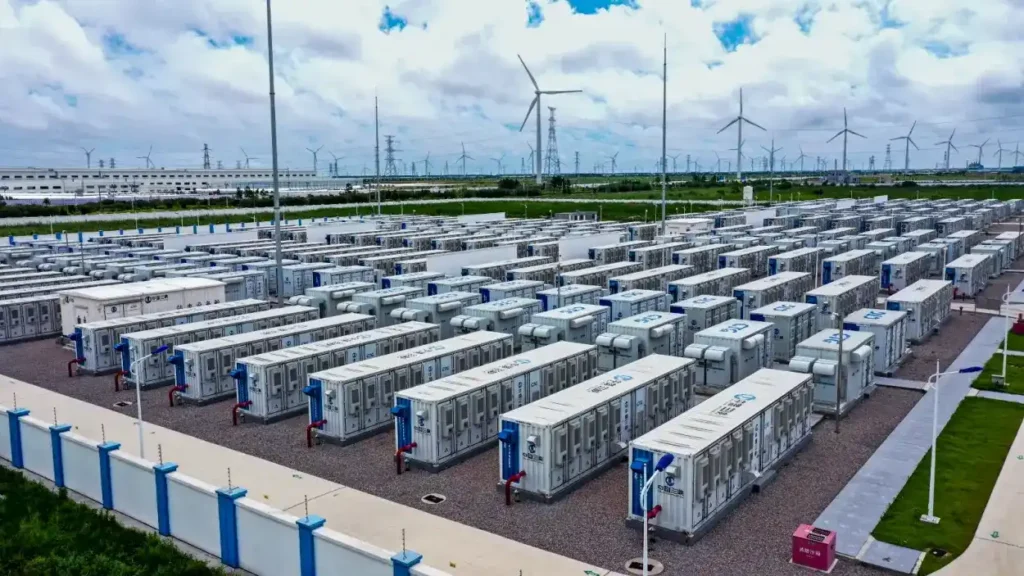
The headline number is $1.4 billion. The dates are the more interesting part. Jupiter Power’s four battery storage financing packages closed between April and July 2026 and were announced together on September 16 — so what arrived this month was a portfolio summary, not a fresh commitment of capital.
The transactions cover ten utility-scale battery projects in Texas and Michigan totalling 1,500 MW / 3,600 MWh, as the company’s own announcement sets out, and they lift Jupiter’s total financings since it was founded in 2017 to more than $3 billion. Jupiter says it now holds 5.6 GW / 19.7 GWh operating, in construction or under contract, with another 23 GW in development across the major US power markets.
What the Four Jupiter Power Financings Actually Are
Four closings, four different structures, and not one capital stack applied across the portfolio.
| Closed | Amount | Structure | Projects | Lenders |
|---|---|---|---|---|
| Jul 2026 | $536m | Construction term loan, tax equity bridge loan, letters of credit | Tidwell Prairie II, Bee Branch, Barton Branch (Texas) | HSBC Bank US, SMBC |
| Jun 2026 | $281m | Senior secured notes plus letter of credit facility, rated BBB− by KBRA | Tidwell Prairie I, St. Gall II (Texas), Tibbits (Michigan) — operating assets | Note purchasers AB CarVal and Nuveen; placement agents Barclays, HSBC Securities |
| May 2026 | $294m | Construction term loan, tax equity bridge loan, letters of credit | Grand Basin, Voyager I (Michigan, MISO) | ING Capital, Societe Generale |
| Apr 2026 | $258m | Senior secured facility | Callisto II, Pamela Heights I (Harris County, Texas) | Societe Generale, MUFG as coordinating lead arrangers |
Read the column on the left together with the third one and the logic appears. Seven of the ten projects are Texas and three are Michigan. And only seven of the ten are being financed for construction — the June package is secured against three batteries that are already running.
Why This Battery Storage Financing Looks Different
The four packages escalate with asset maturity, which is how a storage portfolio is supposed to grow up: construction debt and tax equity bridge loans while equipment is being delivered and installed, then longer-term paper against operating cash flow once the commissioning risk is gone.
The tranche worth studying is the smallest but one. In June, Jupiter issued $281 million of senior secured notes in a US private placement rated BBB− by Kroll Bond Rating Agency, collateralised by Tidwell Prairie I and St. Gall II in Texas and Tibbits in Michigan. That is investment-grade, rated term debt raised against the revenue of batteries that are already dispatching — a different proposition from lending against a construction schedule.
Solar did this a decade ago and storage is now doing it, which is what the industry has been waiting for: lenders willing to price a battery as an operating asset rather than a construction bet. The tax equity bridge loans in the other three packages are the other half of that plumbing — US tax credits are monetised through tax equity investors, and the bridge covers the gap until they come in.
Seven in Texas, Three in Michigan — and Two Different Businesses
The geography is not decoration. Jupiter’s Texas assets sit in ERCOT, where batteries are paid mainly for energy arbitrage and ancillary services and carry the wholesale price risk themselves. Its Michigan assets sit in MISO, where storage build-out leans more heavily on long-term utility contracting. A developer holding both is running a hedge, not a single strategy, which is exactly what ING Capital’s Scott Hancock pointed at when he described “the growing geographic diversity of the battery storage sector”.
The Texas side of that is growing fast. Installed battery capacity in ERCOT reached roughly 14.96 GW / 24.6 GWh in early 2026, up from about 7.8 GW a year earlier, according to Modo Energy grid data reported by ESS News — a market that has roughly doubled in twelve months.
One figure in Jupiter’s own numbers is worth holding on to, though. At 1,500 MW and 3,600 MWh, the portfolio averages 2.4 hours of duration. For all the talk about longer-duration storage — sodium-ion cells, iron-air, eight-hour chemistries — the capacity that actually gets financed in the US in 2026 is still being built in roughly two-hour blocks, because that is where the revenue is. Other parts of the flexibility market are scaling from a different direction — China is pushing vehicle-to-grid capacity toward a 50 GW target by 2030, which would meet some of the same need straight from cars rather than from containers.
Where the Money Comes From
Look at the lender column again. HSBC Bank US, SMBC, MUFG, Societe Generale, ING Capital, and Barclays and HSBC Securities as placement agents: the construction risk on this much US grid infrastructure is being carried by British, Japanese, French and Dutch bank groups rather than by American ones. The rated notes in the June package went to two US asset managers, AB CarVal and Nuveen.
That split is not unusual in project finance, but it lands in a year when the equipment side of the same projects is under new pressure. The US restricted imports of inverters, transformers and other grid equipment in August on grid-security grounds, and transformer and power-conversion supply was already the tight end of the market — the same shortage driving new transformer products for AI campuses. On the cell side, Chinese storage cell prices moved in the opposite direction to the long-run trend this year. Financing a battery is one problem; getting the boxes, the power conversion and the switchgear on site on schedule is another.
Jupiter has been returning to the market steadily rather than in one move. In January 2026 it closed a $500 million green loan facility, and the four transactions announced this week take the cumulative total past $3 billion — a pace that says as much about the developer’s access to capital as about the storage market itself.
What the Numbers Do Not Say
A few things are worth being explicit about, because the headline invites the wrong reading.
$1.4 billion is not the cost of 3,600 MWh. The figure spans construction debt, short-term tax equity bridge facilities, letters of credit and a refinancing of three assets that were already operating. Dividing it by energy capacity produces a number that means nothing, and we have not done it.
The announcement also does not give commercial operation dates, revenue expectations, the contracted-versus-merchant split project by project, the equipment suppliers, or how much of the 1,500 MW is energised today. Like most portfolio announcements of this kind, it is a financing disclosure, not an operating disclosure.
And the pipeline dwarfs what was financed. Jupiter is developing 23 GW; these four packages convert 1.5 GW of it into funded construction. The binding constraints on US storage are not development rights or demand — they are capital, interconnection and equipment, in some order that changes by market.
Sources & Further Reading
Accuracy note: The financing amounts, structures, lenders, note purchasers, project names and capacity figures are as stated in Jupiter Power’s own announcement of September 16, 2026, which covers transactions closing between April and July 2026; where the trade press has given a different headline capacity (1.6 GW in one report, 3.8 GWh in another) we have used the company’s figures of 1,500 MW and 3,600 MWh. The 2.4-hour average duration is our calculation from those two figures and is an average across projects with different configurations, not the duration of any single asset. Jupiter’s portfolio and pipeline figures (5.6 GW / 19.7 GWh; 23 GW) are the company’s own and cover assets at different stages of delivery certainty, as the announcement states. The ERCOT capacity figures come from Modo Energy grid data as reported by ESS News and are not independently verified by us. The January 2026 $500 million green loan facility and the description of August’s US restrictions on imported grid equipment are as reported by the trade press; we have not seen the underlying filings. Jupiter Power has not published revenue, contracted-versus-merchant splits or commercial operation dates for these projects, and we have not estimated them.
Sourcing note: The primary source is Jupiter Power’s announcement, which we read directly, including the statements from Jesse Campbell, the company’s chief financial officer, and from SMBC, ING Capital, Societe Generale and MUFG. Capacity and market context come from ESS News, Electrical News, Power Technology and Energy-Storage.news, which we read but did not rely on for any figure the company states.
- Jupiter Power — “Jupiter Power Secures $1.4 Billion in Project Financing for Ten Utility-Scale Battery Energy Storage Projects” (2026-09-16) — the four transaction sizes, structures, lenders, note purchasers, project names, the 1,500 MW / 3,600 MWh portfolio total, the $3 billion lifetime figure and the company’s current portfolio and pipeline.
- ESS News — “Jupiter Power secures $1.4 billion in financing for 1.5 GW energy storage portfolio” (2026-09-17) — the Modo Energy ERCOT capacity figures used for market context.
- Electrical News and Power Technology coverage of the same announcement (2026-09-17) — the transaction-by-transaction breakdown and the January 2026 green loan facility. Listed without links as they restate the company’s disclosure.
- EVsays — related coverage: power equipment demand from AI campuses, Chinese storage cell pricing and battery storage investment in Europe for the wider cost and capital picture.