
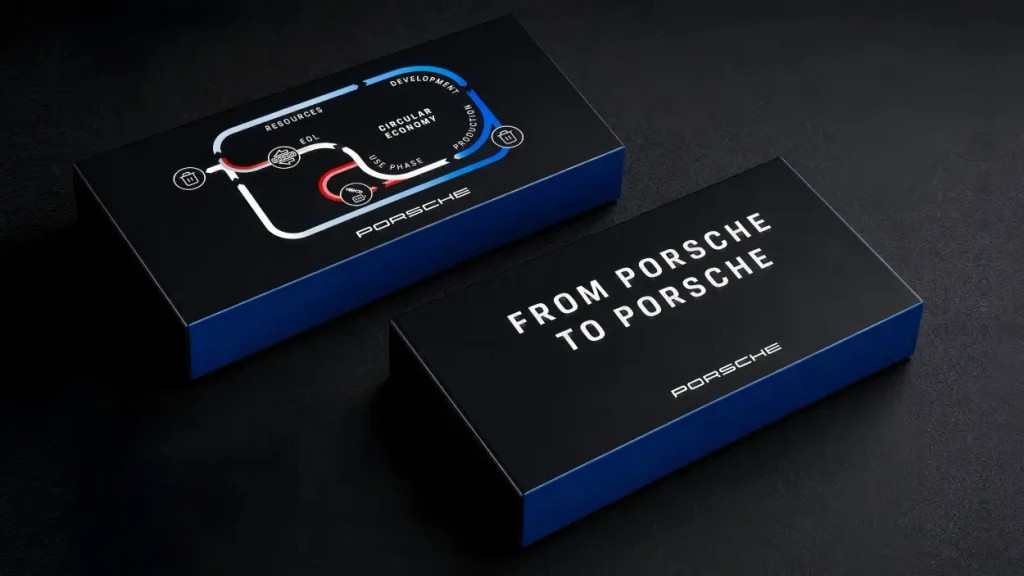
Porsche has produced battery cells whose cathode active material is made entirely from recycled raw materials — a first for the company, and one of the more concrete steps anyone has taken in battery recycling in Europe. The recycler behind it is one Porsche part-owns.
The cells use lithium, nickel, cobalt and manganese recovered from Porsche’s own end-of-life high-voltage packs, according to the company’s announcement on September 17, and are now under operational testing. The pilot began in 2025; this second phase is the one where recycled active material replaces primary material outright rather than being blended into it.
The arrangement is already running as an ordinary disposal route in parallel. Since May 2026, end-of-life batteries collected from Porsche Centres across Germany have been processed by the Aachen-based recycler cylib using a water-based process, and the recovered material is booked into what Porsche calls a dedicated material account. From 2028, that material becomes available to Porsche and selected partner companies for cell production.
What Porsche and cylib Actually Announced
The claim is narrower than the headlines it will attract, and it is worth stating precisely. Porsche has made cells — not a car — and the milestone is about where the material came from, not about how the cells perform.
“With battery cells made entirely from recycled raw materials such as lithium and cobalt, we have achieved an important technological milestone,” says Joachim Scharnagl, the Porsche executive board member responsible for procurement. The company says initial tests have indicated technical feasibility, and that further results are expected in the second half of 2026.
Dr. Lilian Schwich, co-founder and co-CEO of cylib, frames the same result from the other side: “The pilot project with Porsche demonstrates that our approach is feasible in practice: valuable raw materials from Porsche batteries at the end of their first life can potentially flow back into new high-performance batteries for Porsche vehicles.” Note the word potentially. Nothing here yet says the recycled material does the job as well as the ore-derived material it replaced.
The Recycler Porsche Part-Owns
Porsche’s involvement is not a customer relationship. cylib was founded in Aachen in 2022 by Dr. Lilian Schwich, Paul Sabarny and Dr. Gideon Schwich out of research at RWTH Aachen University, and its €55 million Series A in May 2024 was co-led by World Fund and Porsche Ventures, alongside Bosch Ventures and others — reported at the time as the largest financing round for a European battery recycling company.
Its process is called OLiC — Optimised Lithium and Graphite Recovery — and the company says it recovers more than 90% of the lithium, graphite, nickel, cobalt and manganese in battery packs, black mass or production scrap, with a carbon footprint about 80% below primary extraction. The industrial plant is at CHEMPARK Dormagen in North Rhine-Westphalia, funded partly by a €26.1 million EU grant and a €63.4 million German federal grant, and sized to reach 140,000 electric vehicle batteries a year by 2027 — roughly 60,000 tonnes of end-of-life batteries, or 20,000 tonnes of black mass.
This is the second time the process has been validated, and the first time on the automotive side. In January 2026, cylib said recycled lithium carbonate recovered from used nickel-rich packs had been qualified by a large, unnamed international battery manufacturer and was going into new electric vehicle batteries. That was a customer signing off. This is the vehicle manufacturer itself, feeding its own packs back into cells it intends to test in its own cars.
Why 2028 Is a Regulatory Date, Not a Marketing One
The dates in the announcement line up closely with the European Union’s Battery Regulation, and that is the more useful way to read it.
From 18 August 2031, electric vehicle and industrial batteries placed on the EU market must contain a minimum share of recycled material: 16% cobalt, 6% lithium and 6% nickel by mass. From 18 August 2036 the thresholds rise to 26% cobalt, 12% lithium and 15% nickel. The regulation also sets recovery duties — 50% of lithium from waste batteries by the end of 2027, rising to 80% by the end of 2031.
Compliance is not the only motive. Raw materials are the largest single swing factor in the cost of a cell — the same line that has been eating into Chinese automakers’ margins — and recycled content is one of the few levers that improves the cost base and the supply position at the same time.
Lay the four metals Porsche recovered against those numbers and the overlap is nearly complete: three of them — cobalt, lithium and nickel — are the ones a recycled-content mandate actually covers for a passenger EV battery. And it is not enough to do the chemistry. Recycled content has to be documented and auditable, which is what a material account is for. Read in that light, the “material account” is the part of this pilot with the longest shelf life: it is the plumbing that turns a recovered metal into a declarable number three years later.
Availability from 2028 leaves three years of slack before the first deadline. That is comfortable, and deliberate.
What the Announcement Leaves Out
Two gaps are worth naming, because they are the difference between a press release and a technology result.
Graphite and electrolyte are not mentioned at all. The release names four cathode metals. cylib’s own technology is named for graphite recovery, and graphite is arguably the material Europe has the strongest supply-security interest in, given how much of the world’s anode graphite is processed in one country. Whether anode graphite or electrolyte from these packs re-entered these cells is not stated, and we are not going to assume either way. It may simply be the next announcement.
There are no numbers. No cell count, no cell manufacturer, no cost per kilogram, no energy density, no cycle life, no production volume, no model. Porsche says results are due in the second half of 2026 — that period is now — and nothing has been published. Until then, the honest description of this milestone is: the material sourcing works, and the cell performance is unknown.
The Scale Question Facing European Battery Recycling
The Dormagen plant is designed for 140,000 vehicle batteries a year. Porsche’s own returns to Porsche Centres in Germany will be a small fraction of that, and they will arrive slowly, because a high-voltage pack usually outlives the car it was built into and then spends years in reuse or storage before it reaches a recycler.
That mismatch — recycling capacity being built in advance of the used batteries that will feed it — applies to the whole European sector, not to this project, and it is the reason automakers are being recruited as feedstock partners rather than just customers. The value of an arrangement like Porsche’s is that it secures a named, traceable stream from a specific dealer network: small, but documented, which is exactly what a recycled-content declaration requires.
There is a parallel answer to the same problem, which is to design batteries that need less of the hard-to-source material in the first place — the direction of anode designs that remove graphite from the cell entirely. Recycling and material substitution are competing uses of the same engineering effort, and Europe is currently funding both.
Sources & Further Reading
Accuracy note: The milestone, the four recovered metals, the 2025 pilot start, the May 2026 start of recycling for batteries collected from Porsche Centres in Germany, the material account and the 2028 availability date are as stated in Porsche’s own announcement. The quotes from Joachim Scharnagl and Dr. Lilian Schwich are as published there. cylib’s founding, the €55 million Series A co-led by World Fund and Porsche Ventures, the OLiC process, its stated recovery rates and carbon-footprint claim, the Dormagen plant and the grant amounts are from cylib’s own statements and press coverage of them; we have not independently verified the recovery rates or the carbon figure. The 2027 capacity figures for Dormagen (140,000 batteries, 60,000 tonnes of end-of-life batteries, 20,000 tonnes of black mass) are the company’s target and describe a plant still under development. The EU recycled-content thresholds, the recovery-efficiency duties and their dates are taken from the Battery Regulation as published; we have summarised them rather than quoted them. Porsche has disclosed no cell count, cell supplier, cost or performance data, and we have not estimated any. The observation that graphite and electrolyte are absent from the announcement is a reading of the text, not a statement that they were not recovered.
Sourcing note: This article is based on Porsche’s newsroom release of September 17, 2026, which we read directly, together with cylib’s own company statements and reporting by electrive, Recycling International and Silicon Canals on cylib’s funding and industrial plans. We have not seen the pilot’s test data, and we have not spoken to either company. The internal links point to our own earlier coverage of battery life, anode chemistry and raw-material costs; our editorial standards are set out in our editorial policy and corrections are handled under our correction policy.
- Porsche Newsroom — “From Porsche to Porsche: Next Milestone in Battery Recycling” (2026-09-17) — the milestone, the recovered metals, the material account, the 2028 date and the quotations from Scharnagl and Schwich.
- European Union — Regulation (EU) 2023/1542 on batteries and waste batteries — the recycled-content thresholds applying from 18 August 2031 and 18 August 2036 and the recovery-efficiency duties, summarised in the text above.
- cylib company announcements (2024–2026) — the Series A and its investors, the OLiC process and its stated recovery rates, the Dormagen plant, the EU and German grant funding, and the qualification of recycled lithium carbonate by an unnamed battery manufacturer in January 2026.
- electrive, Recycling International and Silicon Canals — reporting on cylib’s funding, plant capacity and lithium recovery work, used for context on the industrial scale-up.
- EVsays — related coverage: how long EV batteries last, raw-material costs inside Chinese automaker margins, and anode designs that do without graphite.