
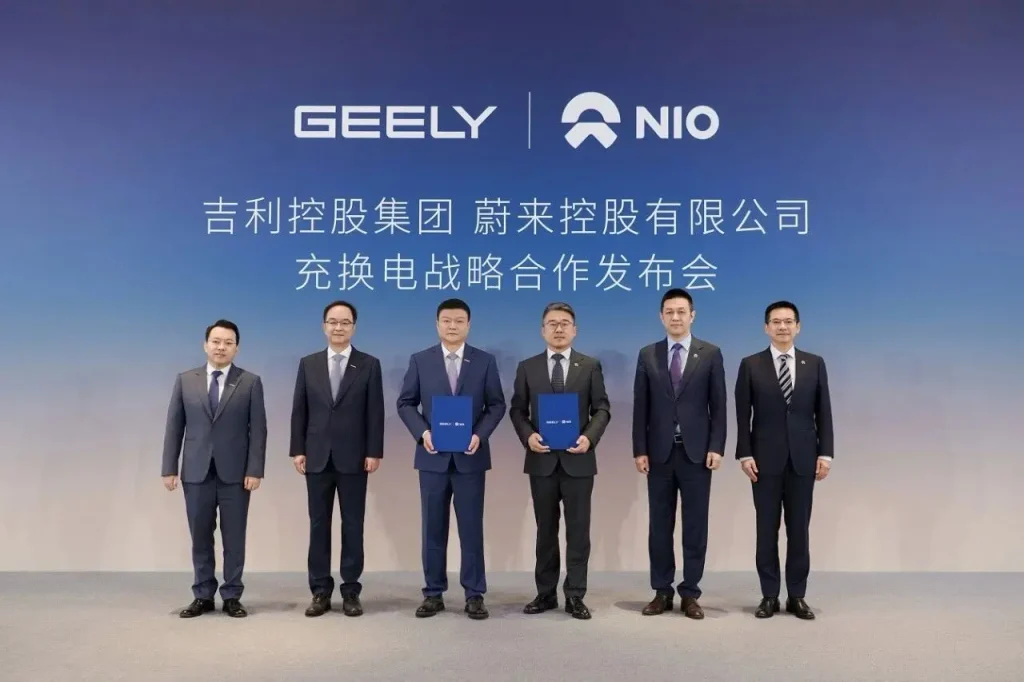
On September 28 in Hangzhou, Zhejiang Geely Holding and NIO settled a charging and swapping partnership the way infrastructure deals increasingly get settled: with cross-shareholdings rather than a memorandum. Geely Holding takes 30% of NIO Power, handing over its commercial-vehicle battery swap network operator Yiyi Interconnect plus RMB 640 million in cash. NIO takes 10% of Haohan Energy, Geely’s charging arm, and becomes the first car brand outside the group admitted to Geely’s Smart Charging network. The two companies are direct competitors in electric vehicles. That is the point.
Battery Swap Network Deal: What Each Side Actually Handed Over
The transaction runs in both directions at once and is best read as two asset transfers rather than one agreement.
In swapping, Geely Holding contributes 100% of Yiyi Interconnect, its commercial-vehicle swap operator, plus RMB 640 million in cash, and receives 30% of NIO Power. Yiyi Interconnect’s fleet-vehicle swap business is absorbed into NIO Power, which takes over its operation. The two sides will then build a common consumer-facing swap technology and standard — and crucially, Geely Holding will develop passenger cars with swappable packs, which NIO Power will service. That last clause is the substantive one: Geely is committing to build vehicles around NIO’s swap architecture rather than merely feeding its existing fleet through it.
In charging, NIO buys 10% of Haohan Energy, Geely’s charging subsidiary, and the two networks interconnect. Roughly 10,000 of NIO’s own charge guns join Geely’s Smart Charging platform, making NIO the first external car brand on it. Geely’s own release describes Haohan as having already merged the charging maps of Zeekr, Lynk & Co and Galaxy — the NIO deal is where that consolidation stops being an internal exercise.
The agreement was exchanged by Geely Holding’s rotating president Dai Qing and NIO’s chief financial officer and NIO Power head Qu Yu, witnessed by Geely Holding chief executive An Conghui, Geely Auto Group chief executive Gan Jiayue, and NIO’s Li Bin and Qin Lihong. Both companies framed it as a response to national industrial policy for intelligent connected new-energy vehicles and to what they call anti-involution — the Chinese industry term for competition that destroys value. An Conghui’s line was that the charging network is “public infrastructure for the whole society, and it should be co-built, shared and interconnected”.
The Numbers Each Side Brought to the Table
The scale asymmetry is the interesting part of this deal. NIO has spent more than RMB 20 billion on charging and swapping infrastructure and has built the largest passenger-car swap network in the world. Geely has the larger charging footprint and the larger vehicle base, but a much smaller swap business.
| NIO (as of 27 September 2026) | Geely Holding | |
|---|---|---|
| Swap stations | 4,126 | 420+ (Yiyi Interconnect, 50+ cities) |
| Charging stations | 5,307 | 2,500 (Haohan, 232 cities) |
| Charge guns | 30,598 | 12,000+, of which 7,000+ fast |
| Sessions delivered | 220m total, 125m of them swaps | Not disclosed |
| Cumulative investment | Over RMB 20bn | Not disclosed |
| Stated target | 10,000 swap stations by 2030 | 22,000 charge stations / 100,000 guns by end-2027; 150,000 / 600,000 longer term |
Geely’s charging target is aggressive on its own terms: 2,500 stations today against 22,000 by the end of 2027 is close to a ninefold build in fifteen months, and the company pairs it with a promise of county-level coverage nationwide. Gan Jiayue framed the consumer offer as a three-kilometre charging circle — within two kilometres in core urban districts of first-tier cities, 2.5 in second and third-tier cities, three elsewhere.
What 100 Billion kWh a Year Would Mean
Buried in the announcement is the number that turns this from a car story into a power story. NIO Power expects its swap network to carry annual electricity demand of more than 10 billion kWh once the 10,000 stations are built.
Run that through the station count and it works out to roughly one million kWh per station per year, or about 2,740 kWh a day. That is a reasonable duty cycle for a station serving commercial fleets and private owners in a dense market, and it explains why the fleet business Geely is folding in matters: utilisation is what makes a swap station pay. For scale, 10 billion kWh is 10 TWh — about 0.1% of China’s entire electricity consumption, which the IEA put at 10,310 TWh of net demand for 2026 in its mid-year electricity update. A single carmaker’s swap network drawing a thousandth of a national grid is the clearest signal yet that charging infrastructure is becoming a utility, with the load profile to match.
NIO’s existing network gives a sense of how far utilisation has to travel. Across 4,126 stations, the company has delivered 125 million swaps — an average of about 30,300 per station since each opened, which sounds large until it is spread over years of operation. The swap model’s economics depend on getting that daily figure up, and folding in Geely’s fleet customers is a direct attack on it.
Why Two Competitors Signed This
Geely Holding’s senior vice president for communications and public relations, Victor Yang, made the case in a signed commentary distributed with the announcement, and it is worth quoting because it is the clearest statement of the logic either side has offered: “No single company can create a simple, reliable energy experience on its own. Both charging and swapping benefit from network effects.”
The economics behind that are not subtle. Charging and swapping are heavy-asset businesses with long payback periods. When every brand builds its own network, capital is duplicated, sites sit underused and the industry carries a cost it cannot recover from drivers. Geely’s own framing is that merging the two networks cuts duplicate investment and lifts asset utilisation — and that the asset base being merged is complementary rather than overlapping, because NIO brings passenger-car swap technology, private-owner operations and a premium user base, while Geely brings scale, cost structure, a four-brand vehicle matrix and the commercial-vehicle and robotaxi operating scenarios that come with Cao Cao Mobility.
The approach contrasts sharply with the other Chinese strategy in this market. BYD has been building out flash charging on its own, passing 10,000 stations in August, and treating network scale as a brand asset rather than an open platform. Geely has now taken the opposite bet: open the network, admit a competitor, and make the platform the product. Its Smart Charging launch three weeks earlier — the 2,250 kW station and AI charge management covered here — was the technology pitch. This is the distribution pitch.
What the Announcement Does Not Say
Four things are missing, and each of them will decide whether this is as significant as it looks.
The first is a valuation. Neither side disclosed one. The cash component gives a floor rather than a price: if RMB 640 million in cash is part of the 30% stake in NIO Power, then 30% of NIO Power is worth at least RMB 640 million, implying a total of at least RMB 2.13 billion, or about $294 million. That is our arithmetic on a partial disclosure, not a figure either company published — and given that NIO has spent more than RMB 20 billion building the infrastructure being bought into, it is a long way below the capital invested.
Second, there is no closing date, no list of regulatory approvals and no statement of conditions. Third, Geely has committed to developing consumer swap models without naming a brand, a platform or a timeline. And fourth, there is no mechanism for admitting further carmakers, despite the rhetoric about public infrastructure — which raises the obvious question of whether this is an open platform or a two-member club that will grow only on both members’ terms.
The Bottom Line: Geely Holding takes 30% of NIO Power with 100% of Yiyi Interconnect plus RMB 640 million in cash, and NIO takes 10% of Geely’s Haohan Energy, connecting roughly 10,000 NIO charge guns to Geely’s Smart Charging platform as its first external brand. Geely commits to building consumer models with swappable packs, and the battery swap network NIO Power runs targets 10,000 stations by 2030 carrying more than 10 billion kWh a year — about 0.1% of China’s electricity consumption. No valuation, no closing date and no second external brand were disclosed.
Notes: Every figure here is a company statement from the announcements of 28 September 2026, and no financial detail beyond the RMB 640 million cash component was disclosed — no valuation, no completion date, no closing conditions. The implied floor on NIO Power’s valuation, the per-station electricity figures, the 0.1%-of-China comparison and the average swaps per station are our arithmetic on disclosed or IEA figures, not company numbers. Victor Yang’s commentary is a signed column by a Geely Holding executive and is quoted as argument rather than as fact. EVsays did not attend the signing. See our editorial policy and correction policy.
Sources & Further Reading
- China Securities Journal / cnstock (中国证券网) — “吉利控股集团与蔚来公司达成充换电领域全面战略合作” (2026-09-28) — the signing, the parties who exchanged and witnessed the agreement, the two-way equity terms, and the full quotations from An Conghui and Li Bin.
- CNR (央广网) — “蔚来公司与吉利控股集团达成充换电战略合作” (2026-09-28) — the structure of both share issues, the Yiyi Interconnect transfer, the joint consumer swap standard and Geely’s commitment to develop swappable consumer models.
- China Economic Net (中国经济网) — “蔚来与吉利充换电领域全面战略合作 互持旗下能源公司股权” (2026-09-28) — the 2030 swap-station and electricity-demand figures, Geely’s end-2027 charging targets, and Gan Jiayue’s three-kilometre charging circle.
- China.com (中华网) — “吉利控股集团CEO谈换电与快充 共筑开放合作新生态” (2026-09-28) — NIO’s cumulative infrastructure investment of over RMB 20 billion, its 9,433 charging and swap sites, and the 220 million cumulative charging and swapping sessions.
- China Economic Times (中国经济新闻网) — “吉利与蔚来达成战略合作:蔚来成为首家接入吉利智充网络的车企品牌” (2026-09-28) — Yiyi Interconnect’s 420-plus swap stations across 50-plus cities, the robotaxi and smart-transport extensions, and Geely’s longer-range 150,000-station plan. Consulted without hyperlink.
- IEA — Electricity Mid-Year Update 2026 — the figure for China’s net electricity demand used in the scale comparison above.
- Victor Yang, Senior Vice President, Communications and Public Relations, Zhejiang Geely Holding Group — signed commentary on the cooperation, September 2026. Consulted as commentary; not linked.
- EVsays — the surrounding market: Geely’s Smart Charging launch, CATL’s move into Hong Kong swap, CATL’s heavy-truck swap partnership and NIO’s Shanghai battery plant.