

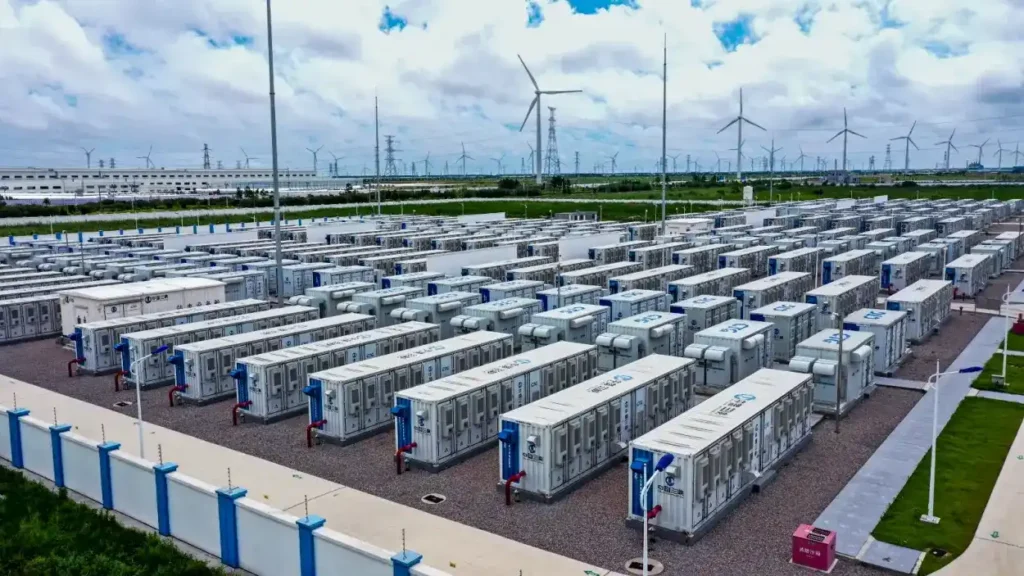
Two announcements five days apart show grid-scale battery storage pulling in opposite directions. In New South Wales, Akaysha Energy’s Waratah Super Battery entered final commercial operations at 850 MW and 1,680 MWh — the largest battery in Australia and, on rated power, the most powerful in the world. In Changzhou, Jiangsu, EnerVenue started up the first high-volume line for its aqueous metal cell, a lithium-free, water-based nickel-hydrogen chemistry designed for 30,000 cycles and a 30-year life, with a first commercial order of 11 MWh. One asset is built to move a lot of power for two hours. The other is built to sit still for three decades.
What Akaysha Actually Switched On
Waratah sits on the site of the former Munmorah coal-fired power station near Budgewoi, on the New South Wales central coast. It was commissioned by the state government through EnergyCo, and built, owned and operated by Akaysha Energy, a developer backed by BlackRock. The state confirmed the milestone in a joint media release on 28 September, alongside approval from the Australian Energy Market Operator to operate at full capacity.
The headline numbers are 850 MW of power, 1,680 MWh of energy, and enough output at peak to serve 340,000 New South Wales households. More than A$1 billion of private capital went in, and around 1,000 people worked on design and construction, including 170 on site at the peak. Hitachi Energy supplied and commissioned 288 power conversion systems and two power plant controllers, and holds a 20-year service agreement covering monitoring and diagnostics.
One detail in the partner list is worth flagging for anyone watching the supply chain: the cell suppliers named in the project’s acknowledgements are REPT Battero and EVE Energy. The most powerful battery in the world is built on Chinese cells — the same EVE Energy that has been signing supply frameworks of its own.
What Grid-Scale Battery Storage Sells Here: System Strength
The important thing about Waratah is what it is paid for. It is not primarily an energy arbitrage asset, buying cheap and selling dear. It is a contracted piece of grid protection.
The battery is wired into Transgrid’s System Integrity Protection Scheme, or SIPS, which monitors 36 transmission lines in real time and can trigger an injection of power within milliseconds when something goes wrong — a bushfire downing a line, a lightning strike, a trip at a generator. Akaysha’s own description of the asset is a “giant shock absorber”. The commercial obligation behind it is a contracted 700 MW of SIPS service to Transgrid.
That arrangement does something unusual: it lets existing transmission lines serving the Hunter, Sydney and Illawarra regions carry more power than they otherwise could, as a bridge until the Hunter Transmission Project connects inland renewable energy zones. In other words, the battery is standing in for a transmission upgrade. Storage as a substitute for network investment is a familiar idea in planning documents; this is one of the largest instances of it actually operating.
The contrast with the trading model is sharp. Australia’s national electricity market is one of the world’s most volatile, and the International Energy Agency’s mid-year electricity update recorded negative prices in more than 20% of trading intervals in South Australia and Victoria in the first half of 2026, with South Australia’s peak prices running above A$5,000/MWh in the first quarter — a spread that pays arbitrage batteries handsomely. Our write-up of that report covers the wider picture. Waratah earns its money on a different curve: not the price spread, but the value a transmission operator places on not losing the system.
The Transformer That Held the World’s Most Powerful BESS to 350 MW
Waratah’s path to this week was not clean, and the reason is instructive for anyone who thinks of a battery project as a battery problem.
In October 2025 the site suffered what Akaysha described as a catastrophic failure of High Voltage Transformer 3. The fault caused extensive winding damage and an overpressure event that ruptured the transformer tank wall, forcing the unit to drain itself into its bunded area; a second transformer was taken offline as a precaution. Output was capped at 350 MW — about 41% of rated capacity — for months, during which the project could only meet an interim, reduced SIPS obligation. An energy insurance broker, NARDAC, estimated the total loss at between A$50 million and A$80 million (roughly US$32 million to US$51 million), depending on how fast replacement transformers could be sourced.
The fix came from a domestic manufacturer. Wilson Transformer Company, working with Consolidated Power Projects Australia and independent consultants, delivered the replacement on a Q3 2026 timeline that avoided the 12–18 month lead times typical of internationally sourced specialist transformers. The unit first reached its full 850 MW on 7 September, and two days later discharged 701 MW in what industry reporting read as a test of its full contracted 700 MW SIPS obligation.
Read that sequence as a lesson about where storage projects actually break. The cells were fine. The chemistry was fine. The software was fine. A single piece of conventional grid hardware — the kind of equipment nobody writes milestones about — took the world’s most powerful battery down to 41% for most of a year.
In Changzhou: the Same Problem, the Opposite Bet
EnerVenue’s answer to storage economics starts from the opposite end. The company’s Aqueous Metal Cell uses nickel-hydrogen chemistry and a water-based, non-flammable electrolyte. The chemistry is not new: nickel-hydrogen cells have powered the Hubble Space Telescope and the International Space Station for decades. EnerVenue’s bet is that re-engineering it with cheap bulk materials makes it work on the ground.
The Changzhou plant opened on 24 September. The 20,000 square metre facility was completed 25 weeks after construction started in April, and its first phase is rated at 250 MWh of cells a year — roughly 300 fourth-generation cells a day at full automation. Capacity is planned at 1 GWh during 2027 and several gigawatt-hours by 2028, with space already allocated for a second phase of similar size. Every cell passes 41 quality checks across 11 testing stations.
The first commercial order, announced on 23 September, is 26 Energy Prism containerised units totalling 11 MWh, for an oilfield in northern China where they will store output from an on-site solar array. Three units ship in December 2026 and the remaining 23 in March 2027. The customer is a major Chinese oil and gas producer that has not been named.
Everything in the pitch flows from the cell’s chemistry. EnerVenue says the electrolyte cannot produce the self-accelerating reaction sequence that ends in thermal runaway, and that the design has passed UL 9540A with no cell-level propagation. That matters commercially because a working oilfield is one of the hardest places to install anything: EnerVenue’s chief executive, Henning Rath, argues the customer examined the safety case before considering performance or cost. The chemistry also means no active cooling and, where local codes allow, no fire suppression system, and the cell itself contains no lithium and no rare earths — mostly steel, nickel, glass-fibre composite and water. Nickel and steel are recoverable at end of life.
The number the company leads with is 30,000 cycles, equivalent to up to three full cycles a day for 30 years, against a typical lithium-ion figure of 8,000 to 10,000. EnerVenue’s claim is that this removes scheduled augmentation — that a lithium-ion site is typically replaced or expanded every seven to ten years while its cell needs nothing. That is a lifetime-cost argument, not a capex argument, and it is the whole thesis: the cell is not better per kilowatt-hour, it is claimed to be cheaper per decade. The company has raised more than US$700 million, including a US$300 million Series B extension in March led by Full Vision Capital.
Grid-Scale Battery Storage, Two Assets Side by Side
Put the two announcements next to each other and the arithmetic makes the split plain.
| Waratah Super Battery | EnerVenue Changzhou | |
|---|---|---|
| What it is | Operating grid asset | Cell manufacturing line |
| Power | 850 MW | Not a power product |
| Energy | 1,680 MWh | 250 MWh a year, phase 1 |
| Duration at rated output | 1.98 hours | Designed for energy, not peaks |
| Chemistry | Lithium-ion | Nickel-hydrogen, water-based |
| Revenue logic | Contracted grid services | Lifetime cost of stored energy |
| First commercial scale | A$1bn+ project, 340,000 homes | 11 MWh, 26 containers |
Three numbers from that table deserve to be stated plainly.
The first is 6.7 years. At 250 MWh a year, EnerVenue’s Changzhou line would have to run at full output for six and a half years to produce the cells for a single project the size of Waratah. Even at the 1 GWh the company plans for 2027, one year of production still would not fill one Waratah — 1,680 MWh is larger than the entire annual capacity. That is not a criticism of the technology; it is a measure of how far apart the two scales are. Grid-scale battery storage is now being deployed in units that a new entrant’s first factory cannot supply.
The second is 1.98 hours. Waratah is a power asset with a two-hour duration. It is built to answer a disturbance, not to shift a day’s solar into the evening. EnerVenue’s product line — 30 kWh Energy Core to 600 kWh–1 MWh Energy Prism containers — is aimed at the opposite job. These two announcements are not competitors. They are two different products serving two different constraints, and the storage industry’s habit of treating “battery storage” as one market hides that.
The third is 153 to 1. Waratah’s 1,680 MWh is roughly 153 times the size of EnerVenue’s first commercial order. A first multi-megawatt-hour order is a milestone; it is also a rounding error next to what is already operating.
The Bottom Line: Grid-scale battery storage split into two shapes this week. Akaysha Energy’s Waratah Super Battery entered final commercial operations on 28 September at 850 MW and 1,680 MWh, earning its revenue from a contracted 700 MW system-strength service to Transgrid rather than from energy arbitrage, after a transformer failure had capped it at 350 MW — 41% of rated output — for most of a year. Five days earlier, EnerVenue opened the first high-volume line for its lithium-free aqueous metal cell in Changzhou, rated at 250 MWh a year and scaling to 1 GWh in 2027, alongside an 11 MWh first order for an oilfield in northern China. The two announcements describe assets that do not compete: one is a two-hour power asset paid for grid security, the other is a 30-year energy asset sold on lifetime cost.
Notes: Performance figures are manufacturer claims — the 30,000-cycle design life and the no-thermal-runaway description all come from EnerVenue and have not been independently tested by EVsays. The duration, capacity-matching and order-size comparisons are our arithmetic on the figures above. The transformer loss estimate of A$50–80m comes from an insurance broker quoted in specialist trade reporting, not from Akaysha; the 7 and 9 September output figures come from market data reported by specialist trade press rather than from the project’s own announcements. The IEA price figures cited cover the first half of 2026. Where reporting is drawn from Chinese-language trade coverage it was cross-checked against company disclosures, and EVsays did not attend the Changzhou opening or the Waratah milestone. See our editorial policy and correction policy.
Sources & Further Reading
- Akaysha Energy — “Waratah Super Battery reaches final commercial operations” (2026-09-28) — the milestone itself: 850 MW / 1,680 MWh, the Munmorah site, the A$1bn-plus investment, the ~1,000 people involved, the EVE Energy and REPT Battero cell suppliers, and the Transgrid SIPS control system.
- EnergyCo (NSW Government) — “NSW flicks the switch on one of the world’s most powerful batteries” (2026-09-28) — the joint media release with AEMO’s approval to operate at full capacity, the 340,000-household figure, the 36 transmission lines under SIPS monitoring, and the state installed-storage and renewables context.
- EnerVenue — “EnerVenue opens aqueous metal cell production line in Changzhou” (2026-09-24) — the 20,000 m² plant, the 25-week build, phase-one 250 MWh capacity and the 300-cells-a-day rate, the 2027 and 2028 expansion targets, and the 41 quality checks across 11 stations.
- EnerVenue — “EnerVenue’s first multi-megawatt-hour commercial order” (2026-09-23) — the 26 Energy Prism units totalling 11 MWh, the northern China oilfield site and its solar pairing, the December 2026 and March 2027 delivery schedule, and the UL 9540A result.
- Hitachi Energy — “Waratah Super Battery reaches full capacity” (2026-09-28) — the 288 power conversion systems and two power plant controllers, and the 20-year HMAX service agreement.
- The Energy ST — “Multi-megawatt-hour commercial order to supply lithium-free storage” — the 30,000-cycle design life against 8,000–10,000 for lithium-ion, the no-augmentation claim, the absence of active cooling and fire suppression, and the six-market customer footprint.
- BEST Magazine — “EnerVenue opens 250MWh aqueous metal cell line in Changzhou” — the product line-up from the 30 kWh Energy Core to the containerised Energy Prism, the electric-bus demonstration at Jintan running since November 2025, and the memoranda signed at the opening with Towngas, Shanghai Electric, Guangzhou Development Group and Desert Technologies.
- China Industry News (中国工业新闻网) — “从油田到全球:屹创新能源首个多兆瓦时订单落地,常州新产线9月24日启用” (2026-09-25) — Chinese-language coverage confirming the Changzhou start-up date, the 30-year service life, the no-lithium and no-rare-earth material set, and the customer references at Radiance Energy, PowerSecure and Horizon Power.
- IEA — Electricity Mid-Year Update 2026 (published 23 July 2026) — the first-half price data behind the Australian arbitrage comparison: average prices down about 30% year on year, negative prices in more than 20% of intervals in South Australia and Victoria, and the Q1 South Australian peaks above A$5,000/MWh.
- Energy-Storage.news — “Akaysha Energy’s Waratah Super Battery tests full SIPS obligation as 850MW output recorded” — the 7 and 9 September output readings from Open Electricity data, the high-voltage transformer failure timeline, and the NARDAC loss estimate. (The site returned a 403 error to EVsays at the time of publication and is listed in text only.)
- EVsays — related coverage: IEA’s grid-enhancing technologies report, CATL’s 587 Ah storage cell pricing, Jupiter Power’s US$1.4bn storage financing, Hithium’s sodium-ion storage system and EVE Energy’s 206 GWh supply framework.