

Europe’s car market grew in the first eight months of 2026. Almost none of that growth came from Europe. Of roughly 500,000 additional Europe new car registrations between January and August, 419,000 came from Chinese automakers — 84% of the total — according to a new AutomotiveCompass analysis from Germany’s Center of Automotive Management. The same dataset records a second crossover: battery-electric cars outsold petrol-only cars across the continent for the first time.
Europe New Car Registrations: What the 84% Figure Means
The analysis covers the European Union, EFTA and the United Kingdom, using ACEA registration data, and was published by the Center of Automotive Management (CAM) under its AutomotiveCompass programme, which is led by Professor Stefan Bratzel. Total registrations rose 5.8% year on year, to 9.19 million cars. That is a healthy headline for a market that spent two years flat.
Strip out the Chinese automakers and it disappears. Every other manufacturer combined grew 0.3%. Without the Chinese increase, the analysis states, the European market would have grown less than 1%. One Chinese reading of the same ACEA dataset went further: in August alone, five Chinese groups added 45,766 cars while the entire market added 41,583 — meaning every other manufacturer combined was a net negative for the month by around 4,200 units.
The level, not just the increment, has crossed a line. Chinese automakers registered 1,034,685 cars in the eight months, up 68.1%, the first time they have passed a million in Europe. Their share went from 7.1% to 11.3% — a gain of 4.2 percentage points, or a 59% relative increase in a single year. Spread across the period, that is roughly 129,000 registrations a month.
BYD and Chery Have Overtaken Tesla in Europe
The growth is concentrated in a handful of names, and two of them now beat the most recognisable EV brand on the continent.
| Group | Jan–Aug 2026 registrations | Year on year |
|---|---|---|
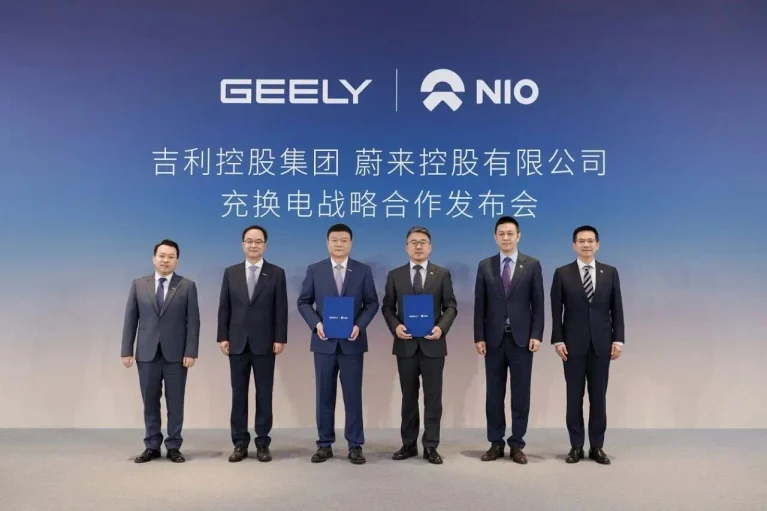
| Geely Holding | 289,000 | +11.6% |
| BYD | 234,099 | +144.1% |
| SAIC Motor (MG) | 230,000 | +19.7% |
| Chery, including Omoda and Jaecoo | 207,871 | +280% |
| Leapmotor | 73,000 | +450% |
| Tesla (comparison) | 191,787 | — |
BYD and Chery together registered 441,970 cars, about 2.3 times Tesla’s European total. In August, the five Chinese groups combined sold 103,000 cars, ahead of the Renault Group and behind only Volkswagen and Stellantis — a year ago they ranked seventh. Two other milestones landed earlier: in May 2026 Chinese brands outsold Japanese brands across 31 European markets for the first time, and they repeated it in June. BYD took the UK’s battery-electric sales crown in the first four months of the year.
Crucially, this is not one strategy repeated five times. Geely Holding is the largest and slowest — because much of its European volume is really European, sold through Volvo, Polestar, Lynk & Co and smart. BYD is growing fastest off a smaller base and selling plug-in hybrids alongside its BEVs. Chery is doing it with multiple brands stacked on one distribution machine. Leapmotor’s 450% comes from a distribution deal with Stellantis, not from its own network.
The Crossover: BEVs Outsold Petrol Cars for the First Time
The second structural shift in the same dataset may matter more than the first. Battery-electric registrations rose 38.8% to 2.13 million, taking 23.2% of the market, while petrol-only registrations fell 17.5% to 1.97 million and diesel dropped 19.0%. It is the first time electric cars have outsold pure petrol cars in Europe.
Within the EU-27 the gap is finer — 1.641 million electric against 1.635 million petrol, both at 21.7% — which tells you the crossover is real but thin, and that hybrid is the actual volume winner. Hybrids hold 36.6% of the European market, and in August electric took 27.7% against petrol’s 18.9%.
The country spread is where the next phase of this market lives. Norway is effectively finished as a combustion market at 98% electric, Denmark sits at 81%, and the big markets are converging quickly: France near 30%, Germany 26.2%, the UK 25.6%. Then there is Italy at 8.0%, where buyers are still choosing conventional hybrids — and where the growth that is happening is coming from plug-in hybrids rather than battery-electric cars.
What the 1.03 Million Figure Does Not Say
Three caveats belong next to these numbers.
The first is definitional, and it cuts against the headline’s drama. “Chinese automakers” here means Chinese-owned groups, and ACEA’s attribution puts Volvo, Polestar, smart and Lotus inside Geely Holding’s total. That is why the largest Chinese group in Europe is also the slowest-growing one at 11.6%: a substantial part of what it registers are European brands with European heritage. The one-million milestone is a statement about ownership, not about cars built in China — and both are different from the narrower question of how fast Chinese-origin brands are winning European buyers.
The second is data maturity. ACEA’s 2026 registration figures are preliminary and get revised, so the exact percentages will move.
The third is where the growth is coming from. The mix is tilted towards plug-in hybrids, which are not subject to the European Union’s countervailing duties on China-built battery-electric vehicles — a structure that explains why southern Europe is going plug-in first. Whether the growth continues at this rate depends on two things this dataset cannot answer: how the trade measures evolve, and how far plug-in hybrids can run in markets like Italy before charging infrastructure becomes the constraint.
The Bottom Line: Europe new car registrations rose 5.8% in January to August 2026, and 84% of that growth came from Chinese automakers, who passed one million European registrations for the first time and lifted their share from 7.1% to 11.3%. BYD and Chery have each overtaken Tesla in the region. In the same period battery-electric cars outsold petrol-only cars in Europe for the first time, 2.13 million to 1.97 million. The number counts Chinese-owned groups, which per ACEA includes Volvo, Polestar, smart and Lotus — ownership, not manufacturing location.
Notes: All registration figures come from ACEA data as analysed by the Center of Automotive Management’s AutomotiveCompass programme and as reported on 24 and 28 September 2026; ACEA’s 2026 figures are preliminary and subject to revision, and the group-level monthly figures and the August net-of-Chinese calculation come from a Chinese analysis of the same dataset rather than from CAM. The monthly average, the annualised rate, the BYD-and-Chery-versus-Tesla multiple and the 4.2-point share gain are our arithmetic on the figures above. “Chinese automakers” follows ACEA’s group attribution, which places Volvo, Polestar, smart and Lotus under Geely Holding; that attribution is the source’s, not ours. EVsays has not verified the underlying registration records and did not attend any event. See our editorial policy and correction policy.
Sources & Further Reading
- Sina Finance (新浪财经) — “CAM:2026年1-8月中国车企欧洲注册量103.47万辆,同比增长68.1%” (2026-09-28) — the CAM AutomotiveCompass figures: total market growth, the 419,000 Chinese contribution, the BYD and Chery totals, and the BEV-versus-petrol crossover with country splits.
- Tencent News (腾讯新闻) — “8月最新欧洲车市:9辆新车中1辆是中国车” (2026-09-24) — the group-level breakdown, the August comparison against Renault, Volkswagen and Stellantis, the EU-27 electric-versus-petrol figures, the 36.6% hybrid share, and the note that ACEA’s Geely Holding attribution includes Volvo, Polestar, Lynk & Co, Zeekr, smart and Lotus.
- NotebookCheck — “BYD and Chery overtake Tesla: China accounts for 84% of global car market growth” — English coverage of the same CAM analysis, including the country-level BEV shares for France, Germany, the UK and Italy.
- Center of Automotive Management (CAM) — the institute behind the AutomotiveCompass analysis, led by Professor Stefan Bratzel.
- ACEA — passenger car registrations — the underlying registration data for the European Union, EFTA and the United Kingdom, published monthly and revised.
- EVsays — the same market over the past year: Chinese brands’ European market share, Lynk & Co’s European distribution reset, BYD’s plug-in hybrid push in Europe and BYD’s European manufacturing plans.