

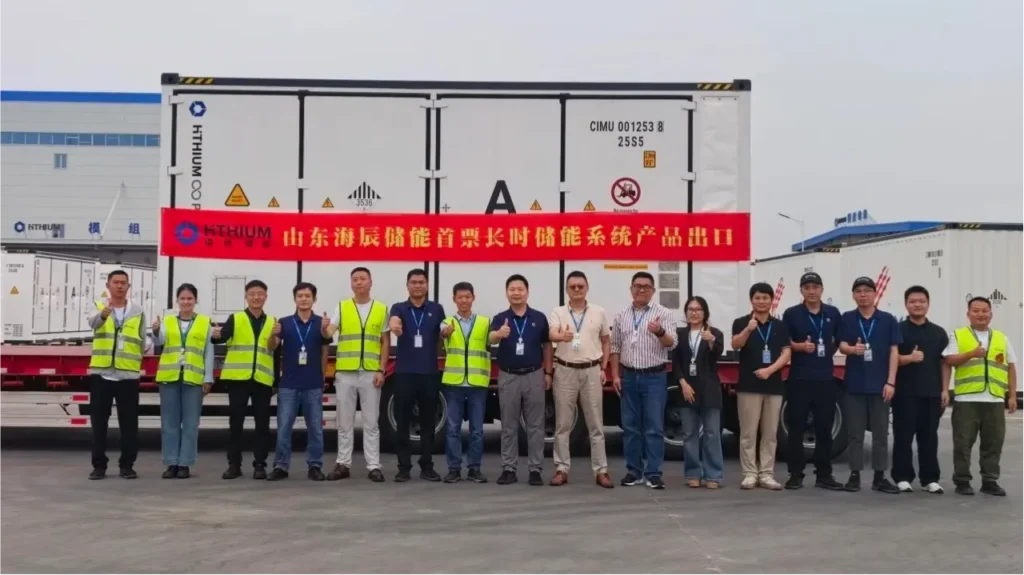
Hithium’s Shandong base has shipped its first export cargo: 106 prefabricated long-duration energy storage containers, each rated at 6.25 MWh and built around a 1175 Ah cell, leaving Heze for Qingdao Port and onward to Israel. It is the first large-scale export from the Heze industrial park since the site started mass production in August, and it lands on top of a 300 MW / 1.5 GWh framework the company has signed with an Israeli EPC. But the cell at the centre of the shipment is not new. It has been in production since June 2025 — and that fact is the most useful thing about this story.
What Left Heze on 28 September
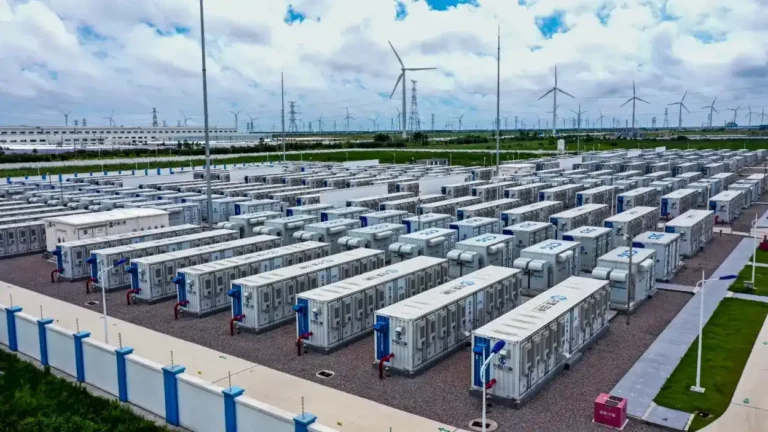
The cargo consists of 106 units of HiTHIUM’s ∞Power 6.25 MWh 4-hour system, each built into a standard 20-foot container and carrying ∞Cell 1175 Ah cells. The units left the Heze base in Shandong province and will sail from Qingdao Port to Israel, where they will be distributed to project sites through local logistics. The company says the system can be configured for four to eight hour applications, covering renewable integration, grid peak-shaving and frequency regulation, and commercial and industrial arbitrage.
Heze is the more consequential part of the announcement. The park is described by Hithium as the world’s first industrial base dedicated entirely to long-duration storage, with planned annual capacity of 30 GWh of long-duration cells and 20 GWh of integrated system products, on a total investment of more than RMB 13 billion. It began mass production in August 2026. Shipping a first export consignment within about two months of that is fast ramp-up by battery industry standards, though the 106 units are small next to the plant they came from: at full output the cell lines alone would produce the equivalent of 30,000 MWh a year, which makes this first export about 2.2% of one year’s rated capacity.
Hithium ranks second globally in energy storage cell shipments for the first half of 2026, and its products reach more than 40 countries. Its Chongqing plant was recognised by the World Economic Forum as the first lighthouse factory in the energy storage battery sector in January 2026. In other words, this is the world’s number two shipping one month of output to one customer — not a startup’s first container.
The Cell Inside Is 15 Months Old, Not New
Chinese-language coverage of the shipment describes the ∞Cell 1175 Ah as the world’s first “kAh” — kilo-amp-hour — cell for long-duration storage. All of that is true. What the phrasing encourages readers to assume is that the cell is new. It is not.
Hithium announced volume production of the ∞Cell 1175 Ah on 11 June 2025 at the SNEC exhibition in Shanghai, at its Chongqing manufacturing base, after starting development in 2022. The same event saw the cell receive UL 1973 and UL 9540A certification from UL Solutions. The product has therefore been in production for fifteen months, and what is new on 28 September is the shipping route, not the chemistry.
That distinction matters for anyone reading the announcement as a technology milestone. The genuinely new thing here is that a plant only weeks into mass production has cleared the qualification, packing and logistics chain needed to put product on a ship.
Why 1175 Ah: Same Container, Twice the Hours
The technical logic behind the cell is more interesting than the “world’s first” framing, and Hithium’s own design notes explain it.
Alongside the 1175 Ah cell, Hithium makes a 587 Ah cell, which the company describes as a half-scale design of the 1175 Ah and which was launched in December 2024 for two-hour applications. The two cells share the same pack and system platform, and both feed the same 6.25 MWh container. The 1175 Ah is almost exactly twice the 587 Ah. So the same steel box ends up with the same energy capacity in both cases — but one is a two-hour system and the other is a four-hour system.
That is the whole idea, and it is counter-intuitive. In long-duration storage, longer duration does not come from stacking more containers. It comes from putting bigger cells into the same container, which changes the ratio of energy to power without changing the enclosure, the wiring, the transformer or the site layout. Hithium’s published numbers for the switch from a 314 Ah cell to the 1175 Ah give the commercial version of the same argument: about 7.5% lower cost per watt-hour at the cell level, and roughly 30% lower cost across the non-cell parts of the system.
The cell’s stated figures are 11,000 cycles at 25°C, 100% depth of discharge and 0.25P to 70% state of health, which Hithium converts into a system life of up to 27 years. The trade-offs are the familiar ones for large-format cells: more energy per unit of manufacturing labour, but a harder problem in thermal management and quality control. Hithium’s own description of the production line mentions a coating mass-density variation below 0.2%, stacking alignment of 0.5 mm at 0.1625 seconds per sheet, a redesigned top cover with integrated 3D air channels, and electrolyte filling at 1.2 MPa. Those are the reasons it took from 2022 to 2025 to get a kilo-amp-hour cell off a line.
Long-Duration Energy Storage: The Other Half of the Market
It is worth placing this shipment next to a project that reached commercial operation on the same day, on the other side of the world. The Waratah Super Battery in New South Wales is rated at 850 MW and 1,680 MWh — about the same energy as Hithium’s entire Israeli framework, which is 300 MW and 1,500 MWh. But Waratah’s duration is 1.98 hours and the Israeli framework works out at five hours. One is a shock absorber paid to keep a transmission network stable; the other is a device for moving solar output from afternoon to evening.
| Waratah, Australia | Hithium × El-Mor, Israel | |
|---|---|---|
| Power | 850 MW | 300 MW |
| Energy | 1,680 MWh | 1,500 MWh |
| Duration | 1.98 hours | 5.0 hours |
| Purpose | System strength and grid protection | Renewable shifting and peak capacity |
| Container | Site-built on a former coal plant | 106 × 6.25 MWh, 20-foot, factory-built |
| Status | Operating at full capacity | First batch en route |
The comparison shows why “battery storage” is a poor unit of analysis. Two projects of nearly identical energy capacity differ by a factor of 2.5 in duration, and therefore in what they can be paid for, in what cells they use, and in what a buyer is actually purchasing. The Israeli framework is the second kind of asset: the El-Mor agreement covers a 1 GWh solar-plus-storage project at Ramat Beka, which the company describes as the largest of its kind in the region, with El-Mor acting as EPC and Hithium supplying an equipment package that bundles battery containers, power conversion systems, medium-voltage transformers, switchgear and the energy management system.
What the Shipment Does Not Tell You
Three things are missing from the announcement, and all three matter.
No schedule. The framework covers 1.5 GWh, and this first batch of 662.5 MWh is 44% of it by capacity. The company has not said when the remaining 56% ships, or when the Ramat Beka project reaches commissioning. The equipment package includes grid-connection modelling and protection coordination, which are typically the long-lead engineering items, and none of that timeline is public.
No customer name on the shipment itself. The cargo is bound for Israel and El-Mor is the known Israeli partner, but Hithium’s own shipping announcement does not name the recipient of these 106 units. The link between the two is reasonable and unconfirmed.
No commercial terms. No value, no pricing, no financing structure. For a framework of this size that is normal at the shipment stage, and it means the deal cannot yet be compared against the financing structures now being used to fund storage in other markets.
It is also worth noting what is being exported here. Heze sits in Shandong, and the shipment leaves through Qingdao. This is a Chinese industrial base selling complete systems — cells, containers, power conversion and controls — into a market where cell pricing has been falling for three years. The margin story in storage has moved from the cell to the integration, and this shipment is entirely a system sale.
The Bottom Line: Hithium’s Heze base shipped its first export consignment on 28 September — 106 units of the ∞Power 6.25 MWh 4-hour long-duration energy storage system carrying ∞Cell 1175 Ah cells, bound from Qingdao Port for Israel. The batch totals 662.5 MWh, about 44% of the 300 MW / 1.5 GWh framework the company has with Israeli EPC El-Mor Renewable Energy. The 1175 Ah cell is not new: Hithium announced volume production in June 2025 and it holds UL 1973 and UL 9540A certification. What is new is the export route from a plant that only began mass production in August, and the design logic behind the cell — a 587 Ah two-hour cell and a 1175 Ah four-hour cell share the same pack platform and the same container.
Notes: Cycle life, system life, cost-reduction percentages and the durability description of the 1175 Ah cell are Hithium’s own claims and have not been independently tested by EVsays. The 662.5 MWh total, the 44% share of the framework, the 2.2% share of Heze’s rated annual output, the five-hour duration of the Israeli framework and the container comparison are our arithmetic on the figures above. The link between this shipment and the El-Mor framework is not stated in Hithium’s shipping announcement; we have inferred it from the destination and the partner’s identity, and we could not independently confirm the date on which the El-Mor framework was announced. Reporting is drawn largely from Hithium’s own Chinese-language release, cross-checked against the company’s English and Chinese newsroom; no English-language trade coverage of this shipment had appeared at the time of writing. EVsays has not attended any Hithium event. See our editorial policy and correction policy.
Sources & Further Reading
- Sina Finance (新浪财经), via People’s Finance — “山东海辰储能菏泽基地开启长时储能规模化海外交付” (2026-09-28) — the first export itself: 106 containers, the 6.25 MWh / 4-hour rating, the Qingdao Port route, the Israeli destination, and the Heze base’s 30 GWh / 20 GWh capacity plan.
- Dazhong News (大众日报·大众新闻) — “首批106台!山东海辰储能菏泽基地开启长时储能规模化海外交付” (2026-09-28) — the 20-foot container format, the four-to-eight-hour application range, the August 2026 mass-production date, the RMB 13 billion investment, and the top-two global shipment ranking with coverage in more than 40 countries.
- HiTHIUM — “HiTHIUM Pioneers Mass Production of the world’s first kAh Battery Cell” (2025-06-11) — the volume-production date of the ∞Cell 1175 Ah in Chongqing, the UL 1973 and UL 9540A certifications, and the five manufacturing innovations behind the cell.
- 海辰储能 — “全球首款千安时电池率先量产,海辰储能开启长时储能规模化应用时代” (2025-06-11) — the cell-level and system-level safety architecture, the 2022 development start, and the cell’s position as the first dedicated product for four-to-eight-hour applications.
- 海辰储能 — “持续创新,稳健前行|海辰储能荣获高工储能电池企业TOP10” — the 587 Ah cell as a half-scale design of the 1175 Ah optimised for two-hour applications, the shared pack and system platform, and the 94.5% efficiency and 415 Wh/L figures for the 587 Ah.
- Energy News — “HiTHIUM partners with El-Mor to deploy 1.5GWh of long-duration storage in Israel” — the 300 MW / 1.5 GWh framework, the Ramat Beka 1 GWh solar-plus-storage project, El-Mor’s role as EPC, and the scope of Hithium’s equipment package.
- Sina Finance (新浪财经·财经头条) — “海辰储能∞Power 6.25MWh长时储能方案首落以色列” — the equipment package breakdown including PCS, medium-voltage transformers, switchgear and EMS, plus quotes from Hithium’s senior sales director for Israel, Steven Song, and El-Mor chairman Avi Elkayam.
- EVsays — related coverage: Hithium’s sodium-ion storage system, CATL’s 587 Ah storage cell pricing, the Chinese storage cell price turn, EVE Energy’s 206 GWh supply framework and storage designed for AI data centres.