

On 17 September, Figure released Helix 2.5 and did something the humanoid industry had not done before: it isolated the value of human data. Holding architecture, task data and evaluation fixed, pretraining on Figure’s own human-behaviour dataset lifted zero-shot success in 30 unfamiliar homes from 9% to 56%. On 10 October, a Shanghai company founded in April published its first demo, built on the same premise — that a humanoid foundation model should be pretrained on human demonstrations rather than on robot data alone. Its version is three minutes long and contains no success rate at all.
What Figure’s Numbers Actually Show
The result is worth stating precisely, because the industry has spent two years arguing about whether human video can teach a robot anything, and this is the first clean measurement of it. Figure pretrained Helix 2.5 on Index, its dataset of human behaviour, then adapted one base model into three behaviours: tidying a living room, folding towels and making a bed. It collected no data inside the 30 Bay Area homes, did no fine-tuning and no adaptation there.
| Measure | Result |
|---|---|
| Zero-shot success, Index-pretrained | 56% (237 of 420 attempts) |
| Zero-shot success, randomly initialised control | 9% |
| Making a bed | 67% (94 of 140) |
| Folding towels | 62% (87 of 140) |
| Tidying toys | 40% |
| Task-specific data required | Half of a comparable Helix 02 behaviour |
Three clarifications matter more than the headline. First, the 9% control is not Helix 02. It is the same policy with random initial weights — which is what makes the comparison useful, and also means 9% to 56% measures the value of pretraining, not the improvement over the previous generation. Second, the scoring was all-or-nothing. A tidying run counted only if all 13 to 15 toys ended up in the basket, and any rollout that needed human intervention for safety was recorded as a failure. Third, the spread across the three tasks is wide — 67% for beds against 40% for toys — so 56% should not be read as uniform household competence.
Figure also claims a scaling relationship: repeatedly doubling the Index pretraining data reduced downstream robot action-prediction loss smoothly enough that smaller runs forecast the largest model’s loss to four decimal places. That is a real result, but Figure’s own write-up is explicit that the metric is action-prediction loss, not task completion. Nobody has yet shown that doubling human data doubles household success.
What sits underneath is scale. Figure says Index is adding roughly 35 minutes of human experience every second, that it has committed USD 3.5 billion of compute to Helix training, and that it has contracted Nscale for roughly 100,000 Nvidia Vera Rubin GPUs in a deal worth up to USD 6 billion. The human-data thesis is not a research curiosity for Figure. It is the company’s capital allocation.
What Archon Robotics Has Shown So Far
Archon Robotics, trading in Chinese as Source Intelligence (源策未来), was founded in April 2026 and works out of the Caohejing development zone in Shanghai’s Xuhui district. Its stated goal is a general-purpose whole-body humanoid foundation model, and it calls the approach Whole-Body Intelligence.
The architecture has three parts. S1 handles task understanding and multimodal input. S0 handles coordination, stabilisation and precise execution — the company describes it as the cerebellum. EgoBody is the data platform. A technical blog published in July described a broader four-layer framework including task planning and motion generation; the October video concentrates on S1 and S0 and does not say whether that reflects an architectural change.
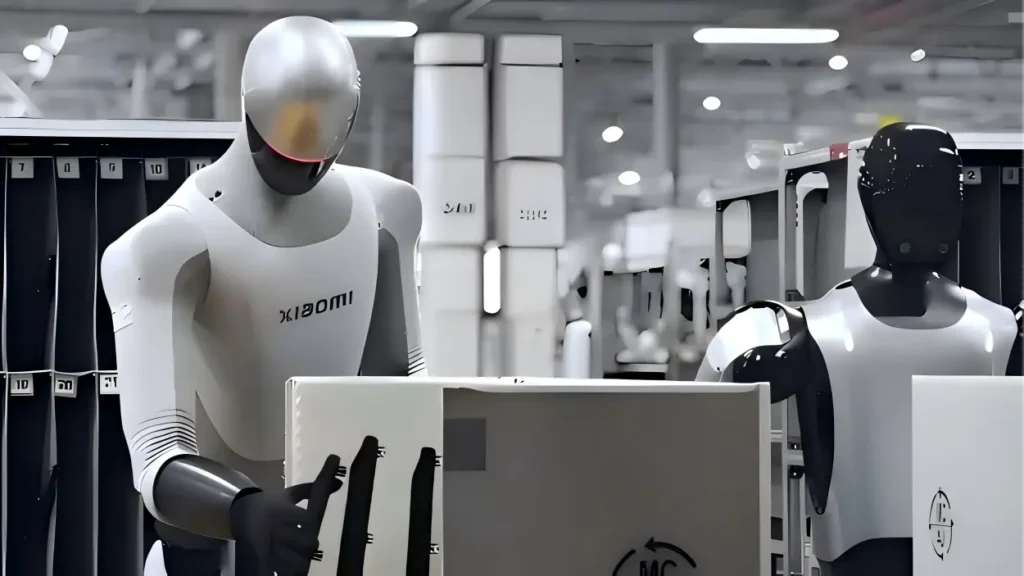
The demo, published on 10 October, shows robots stepping up into a kitchen, bending to pick objects off the floor, and lifting a bicycle, along with autonomous multi-stage tasks such as clearing a table and loading a dishwasher. Two hardware configurations appear: modified Unitree G1s and Booster T2 robots, with an AGIBOT A3 in one sequence. That hardware list is what is visible in the footage — there is no published compatibility list, and several robots working in one room does not establish that they are running the same weights or coordinating.
The data design is the part that matters. Archon says its platform collects human demonstrations across multiple cities in China for pretraining, then uses real-robot data for post-training, with DAgger corrective demonstrations mixed in so the model learns how to recover from a mistake and resume a task. Quality control is automated checks plus human spot checks plus review of flagged samples.
The demo closes with a disclosure worth reading closely: the complete task demonstrations run autonomously at normal speed, while the S0 explanation segments and the DAgger segments are teleoperated. That is a more honest split than most launch videos, and it is also the reason the footage itself cannot be used to judge the model.
Why Real-Robot Data Is the Bottleneck
The number that explains the whole strategy is a cost. Archon’s chief executive, Li Tianyu, puts real-robot data collection at several hundred yuan to nearly 1,000 yuan per hour — and that is for data that may be unusable if the robot loses balance mid-demonstration. His argument, made to Chinese trade media, is structural rather than economic: existing embodied datasets are large but thin. First-person video records what a person saw, not what their body did; squatting, bending and leaning are not captured as pose. Robotic-arm datasets record end-effector trajectories on a plane. Neither contains the information that actually governs a full-body task — how the centre of mass shifts, how the torso leverages, how force travels from the legs to the hands.
His illustration is a door. Pull a light door and a heavy door, and the hand trajectory is nearly identical; what differs is how the person braces their whole body against the load. A model trained only on hand paths learns nothing from that distinction. This is the same gap Figure is addressing from the other direction, and the 9% to 56% result is the first evidence about how much it is worth. It is also why the same argument shows up around Chinese carmakers opening their factories as robot training grounds: whoever can generate usable whole-body data cheaply sets the pace.
Archon’s plan is not to solve that with more robots. It is to capture humans directly — high-precision whole-body and hand capture, plus tactile sensing as a new modality, with the claim that one sample containing whole-body dynamics is worth more than a hundred samples of hand trajectories. Whether that holds up is exactly what Figure’s scaling experiment was designed to test in the other direction.
The Humanoid Foundation Model Money
Archon’s seed round was in the hundreds of millions of yuan, with ZhenFund, Banyan Capital, IDG Capital and Matrix Partners China leading alongside a Gobi Partners × University of Hong Kong joint fund, MiraclePlus and the Shanghai Institute of Innovation and Intelligence. LightSpeed Capital advised. The company says the money goes into model development, multimodal whole-body motion data collection, hiring, and R&D centres in several cities, with a commitment to open-source the humanoid base model within the year and ship its first humanoid-native foundation model in late 2026.
The team is the reason the betting is not casual. Founder Li Hongyang is an assistant professor at the University of Hong Kong and assistant dean of its School of Computing and Data Science; the end-to-end autonomous driving project UniAD that he led won best paper at CVPR 2023, and in 2026 he received the RSS Early Career Award — the first scholar based in China to do so in the award’s 20-year history. Co-founder and chief executive Li Tianyu worked on Huawei’s ADS 4.0 World Engine. Co-founder and head of AI Li Chen was first author on the UniAD paper.
The funding context is just as relevant. Omdia-derived figures put China’s embodied intelligence and robotics sector at 288 financing rounds worth more than RMB 46 billion in the first half of 2026 — about 83% of the RMB 55.4 billion raised in the whole of 2025, in six months. That flow is why robot teams that were unknown a year ago are now valued in the billions, and it is the reason a four-month-old company can staff up on autonomous-driving and foundation-model researchers and promise an open-source base model by December.
What Is Not Established
Archon has published no performance numbers. No success rate, no intervention count, no dataset size, no comparative result across the three robot platforms it shows. The company’s own video draws a line between autonomous execution and teleoperated segments, but a viewer cannot verify the boundary.
Six months against Figure is not a scoreboard. Figure has raised billions and has a production humanoid; Archon was founded in April and has a seed round. Treating the absence of published metrics as evidence of a worse model is not supportable, and neither is treating a three-minute video as evidence of a working one. The honest statement is that the same thesis is now being pursued in two places at very different maturity, and only one of them has produced a number.
The measured scaling law is about prediction, not competence. Figure’s four-decimal forecast is an action-prediction loss result. The link between that and completing a bedsheet fold in a house the robot has never seen is assumed, not demonstrated.
56% is the ceiling of a demo, not a product floor. The strongest task scored 67% and the weakest 40%, with human intervention scored as failure. A robot that folds two towels in three is not yet doing a household’s laundry.
And the older bottlenecks have not gone away. Energy is still a hard limit — a robot carrying under 2 kWh is working a shift measured in hours, not days. Hands and tactile sensing are still unsolved, which is why Archon lists tactile capture as an addition rather than a given. A better brain does not fix either one.
Author’s Take: The most useful thing that happened in September was not a robot doing laundry. It was Figure publishing a controlled experiment with a randomly initialised baseline, which turned a two-year argument about human video into an effect size: roughly a sixfold improvement in zero-shot success, at half the task-specific data. That number is now the benchmark every human-data claim will be measured against, and it is why Archon’s debut reads differently from the dozens of Chinese humanoid videos that preceded it. Archon is attacking the right layer — the data infrastructure underneath the model, not the model itself — and it has assembled the academic pedigree to be credible there. But the industry’s habit is to treat a demo as an announcement and an announcement as a result. On the evidence published so far, one company has a number and the other has a thesis. The gap between those two things is where most of this sector’s valuation risk currently sits.
The Bottom Line: Figure’s Helix 2.5 showed on 17 September that pretraining a humanoid foundation model on human behaviour data lifts zero-shot success in 30 unseen homes from 9% to 56% at half the task-specific data, across 420 scored attempts. Three weeks later, Shanghai-based Archon Robotics — founded April 2026, seed-funded in the hundreds of millions of yuan and led by the researchers behind the UniAD autonomous-driving project — published a three-minute demo built on the same premise, using human demonstrations from multiple Chinese cities for pretraining and real-robot data for post-training. It disclosed no success rate, no intervention count and no dataset size, and its own video marks the S0 and DAgger segments as teleoperated. The thesis is now being tested in two places. Only one of them has published the number, and that is what everyone else will be compared with.
Notes: All performance figures are company claims and have not been independently tested by EVsays. Figure’s 9% baseline is a randomly initialised control, not a previous-generation model, and its scaling result is action-prediction loss rather than task completion. The hardware identified in Archon’s footage is our reading of the video, not a published compatibility list. The RMB 46 billion and RMB 55.4 billion financing figures are third-party estimates, and the RMB 55.4 billion full-year 2025 figure is not like-for-like with the 2026 half-year number. Reporting on Archon’s funding, team and data strategy is drawn from Chinese-language trade and financial media; Archon has no official website and published no technical report with the demo. EVsays did not attend any demonstration, has tested nothing, and has received no information from Figure or Archon beyond public materials. See our editorial policy and correction policy.
Sources & Further Reading
- Figure — “Helix 2.5: Zero-Shot 30-Home Generalization” (17 September 2026) — the 9% to 56% comparison, the 30 unseen homes, the half-the-task-data claim, the action-prediction scaling result, the 35 minutes of human experience per second and the USD 3.5 billion compute commitment.
- Humanoids Daily — “Archon Robotics Shares Debut Demo of Its Whole-Body Humanoid Intelligence” — the S1 and S0 split, the EgoBody data platform, the human-demonstration and real-robot data pipeline, the DAgger corrections, the hardware visible in the footage, and the observation that no success rates, intervention counts or dataset sizes were published.
- 36Kr — “Archon Robotics completes a seed round of hundreds of millions of yuan” — the investor list, the founding team’s UniAD and Huawei ADS 4.0 backgrounds, the April 2026 founding, the Caohejing headquarters, the RMB 46 billion first-half financing figure and the real-robot data cost per hour.
- Tencent News — “Six months old, Source Intelligence wants one dataset to serve more robots” (13 October 2026) — the 10 October demo date, the kitchen-step, object-retrieval and bicycle tasks, and the EgoBody, S1 and S0 breakdown.
- Humanoid.guide and theroboradar — trade coverage of the Helix 2.5 release reproducing the per-task breakdown (67% bed making, 62% towel folding, 40% toy tidying), the 237 of 420 completion count and the all-or-nothing scoring rule.
- Chinese-language trade coverage of Archon’s October demo (itbear, elsewhere.news) — the Whole-Body Intelligence framing, the Human Body Learning concept and the midbrain-level cross-platform transfer claim.