

On 12 October, at the 2026 Paris Motor Show, Zeekr opened French order books for the refreshed 7X at EUR 52,990 — and the Zeekr 7X Europe that buyers get is not the car Zeekr sells at home. The European top version makes 680 hp; the long-range one covers 627 km on WLTP. The driver-assistance system, though, is a Bosch unit rather than Geely’s in-house G-Pilot. Zeekr spent the extra money on the powertrain. It did not spend it on the software.
Zeekr 7X Europe vs. China: Two Different Cars
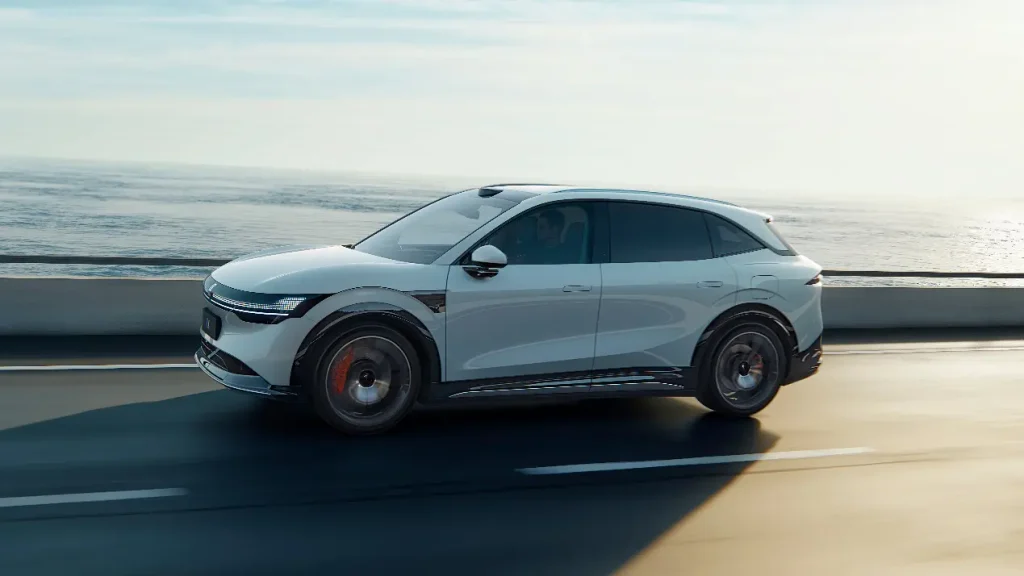
The car on Zeekr’s stand in Hall 5.2 at the Paris Motor Show — the Mondial de l’Auto, which ran 12–18 October at Paris Expo Porte de Versailles — is the 2027 model year 7X. It is the mid-size SUV that has become the brand’s European volume model, and it is not the facelifted 7X that Chinese buyers can order.
Chinese trade coverage puts the domestic facelift’s flagship version at 585 kW (784 hp) with a 103 kWh ternary NMC pack. The European version’s most powerful trim is rated at 500 kW (680 hp) with 100 kWh. That is roughly a hundred horsepower and a battery’s worth of difference between two cars that share a nameplate, a platform and a design language.
The European car is also the more localised one. Zeekr says the 7X was designed at its Gothenburg design centre, and that Zeekr Europe is supported by R&D centres in Sweden, Germany and the UK. The model holds a five-star Euro NCAP rating, scoring 91% for adult occupant protection and 90% for child occupants. Zeekr does not publish European volumes for the model; Chinese trade reporting puts cumulative global 7X sales above 200,000 units since the 2024 launch.
More Power, More Range, Same Price
Zeekr’s own European specification sheet describes three cars, all on the 800-volt SEA architecture, all rated to tow 2,000 kg.
| Trim | Drive | Power | 0–100 km/h | Battery | WLTP range | 10–80% DC | France price |
|---|---|---|---|---|---|---|---|
| Core RWD | Single, rear | 335 kW | 5.6 s | 75 kWh LFP | 482 km | 10.5 min | EUR 52,990 |
| Long Range RWD | Single, rear | 335 kW | 5.5 s | 100 kWh NMC | 627 km | 15 min | EUR 57,990 |
| Privilege AWD | Dual | 500 kW (680 hp) | 3.7 s | 100 kWh NMC | 545 km | 15 min | EUR 64,990 |
The headline change is under the skin. CarNewsChina reports the rear-drive car’s motor rose from 310 kW to 335 kW and the all-wheel-drive version from 470 kW to 500 kW — the roughly 40 hp that sits in the headline. The outgoing European 7X carried WLTP ratings of 480 km and 618 km; the refreshed car is rated at 482 km and 627 km. More range, from comparable pack sizes.
Visually the update is modest: redesigned front and rear bumpers, a reshaped centre console that loses the storage bump behind the wireless charging pad, new 21-inch wheels on the AWD trim, and two new paint options, Glacier Silver and Mystic Lilac.
Then there is the price. Across the Zeekr 7X Europe range, the entry Core RWD lands at EUR 52,990 — the same figure Zeekr used when it opened French order books in April 2026 for the 7X, alongside the 001, the 007 GT and the X. The refreshed car adds power and range without moving the entry price. Deliveries begin in the first quarter of 2027.
Three efficiency numbers follow from Zeekr’s own figures, and they are our calculations. Divided out, the trims return 6.43 km per kWh (Core RWD), 6.27 km per kWh (Long Range RWD) and 5.45 km per kWh (Privilege AWD) — or 15.6, 15.9 and 18.3 kWh per 100 km. Two things are worth noting. The cheapest car is the most efficient one: the 75 kWh LFP pack returns about 2.5% more distance per kilowatt-hour than the 100 kWh Long Range pack, which is what carrying a lighter battery buys you. And the AWD flagship consumes roughly 15% more energy per kilometre than the Long Range car in exchange for 165 kW and a 1.8-second quicker sprint to 100 km/h.
Bosch Instead of G-Pilot: What Europe Actually Gets
For the Zeekr 7X Europe, the assistance hardware is a Bosch system with seven cameras and three millimetre-wave radars, delivering adaptive cruise control and remote parking assist. According to CarNewsChina’s report on the launch, Geely is not bringing its in-house G-ASD G-Pilot — the system that made its global debut at CES 2026 — to this car, and the European 7X will not offer the Navigate on Autopilot (NOA) function that BYD and Xpeng are preparing to introduce in Europe. Zeekr has not explained the decision.
What Zeekr is bringing to Europe is entertainment. At the same show the company announced a partnership with N-Dream, the Zurich-based developer behind AirConsole, marking the in-car gaming platform’s first tie-up inside the Geely Auto Group. AirConsole already runs in vehicles from BMW, Volkswagen, Audi, Porsche, Škoda and Tata Motors across more than 5 million cars, per N-Dream. The Paris demo put PAC-MAN Championship Edition on the 7GT’s infotainment screen, with the cabin’s ambient lighting synced to the game, and viewers using a phone as the controller by scanning a QR code. Rollout across select Zeekr models is due before the end of 2026, bundled with the Zeekr Connected Premium service package.
Put the two decisions side by side and the European 7X has a cabin built for passengers playing games and a driver-assistance stack bought in from a German tier-one. Both are perfectly sensible products. Neither of them is G-Pilot.
Why Zeekr Keeps Its Best Software at Home
Zeekr has given no reason for the omission, so the honest position is that the cause is unknown. Three explanations fit the facts, and they are not mutually exclusive. The first is homologation: a driver-assistance system has to be validated against European rules and European road furniture before it can be switched on, and that work is done system by system, not brand by brand. The second is priority: Zeekr’s European flagship is the 9X, which also debuted at Paris, priced from EUR 119,500 with deliveries from January 2027 — Chinese trade reporting says the first 200 units were reserved before the price was even published. If one car in the range is going to carry Geely’s newest software into Europe, it is that one. The third is cost. The refreshed 7X holds its April entry price while adding power, range and content. A Bosch stack that is already type-approved across the industry is a faster and cheaper route to a compliant car than certifying a new in-house system is.
That third point is our reading of the numbers, not a company statement. What is not a reading is the competitive setting. In the European mid-size electric SUV segment the 7X lines up against the Tesla Model Y, the Volkswagen ID.4 and the Ford Mustang Mach-E, and in that set the comparison sheet is still led by range, price and charging time. Zeekr’s refresh is aimed squarely at those three columns. At the same show, BYD launched its European Atto 8 — a 115 kWh, 652 km seven-seat SUV carrying the second-generation Blade battery — which is the same show, same segment, same argument. Chinese brands are moving their driver-assistance features into Europe on their own timetables. Zeekr has chosen, for now, not to race them on that axis.
Author’s Take: The interesting thing about the refreshed 7X is not the 40 hp. It is that Zeekr had a choice about where to spend and picked the expensive, boring, measurable column: 15 kWh per 100 km instead of a badge on the tailgate that says the car can drive itself. That is a defensible read of the European buyer in 2026, who is comparing lease rates and charging curves, and it matches the price decision — the entry car did not move. But it is a bet with a visible expiry date. The moment BYD or Xpeng switches on highway NOA in a European market, every 7X window sticker that lists adaptive cruise control becomes a comparison a dealer has to argue against, and no amount of AirConsole will answer it. The likelier reading is that this is sequencing rather than strategy: Geely’s G-Pilot needs European validation, and the 9X at EUR 119,500 is the natural first recipient. If that is the plan, the test is not the 7X. It is whether a future 7X update brings the software down the range — and how long that takes.
The Bottom Line: Zeekr’s refreshed 7X went on sale in France on 12 October at EUR 52,990 with a 680 hp flagship, 627 km of WLTP range and the same 800-volt architecture — more power and more range for the same entry price it used in April. It also gains a Bosch driver-assistance stack with seven cameras and three radars, and does not gain Geely’s G-Pilot or highway NOA. That is roughly a hundred horsepower and a battery short of the Chinese version. Europe gets the hardware and the gaming; China keeps the software. The question is how long that stays true.
Notes: All performance, range, charging, price and safety figures are manufacturer claims from Zeekr’s European specification sheet, Euro NCAP and the launch reporting, and have not been independently tested; EVsays did not attend the Paris Motor Show and did not drive the car. The 6.43, 6.27 and 5.45 km per kWh figures, the 2.5% efficiency difference between the LFP and NMC packs, and the 15% energy-per-kilometre penalty of the AWD trim are our calculations from Zeekr’s published WLTP numbers and are WLTP-cycle arithmetic, not measured consumption. The claim that G-Pilot and highway NOA are absent from the European car, and the power increases against the outgoing version, come from CarNewsChina’s report and were not confirmed by Zeekr. The EUR 52,990 comparison against the April 2026 French launch price is drawn from Chinese trade coverage of that launch and, like all Chinese-market price data, is unverified against a Zeekr filing. Currency figures are given in euros as published. See our editorial policy and correction policy.
Sources & Further Reading
- Zeekr Europe — official Zeekr 7X model and specification page — the trim walk, power outputs, battery capacities, WLTP ranges, 10–80% charging times, 800-volt architecture, towing rating, dimensions and the Gothenburg design attribution. The primary source for every specification in this article.
- Euro NCAP — Zeekr 7X test results: the five-star rating and the 91% adult / 90% child occupant scores, taken from the official results page and cited here by name only.
- N-Dream — “AirConsole Partners With Zeekr, Marking Its Entry Into The Geely Auto Group Ecosystem” (13 October 2026, Zurich; cited by name only) — the Paris Motor Show dates and venue, Zeekr’s European line-up and stand location, the AirConsole rollout plan and Zeekr Connected Premium bundling, the existing BMW, Volkswagen, Audi, Porsche, Škoda and Tata Motors installations, the 5 million vehicle figure, and the quotations from N-Dream chief executive Anthony Cliquot and Zeekr Europe chief executive Lothar Schupet.
- CarNewsChina — “Updated Zeekr 7X launched in Europe with a 40 hp power boost at 52,990 EUR” (14 October 2026) — the 310 kW to 335 kW and 470 kW to 500 kW power increases, the 480 km and 618 km outgoing WLTP ratings, the Chinese facelift’s 585 kW / 103 kWh specification, the Bosch ADAS configuration, the absence of G-Pilot and NOA, and the bumper, wheel and colour changes.
- Sina Auto (新浪汽车) — “2026巴黎车展:2027款极氪7X亮相” (13 October 2026) — the Chinese-language account of the Paris debut, the 52990 euro starting price, the Q1 2027 delivery timing and the AirConsole partnership announcement.
- Wangtongshe / auto.news18a.com — “极氪9X与2027款7X亮相巴黎车展” (13 October 2026) — the Zeekr 9X European price of 119,500 euros, its January 2027 delivery date, the pre-reserved first 200 units, the reported 450 kW peak charging power, the new Glacier Silver and Mystic Lilac colours, and the statement that cumulative global 7X sales have passed 200,000 units.
- EVsays — “BYD Named France for Its Next Factory. It Wants Cheap Power and 40,000 European Workers.” (14 October 2026) — the same Paris Motor Show, BYD’s European Atto 8 specification and the European manufacturing picture used for context above.
- EVsays — European registrations and the Chinese share of growth in 2026 — background on why Chinese brands are pushing models and localisation into Europe now.
- EVsays — earlier reporting on Zeekr’s connected-car software — relevant background on how Zeekr’s software features are governed and delivered.