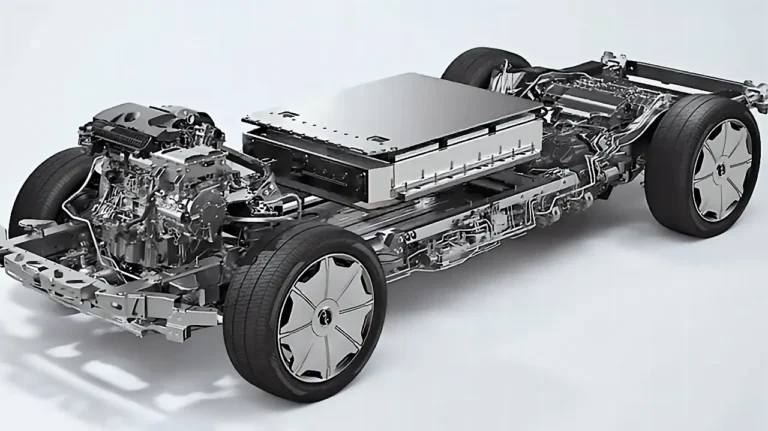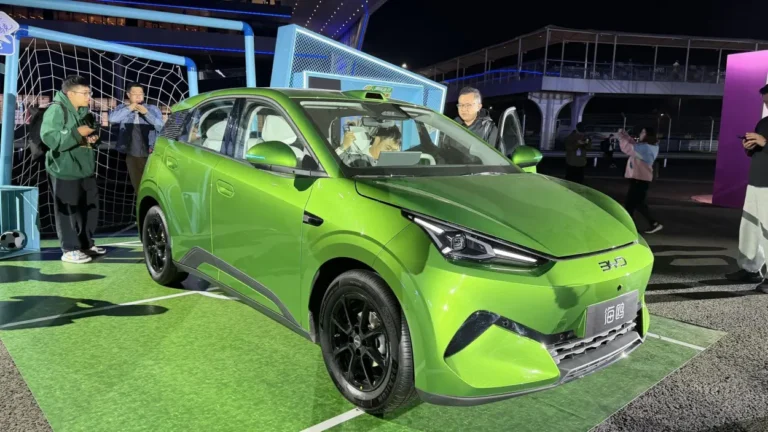


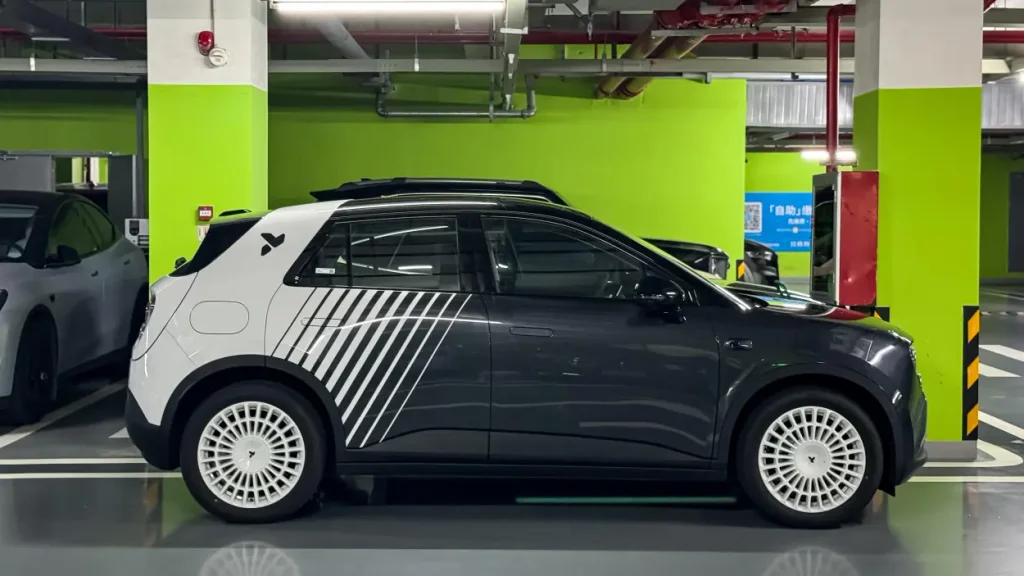
CATL confirmed on 24 October that the Firefly 60 kWh battery NIO’s small-car brand launched the day before is a Qilin pack — and specifically the long-life branch of that family, not the fast-charge one. The interesting part is not the badge. It is that the pack holds 42.5% more energy than the 42 kWh unit it replaces, in a box of identical dimensions, for about 10 kg of extra weight, in a car 4,003 mm long. The Firefly with the big pack starts at 136,800 yuan (USD 18,870 at 7.25); owners of the old car can buy the same upgrade for 17,000 yuan.
What the Firefly 60 kWh Battery Actually Is
The order of events matters. Firefly held its launch on 23 October in Shanghai and published a release that never names CATL. It talks about a ternary — nickel-cobalt-manganese — pack, 14 safety tests that exceed the national standard, and five cell-level technologies aimed at slowing degradation. The supplier attribution arrived a day later, on CATL’s own Weibo account, along with the Qilin name and the 560 km figure.
That post left two things out: which Qilin generation this is — the third generation was unveiled in April — and the charging rate. CATL’s English newsroom carries nothing about the programme at all.
| 42 kWh (standard) | 60 kWh (long range) | |
|---|---|---|
| Usable capacity | 42.1 kWh | 60 kWh |
| Chemistry | LFP | NCM (ternary) |
| Cell supplier | Sunwoda | CATL, Qilin long-life |
| CLTC range | 420 km | 560 km |
| Pack energy density | ~136 Wh/kg (our calculation) | 187.18 Wh/kg |
| Volume utilisation | — | 73.4% |
| 0–100 km/h | 7.9 s | 7.9 s |
| Consumption (claimed) | 10.9 kWh/100 km | 10.9 kWh/100 km |
| 10–80% DC charge | 29 min | 33 min |
| Price, battery included | from 119,800 yuan | from 136,800 yuan |
| BaaS price / rent | 79,800 yuan / 399 yuan a month | 79,800 yuan / 599 yuan a month |
The Same Box, 18 kWh Fuller
Start with the arithmetic the two companies did not publish. A 60 kWh pack at 187.18 Wh/kg weighs about 320 kg. Take away the roughly 10 kg that separates it from the old pack and the LFP unit comes out near 310 kg — which puts it at about 136 Wh/kg. The chemistry swap bought 38% more energy per kilogram at pack level, not just at cell level. That is the whole trick: NIO did not find space in the car, it found density in the cells.
The alternative was measured in people. Firefly brand president Daniel Jin has said a 60 kWh LFP pack would have weighed about 130 kg more — his comparison was two adults sitting in the car permanently. On a 4,003 mm hatchback with a swap-compatible floor, that is not a rounding error: it lands on the springs, the steering and the consumption figure at once.
Volume utilisation of 73.4% is the other half. It describes how much of the pack’s internal volume is occupied by cells rather than structure, cooling plates and busbars — and it is the number that explains how a pack can keep its external dimensions while gaining nearly 18 kWh. Wire-harness-free EDM management and cell-to-pack cooling under the floor are what the space was reclaimed from.
Where Four Kilowatt-Hours Went
Here is where the published figures for the Firefly 60 kWh battery stop agreeing with each other. Capacity rose 42.5%, but rated range rose 33.3%. If range simply tracked energy, 420 km would have become about 599 km. It became 560 — a shortfall of 39 km, or roughly 4 kWh of the 17.9 kWh added that never appears in the rating.
Part of that is deliberate. An NCM pack carrying more energy needs a wider buffer at the top and bottom for thermal margin and cycle life, and a buffer is energy the customer pays for but cannot drive. Part of it, though, is arithmetic that does not close: divide capacity by rated range and the 42 kWh car comes out at 10.0 kWh/100 km, the 60 kWh car at 10.7. Both are quoted at 10.9. Those three numbers cannot all be measurements of the same thing. The identical 10.9 most likely describes the homologated consumption of the model family, and should not be read as proof that the bigger pack costs nothing at the wheel.
The Retrofit Costs What the Factory Option Costs
This is the part almost nobody has priced. The 60 kWh car is 136,800 yuan; the 42 kWh car starts at 119,800. The gap is 17,000 yuan. The upgrade for an existing owner is also 17,000 yuan. NIO is charging retrofit customers exactly what it charges new-car customers for the same battery — no installation premium, no integration fee.
Per kilowatt-hour, that is about 950 yuan (USD 131) for each of the 17.9 kWh added. For a 2026 pack with a Qilin badge and a twelve-year life target, that is close to hardware cost rather than a margin line. It is also the number that decides whether the scheme is a genuine product or a marketing gesture: at 950 yuan a kilowatt-hour, an owner doing intercity runs can justify it; at twice that, nobody would.
The rental route is priced differently. Existing BaaS customers pay a 3,000-yuan service fee — cut to 2,000 on a limited-time basis — and their monthly rent moves from 399 to 599 yuan. New buyers who lock between 23 October and 30 November get one month free for every four paid across the first 48 months, up to nine waived payments. Work that through: 599 yuan times 39 payments over 48 months is about 487 yuan a month, or roughly 88 yuan a month more than the 42 kWh rent for 140 km of extra CLTC range. Cheaper per month than the 17,000-yuan buyout, but you never own the pack and the promotion runs out.
There are conditions attached, and they are tight. Buyout owners can only apply after a full year from the invoice date. The offer applies to first owners who locked their order on or before 22 October and complete the upgrade by the end of 2027. The two packs share casing dimensions, mounting points and locking mechanisms, which is why the swap stations can exchange them at all.
Charging Got Slower. That Is the Point.
Ten to eighty per cent now takes 33 minutes instead of 29. That reads like a regression until you divide it out. The bigger pack moves 42 kWh in those 33 minutes — an average of about 76 kW — against 29.5 kWh in 29 minutes, or about 61 kW, for the small one. Average power is up roughly 25%. Peak power is unchanged near 100 kW, and the cells are good for about 3C.
In a year when Chinese manufacturers are advertising 5C and 6C packs, a 100 kW ceiling looks almost antique. NIO’s answer is that the fast lane for this car is not a cable. Firefly gained access to NIO’s fifth-generation swap stations in August; as of the launch there were 109 of them across 69 cities, each holding 23 to 24 batteries and initially allocating four to Firefly. Three minutes, no charging curve to worry about.
But that network is the reason the 60 kWh pack exists in the first place, and also the reason it may matter less than it looks. A 4-metre car with 109 swap stations in 69 cities is already a car you can take out of town. The 60 kWh version is aimed at buyers who do not live near one.
The Battery That Makes Swapping Less Necessary
There is a clean paradox in this launch, and Firefly has been fairly honest about it. Jin has said roughly 80% of 42 kWh buyers are adding the car to a household that already has a larger vehicle; only about 20% use it as their only car. The 60 kWh pack is intended to move that ratio toward 70:30 — to win the buyer who would otherwise say the range is too short, not to fix a complaint from existing owners.
So the biggest battery NIO sells in its smallest car exists to make the swap network less decisive. And yet the battery is only possible because the swap network forced a standardised module into the car’s architecture back in 2022, years before anyone asked for 60 kWh. The standardisation that NIO and Geely are now pushing across the industry is the same idea at national scale: if packs are interchangeable, capacity becomes a service, not a specification.
That is the real argument against the “small cars don’t need big batteries” line. It is not that 560 km is necessary. It is that the car can acquire it later, and that a vehicle bought in 2025 does not have to be scrapped in 2030 to get a 2026 battery. For a brand that has passed 90,000 cumulative deliveries and is still building its volume — around 7,300 cars in September — that is a retention tool as much as a range tool. NIO’s own battery operations in Shanghai exist to keep those packs in circulation rather than in a scrapyard.
What the Numbers Do Not Say
Four limits are worth stating plainly. CATL did not specify the Qilin generation or the charge rate, so the “Qilin” name establishes the product line, not the performance tier. The twelve-year, 1.25-million-kilometre life figure is a projection — 2,500 cycles multiplied by an assumed 500 km per cycle — and not a warranty term. All range figures are CLTC, which runs optimistic against WLTP and further against EPA, so 560 km should not be read as a European or American number.
And the pack is NCM, which is why Firefly’s release spends a paragraph on added thermal isolation: aerogel mats, mica plates, ceramic separators and a full aluminium frame. Those are real costs, and they are also, for now, manufacturer claims rather than independently verified results. The 60 kWh car also has no published trim structure — only a “from” price.
Author’s Take: The headline is a range number. The product is a module standard. Every other carmaker selling a fixed pack has exactly one way to give a customer 140 more kilometres: sell them another car. NIO sold it for 17,000 yuan, at the same price it charges a new buyer, and it will do it through a swap bay rather than a workshop appointment. Do that consistently across a fleet and the depreciation curve of an electric car changes shape — not because the battery is better, but because the buyer no longer has to bet on which capacity they will need in year five.
Which also means the interesting question is not whether 560 km makes sense in a 4-metre hatchback. It is whether Firefly can resist the temptation to price the next upgrade at a premium. The moment a retrofit costs more than the factory option, the whole argument collapses into a service fee.
The Bottom Line: The Firefly 60 kWh battery is a Qilin long-life pack that adds 42.5% capacity and 33.3% range to a 4,003 mm car while keeping the pack’s external dimensions and adding about 10 kg. It costs 17,000 yuan more than the 42 kWh car, and NIO charges existing owners the same 17,000 yuan to retrofit it. That price parity, not the 560 km figure, is the part worth watching.
Sources & Further Reading
- Firefly — “firefly萤火虫长续航60kWh电池正式发布,CLTC续航达560km” (23 October 2026, Shanghai) — the 60 kWh launch, the NCM chemistry, the 14 safety tests, the five cell-life technologies, the 136,800-yuan and 79,800-yuan-plus-599 prices, and the 90,000 cumulative deliveries.
- CATL official Weibo account (24 October 2026) — the confirmation that Firefly uses a Qilin battery and the 560 km CLTC figure. Cited by name; the post does not state the Qilin generation or the charge rate, and CATL’s English newsroom carries no release on it.
- Firefly media briefing, Shanghai, 22–23 October 2026, as reported by Chinese trade media — the 187.18 Wh/kg pack density, 73.4% volume utilisation, 2,500-cycle life claim, the approximately 10 kg pack weight difference, the 130 kg figure for an equivalent LFP pack, the 33-minute 10–80% charge time, and the retrofit terms including the one-year waiting period and the 2027 deadline.
- EVsays — NIO and Geely move on a shared swap network — why standardised packs are becoming an industry argument rather than one company’s feature.
- EVsays — NIO’s Shanghai battery operations — the asset-management side of treating packs as a circulating fleet rather than a fixed part.
- EVsays — CATL’s battery-swap push in Hong Kong, China — the supplier’s parallel bet that packs should be exchanged rather than owned.
Notes: Pack density, cycle life, safety-test results, weight differences and consumption are figures published by Firefly and CATL and have not been independently verified; the pack-level comparison for the outgoing 42 kWh unit, the per-kilowatt-hour retrofit cost, the monthly rental arithmetic and the four-kilowatt-hour shortfall are our own calculations from the published figures. EVsays has not driven the 60 kWh Firefly or tested either pack, and all range figures are CLTC. Our editorial policy and correction policy apply.