

[Quick Summary] Following the immense success of its plug-in hybrid (PHEV) variant, BYD‘s premium personalized arm has officially rolled out the pure electric version of its mid-to-large luxury hauler: the 2026BYD Fang Cheng Bao ti 7 EV. Built natively on an advanced electric architecture, this SUV features a massive 105 kWh battery pack, ultra-fast flash charging, and a standard DiSus-C adaptive suspension. Entering the market with a highly disruptive pricing strategy, this model is poised to shake up the global premium segment. In this comprehensive BYD Fang Cheng Bao ti 7 review, we dissect its real-world range, track performance, and daily driving dynamics to see if it lives up to the hype.
Editor’s Note regarding Global Pricing & Logistics: The official domestic guidance price for this electric SUV ranges from 199,800 to 239,800 RMB (approx. $27,600 – $33,100 USD). While these entry barriers are highly competitive, buyers looking for a BYD Fang Cheng Bao ti 7 for sale in overseas markets should anticipate additional costs due to international logistics, compliance certification, and regional import tariffs.
1. Specifications Overview: BYD BYD Fang Cheng Bao ti 7 Specs
To kick off our review, let’s look at the foundational architecture and physical footprint of this mid-to-large luxury electric SUV.
Physical Dimensions
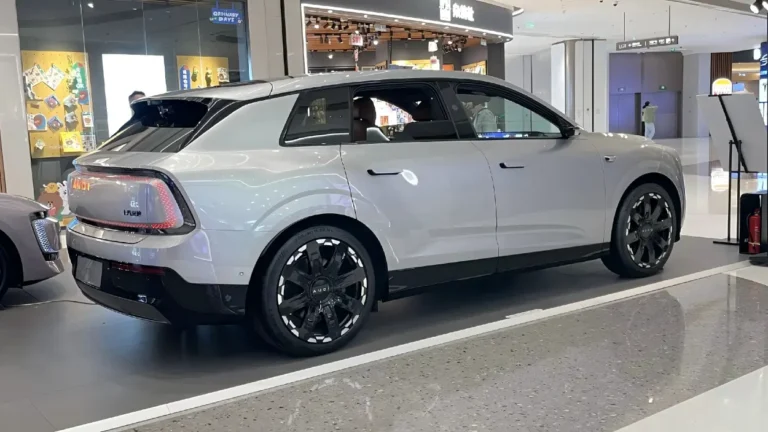
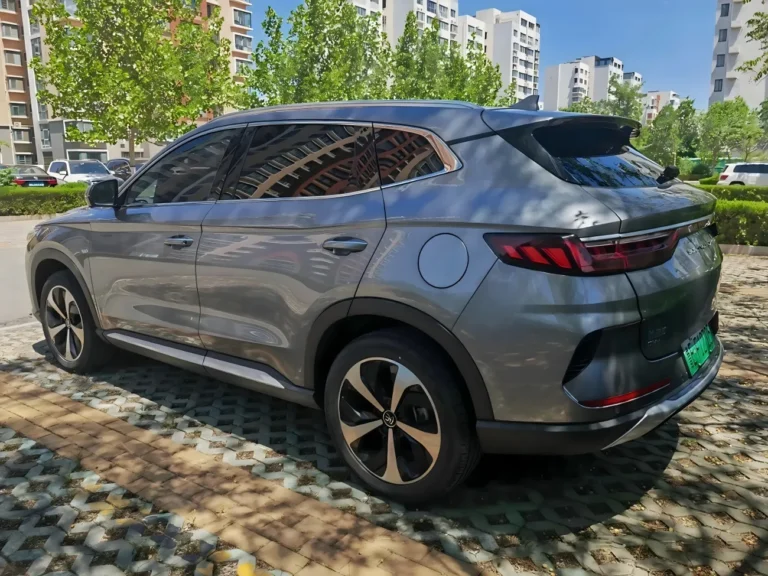
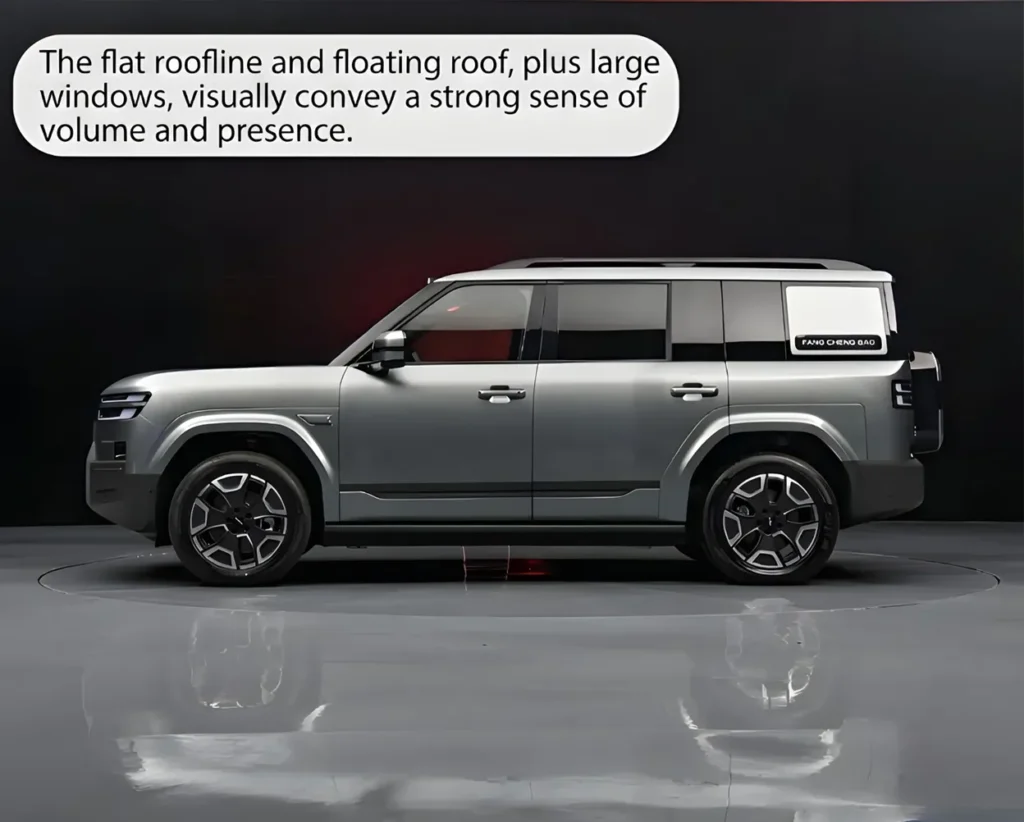
The vehicle boasts a commanding road presence, measuring 4999 mm (196.8 inches) in length, 1995 mm (78.5 inches) in width, and 1865 mm (73.4 inches) in height, anchored by a long 2920 mm (115.0 inches) wheelbase. Visually, the pure electric version heavily inherits the rugged, boxy design DNA of its PHEV predecessor, finished in an exclusive “Shan Shui Green” (山水绿) premium paintwork.
Powertrain Layout
Our test vehicle is the single-motor Rear-Wheel Drive (RWD) Flash Charge edition. It features an unladen curb weight of 2.5 tons (approx. 5,511 lbs) and rides on thick-sidewall Giti Control P10 tires (255/55 R19). The core mechanical BYD Leopard 7 specs include:
Maximum Power Output: 300 kW (408 horsepower)
Peak Torque: 365 N·m (269 lb-ft)
Battery Capacity: 105 kWh Lithium Iron Phosphate (LFP) pack
Official CLTC Range: 755 km (approx. 469 miles)
2. Real-World Range & Charging Efficiency Test
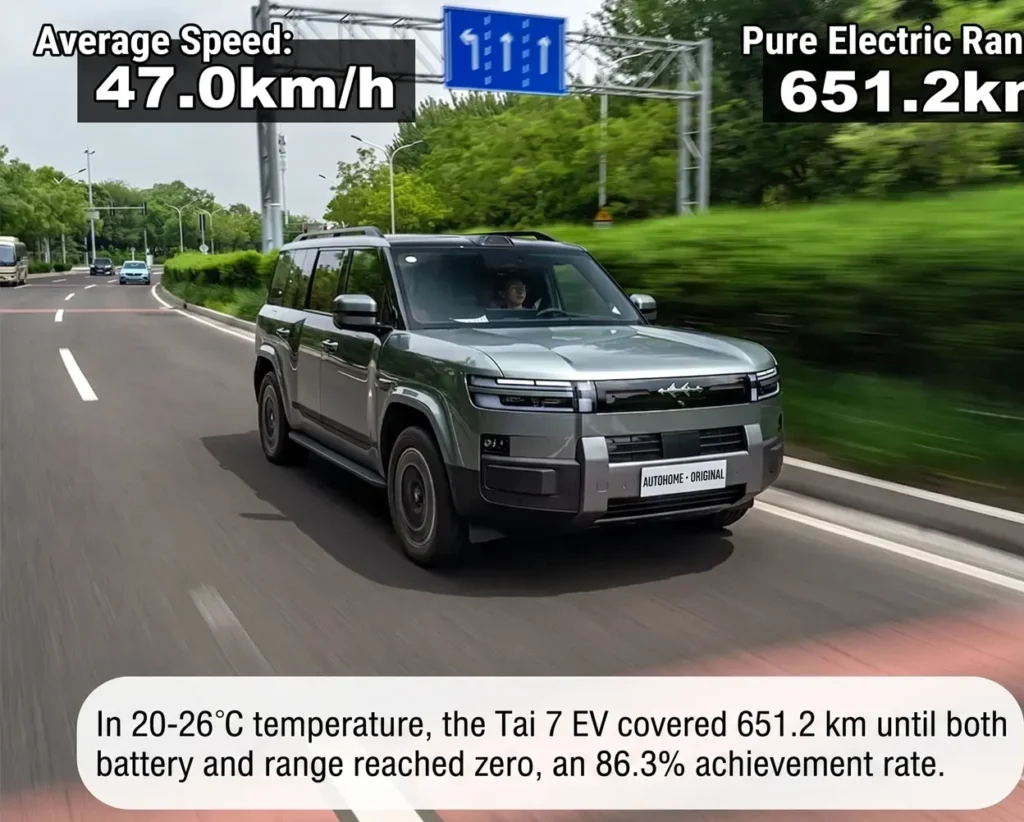
Range anxiety is the ultimate decider for premium EV buyers. We subjected the vehicle to a rigorous real-world endurance and charging test on a high-speed ring road grid under Economic driving mode with maximum energy recovery and climate control locked at 23°C (73.4°F) Auto.
Real-World Range Result: Against its official 755 km CLTC rating, the vehicle delivered a verified real-world driving range of 651 km (approx. 404 miles).
Energy Consumption: The calculated average electricity consumption registered at 17.22 kWh/100km. While not the most efficient in the single-motor segment due to its heavy 2.5-ton boxy profile, it compensates with pure battery volume.
120kW Fast Charging Performance: Hooked up to a standard 120kW fast-charging pile, the SUV showcased an incredibly stable charging curve. It replenished from 0% to 100% in just 59 minutes, while the critical 30%-to-80% bulk charge took 28 minutes. Notably, the battery management software sustained a near-peak 120kW charging speed even after the battery capacity exceeded 90%.
3. Track Performance: Track Testing & Braking Results
We pushed the 2.5-ton chassis to its absolute limits on the test track to extract its true performance boundaries.
Acceleration Boundaries
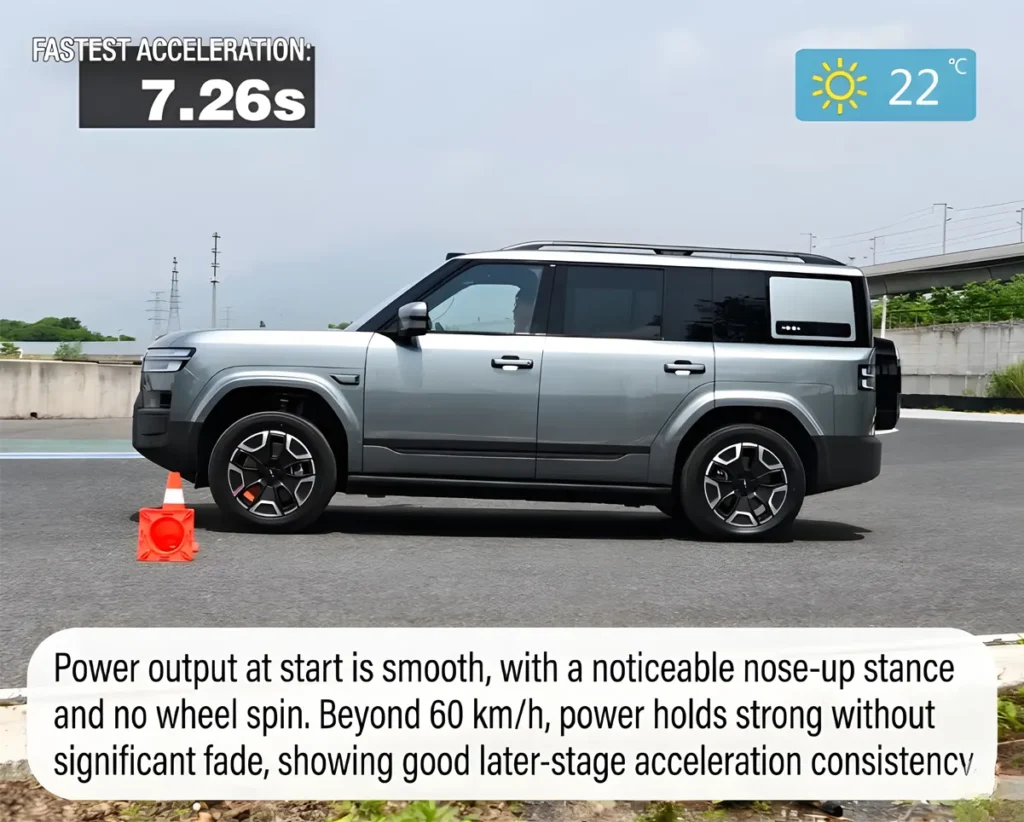
With Sport mode engaged and electronic stability controls fully deactivated, the RWD powertrain delivers strong mid-to-late stage pulling power:
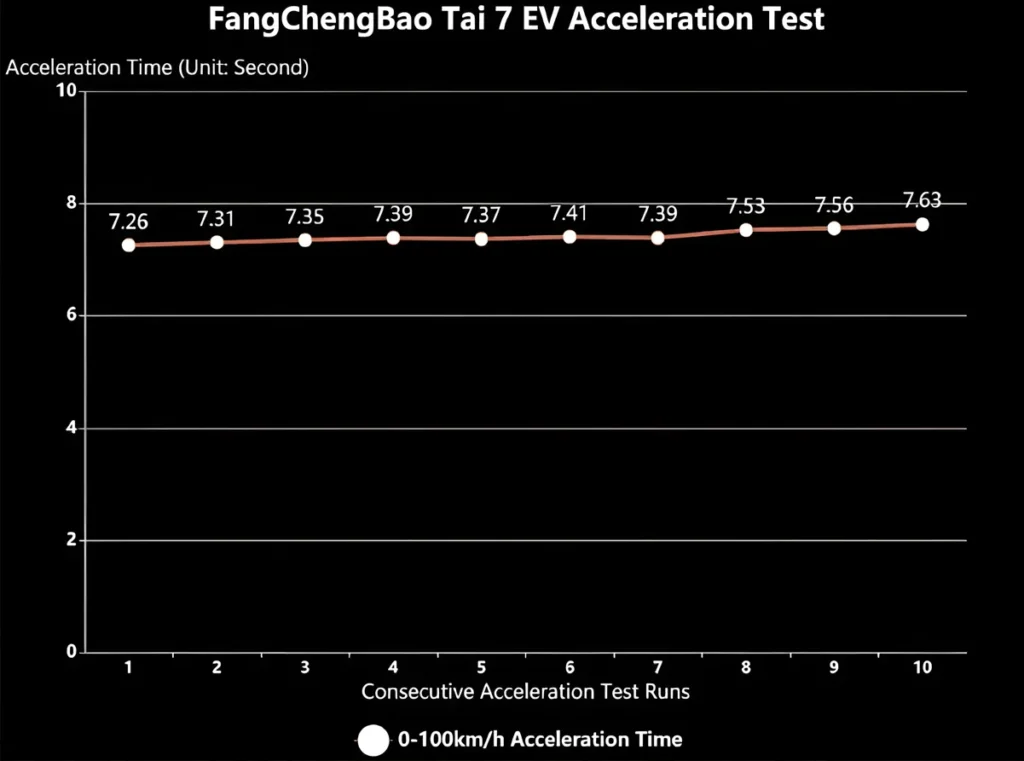
- 0-100 km/h (0-62 mph) Sprint: The best recorded time was a brisk 7.26 seconds on the first run. By the tenth consecutive hard launch, thermal protection caused a minor drop, settling at 7.63 seconds.
- Overtaking Acceleration: It clocked 40-80 km/h in 3.02 seconds and 80-120 km/h in 3.25 seconds, placing its high-speed overtaking ability at the top tier of single-motor SUVs.
Slalom & Moose Test Results
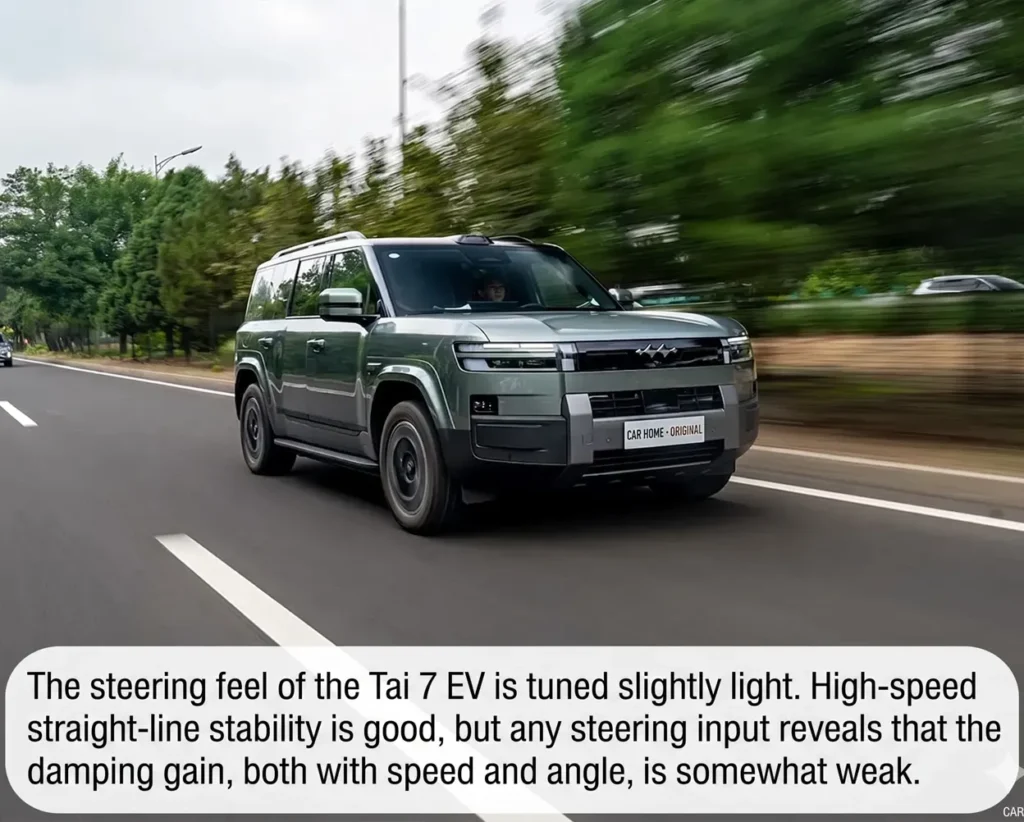
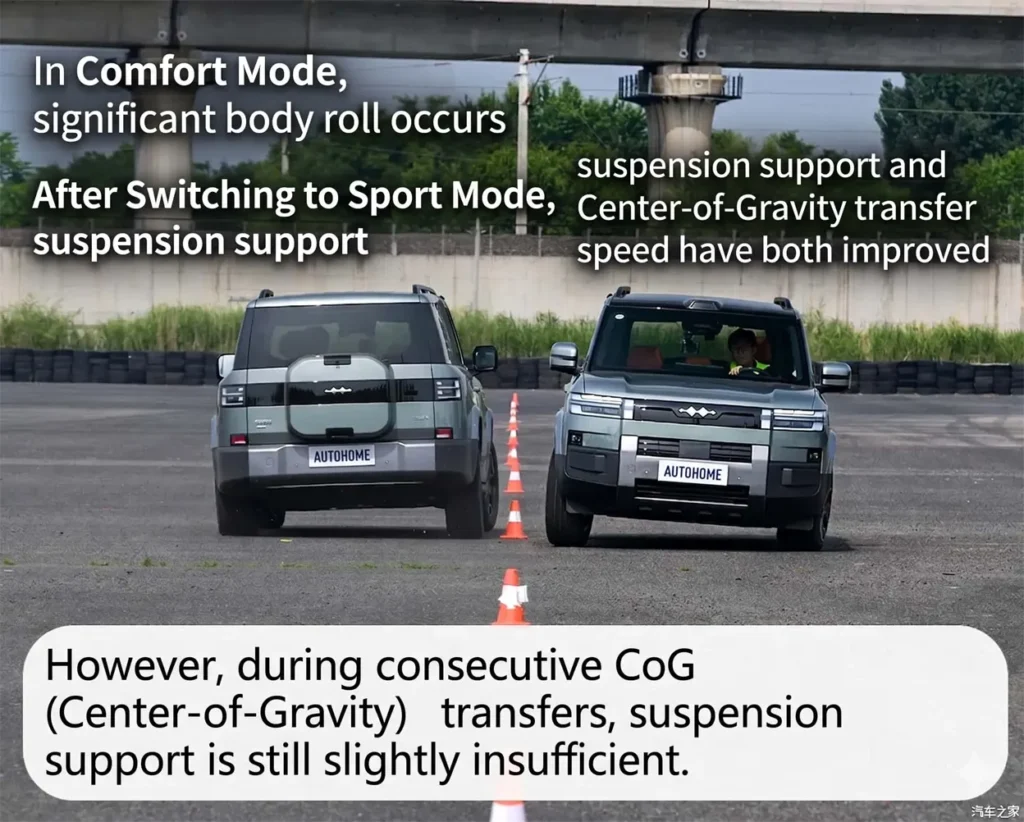
During hard slalom testing, the steering felt light, offering crisp initial turn-in. However, due to the vehicle’s long suspension travel, a noticeable weight-transfer delay occurs as the rear suspension compresses, leading to predictable understeer.
In the Moose Test (Elk Test), the unibody structure combined with the front double-wishbone and rear 5-link independent suspension delivered surprisingly nimble reactions for a rugged-looking SUV. The electronic stability hardware is tuned conservatively—engaging early but with gentle braking force—allowing the vehicle to successfully exit the course at a maximum verified speed of 72.0 km/h (44.7 mph).
Braking & Thermal Fading
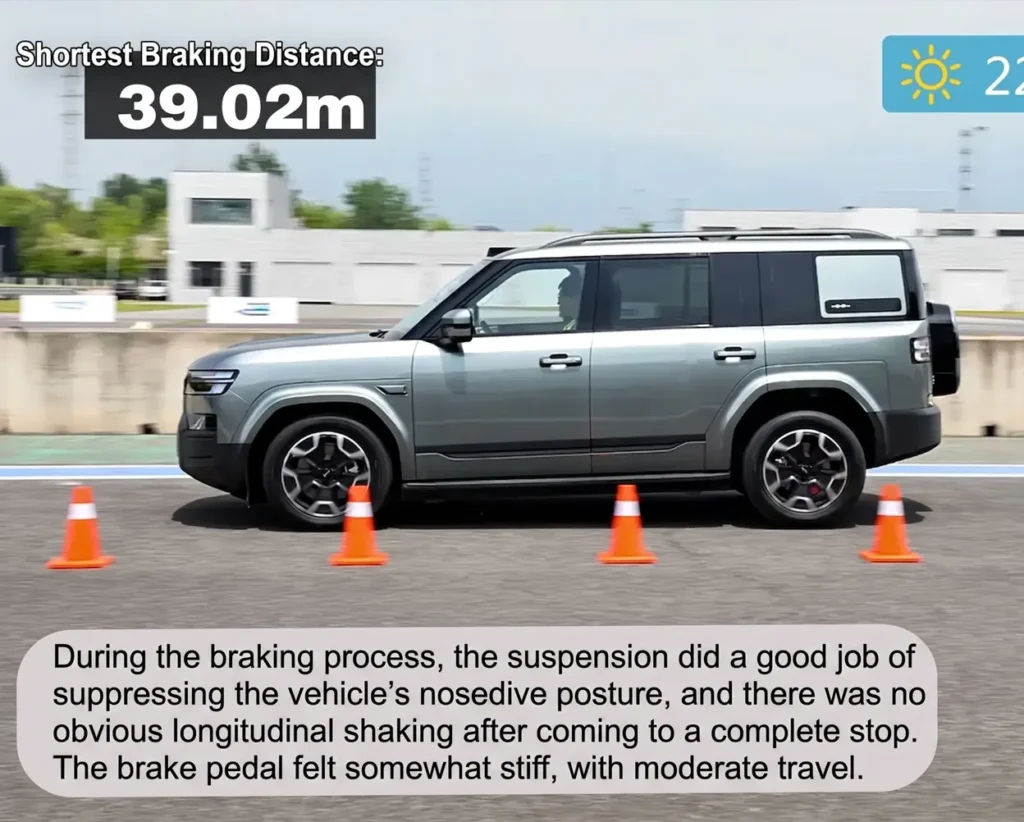
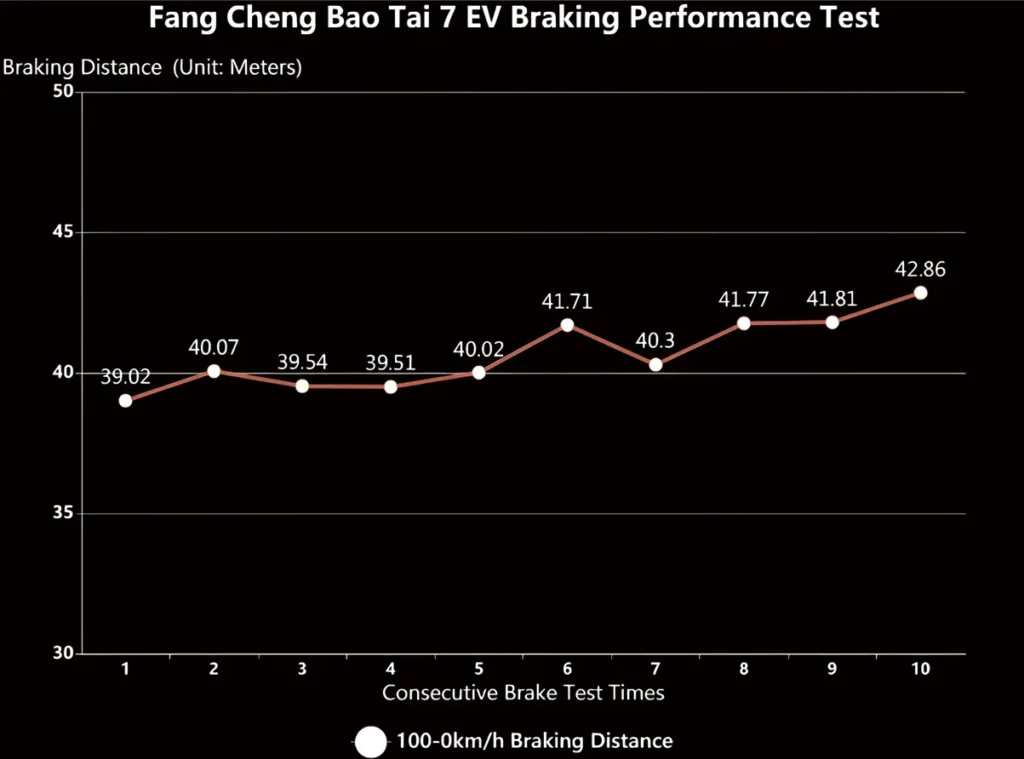
Equipped with dual-piston floating calipers up front and single-piston calipers at the rear on ventilated discs, the best 100-0 km/h stopping distance was 39.02 meters (128.0 feet). However, consecutive heavy braking revealed noticeable thermal degradation, with the tenth stop stretching out to 42.86 meters.
4. Daily Driving & Intelligent Cockpit Experience
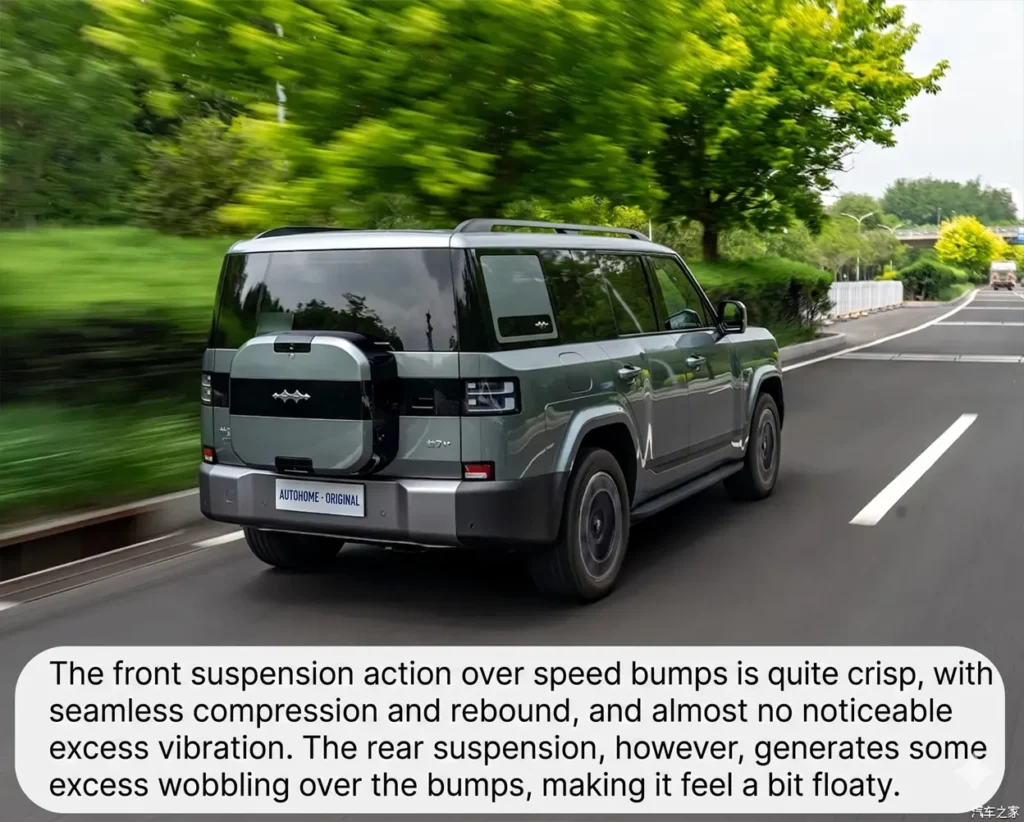
In everyday urban scenarios, the standard DiSus-C adaptive suspension coupled with the high-profile Giti tires absorbs minor road ripples with high compliance.
- Chassis Body Control: The DiSus-C system features specialized anti-pitch and anti-dive comfort algorithms. Setting the system to “Strong” successfully mitigates traditional SUV brake-dive and acceleration-squat, though some secondary lateral body sway remains over continuous undulations.
- NVH Insulation: Mid-to-low speed acoustic isolation is excellent. Once speeds cross 90 km/h (56 mph), road noise remains well-suppressed, leaving wind resistance around the boxy A-pillars as the primary cabin noise source.
- Smart Cabin Infotainment: The cockpit is anchored by a sharp, ultra-fluid 15.6-inch central display. The voice command system executes basic car controls with blazing speed, though complex multi-layered logical reasoning is slightly limited. The software menu layout requires some getting used to—for example, resetting the trip meter requires digging into the display sub-menus rather than the dedicated driving settings page.
5. Value Proposition: BYD Fang Cheng Bao ti 7 Price Analysis
As early production vehicle deliveries commence, higher-tier automated driving features (such as the premium Eye of God 5.0 ADAS suite) will become active via future over-the-air (OTA) updates. Looking strictly at the BYD Fang Cheng Bao ti 7 price matrix, the vehicle offers an undeniable value proposition.
For buyers analyzing the 3 available pure electric trims, the mid-tier long-range RWD version tested here represents the absolute sweet spot. For a marginal premium of just 10,000 RMB (approx. $1,400 USD) over the base model, it provides an additional 13.7 kWh of battery capacity and a critical 80 km of extra driving range. It stands out as an incredibly well-rounded package for families demanding large dimensions, robust fast-charging, and premium ride comfort on a budget.
6. [FAQ] Global Buyer’s Guide: BYD Fang Cheng Bao ti 7 Specs
- Q1: What are the primary BYD Leopard Titanium 7 specs regarding battery and real-world range?
- A: The vehicle carries a large 105 kWh Lithium Iron Phosphate (LFP) battery pack, boasting an official CLTC range of 755 km. In our rigorous real-world testing, it delivered a verified driving range of 651 km (approx. 404 miles) with an average efficiency of 17.22 kWh/100km.
- Q2: How fast is the fast-charging efficiency on the Titanium 7 EV?
- A: Built with advanced flash-charging capabilities, the SUV can charge from 0% to 100% in 59 minutes using a standard 120kW charging station. The system maintains near-peak 120kW speeds even past 90% state-of-charge, while the 30% to 80% charge takes only 28 minutes.
- Q3: What is the estimated BYD Fang Cheng Bao ti 7 price for global markets?
- A: In its domestic market, the SUV is priced aggressively between 199,800 and 239,800 RMB (approx. $27,600 – $33,100 USD). However, if you are looking for a BYD Fang Cheng Bao ti 7 for sale internationally, expect retail prices to increase due to localized electric vehicle import tariffs and sea freight logistics.