

Editor’s Note
For the past year, the mainstream media has been pessimistic about the electric vehicle transition, pointing to rolled-back bans and fading subsidies. But looking at the fresh 2026 registration data hitting our desks this quarter, I can tell you the reality is completely different. The global automotive landscape is undergoing a historic shift, and it’s no longer driven by government mandates—it’s driven by pure market demand. Here is my boots-on-the-ground analysis.
01. The China Paradigm: Pure EVs Take the Driver’s Seat
Since the domestic fuel price surge in March, I’ve been tracking a fascinating shift in consumer behavior across China. For a long time, the industry assumed that “dual-power” strategies—offering both Battery Electric (BEV) and Extended-Range (EREV/PHEV) options—would lean heavily toward hybrids.
The latest data shows the exact opposite. Consumers are skipping the middleman and going straight to pure electric. Whether it’s legacy joint-venture counterattacks like the Nissan NX8 or luxury flagships like the Denza Z9, BEV orders are vastly outperforming their hybrid counterparts.
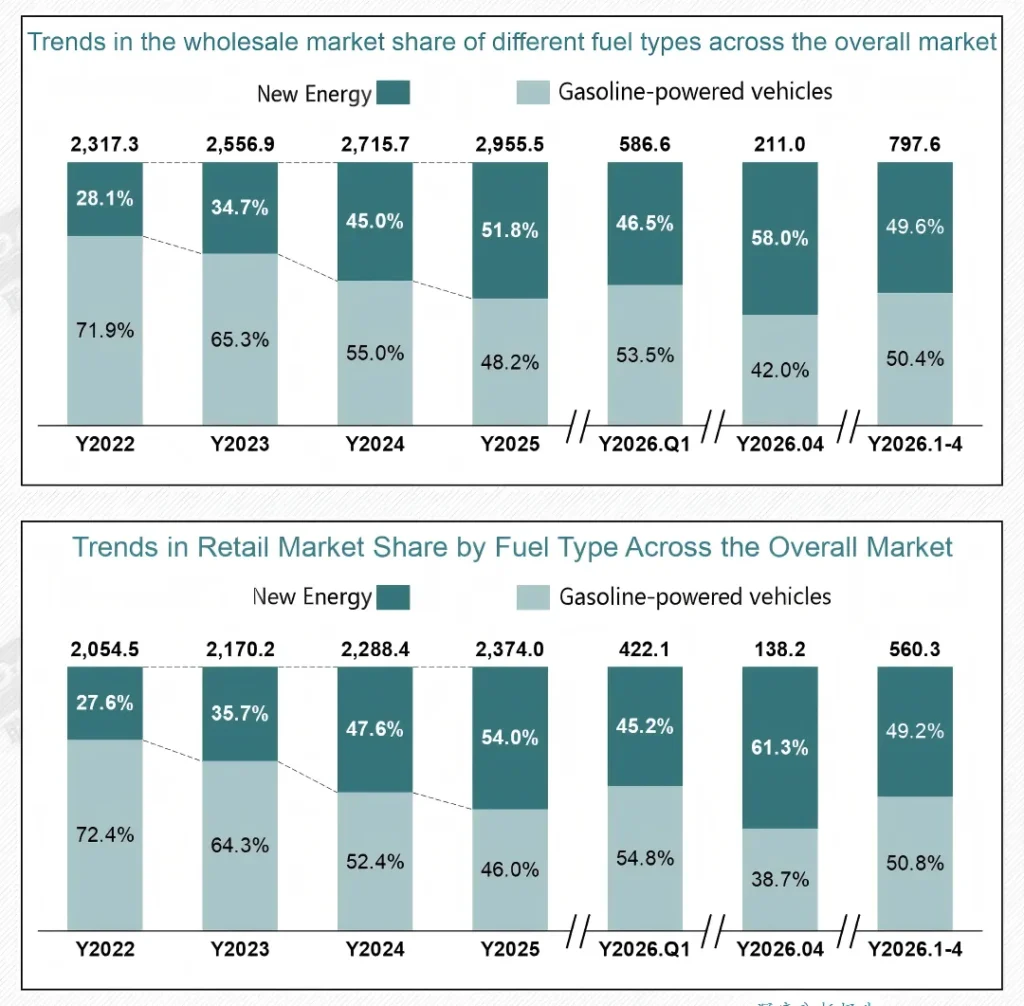
When we break down the retail figures, the pure electric dominance becomes undeniable:
- Breaking Records: In April 2026, China’s New Energy Vehicle (NEV) retail penetration blew past 61.3%, with early data indicating a climb to 62.5% in May. That means out of every 10 cars sold, more than 6 plug in.
- The Hybrid Slump: While the overall automotive market saw a minor dip in April, BEV retail sales pulled off a 2.4% year-over-year growth. Meanwhile, plug-in hybrids (PHEV) and EREVs tanked by 25.4% and 11.1% respectively.
- The 70% Domination: Pure electric models now command over 68% of the entire NEV market. In the top 10 bestselling passenger vehicles for April, traditional internal combustion engines held exactly one spot. The other nine were entirely electric.
We are seeing this play out clearly with specific models. Take the Deepal S05 or the BYD Sea Lion 06 EV—both offer dual powertrains, yet 80% to 90% of buyers are locking in the pure electric versions. Even in the highly competitive three-row family SUV segment, where hybrids used to rule, Nio’s premium electric ES8 clinched the top spot, shipping over 13,000 units in a single month and completely outclassing its hybrid rivals.
This isn’t a fluke. China has built the world’s most aggressive supply chain, bringing high-quality 600km+ range EVs down to the $15,000 price point. Combined with a charging infrastructure that seamlessly links rural towns to highway fast-chargers, the financial argument for owning a pure EV has simply become bulletproof for the average family.
02. The Global Ripple Effect: Bypassing Policy and Moving to Market Demand
Many analysts predicted that outside of China, the global automotive shift would stall out due to a lack of infrastructure. But as I analyze the Q2 2026 global terminal data, those pessimistic forecasts are being thoroughly shattered.
Driven by rising fuel costs tied to geopolitical tensions, international buyers are doing the math and choosing EVs to save their wallets. According to recent data from S&P Global Mobility, the EV transition has quietly hit its tipping point:
- Over March and April alone, 37 countries broke their all-time monthly records for EV sales.
- In 38 countries, EVs now account for more than 10% of all new car registrations.
- More importantly, 28 nations have crossed the 16% penetration threshold—the exact statistical point where an emerging technology transitions into rapid, mass-market adoption.
The International Energy Agency (IEA) has revised its forecasts, projecting global EV sales to hit 23 million units by the end of the year, pushing new car penetration close to 30%. This is no longer a localized trend; it’s a global synchronized movement.
03. The European Battlefield: Cost-Per-Mile Realities Are Killing Internal Combustion
Europe is currently the most dramatic arena for this transition. After a brief lull post-subsidy cuts, the EU electric car market has bounced back with a steady 40% year-over-year growth rate.
If you look closely at the latest May 2026 registration data from major European hubs, the collapse of the traditional gas and diesel car is staggering:
- The UK: Total sales grew by 7.1%, but that growth was entirely carried by electric vehicles. Pure BEV sales skyrocketed by 34.2%, pushing their market share to 27.3%, while pure petrol and diesel shares dropped below the 50% mark for the first time.
- France: EV sales surged by an incredible 92.8% in May, capturing 29.1% of the total market. Meanwhile, petrol sales plunged by 37.4%, and diesel plummeted by over 52%.
- Italy & Spain: Both nations saw massive pullbacks in traditional internal combustion. Spain’s electrified vehicle sales surged 43.6% in the first five months of the year, while Italy saw its pure EV market share jump significantly to nearly 9%.
Against this backdrop, Chinese EV giants are experiencing a phenomenal breakthrough. In May 2026, BYD’s sales in Germany grew by 326.4% year-over-year. Similar triple-digit spikes were recorded in Italy and the UK. According to data from the European car-buying platform Carwow, consumer queries for affordable electric models like BYD’s lineup surged by a staggering 25,000% in Q1 alone.
The underlying catalyst here is purely economic. Right now, a liter of 95-octane petrol in Europe hovers around €1.61 ($6.10 per gallon), while residential electricity averages about €0.45 per kWh. For the average commuter, driving a pure electric car cuts their fuel bill exactly in half compared to a gas-powered counterpart. Faced with doubling their commuting costs, European buyers are pragmatically voting with their checkbooks.
The Final Verdict: History Doesn’t Repeat, But It Rhymes
In its latest strategic outlook, the IEA pointed out that how we react to the current energy crisis will permanently reshape the automotive market trends for the next decade.
It reminds me heavily of the 1970s oil crisis. Back then, skyrocketing oil prices permanently broke the monopoly of gas-guzzling American land yachts and created the perfect storm for highly efficient, compact Japanese cars to conquer the world.
History is rhyming in 2026. This energy-price-driven EV surge is opening a historic window for agile, vertically integrated EV makers to redefine the global automotive hierarchy. No matter the political headwinds, the economic gear has turned—and you cannot turn it back.