

Summary
A bill advancing through Congress could exile Mercedes-Benz from the U.S. market. Toyota just booked ¥1.38 trillion in tariff damage. And America’s EV transition is going in reverse. The protectionist playbook isn’t working.
The Big Picture
Three threads are converging in Washington’s auto policy: a House bill that could ban Mercedes-Benz over its Chinese shareholders, a rewrite of the USMCA that would demand 82% North American content, and a domestic EV market that shrank 27% year-over-year in Q1 2026. Together they tell a story of a country trying to build walls around its auto industry — and finding that the walls keep the wrong things out.
The Mercedes Problem: When Your Ally’s Shareholders Are Your Adversary
On May 29, CNBC reported that the Motor Vehicle Modernization Act of 2026, currently making its way through the House Energy and Commerce Committee, could have an unintended casualty: Mercedes-Benz.
The bill, sponsored by Chairman Brett Guthrie (R-Ky.), would prohibit any automaker with “any direct or indirect equity interest by a foreign-adversary government” from manufacturing, selling, or importing vehicles in the United States for five years. China is listed as a foreign adversary, alongside Russia and North Korea.
Here’s where it gets awkward. Mercedes-Benz’s largest individual shareholder is BAIC, the Chinese state-owned automaker, with a 9.98% stake. The second-largest is Chinese billionaire Li Shufu, founder of Geely, who holds 9.69% through his investment firm. Combined, Chinese interests control 19.67% of Mercedes-Benz Group AG.
A separate 15% ownership threshold in the bill — defining “controlled by” a foreign adversary — could seal the deal. Multiple sources told CNBC the bill, as written, would ban Mercedes from the U.S. market.
- Why This Is StrikingMercedes operates two large assembly plants in the United States — Tuscaloosa, Alabama (which has produced over 5 million vehicles since 1997) and a passenger van facility in South Carolina. The company employs more than 10,000 Americans. In 2025, it sold 303,200 passenger cars and 12,400 vans in the U.S. Banning Mercedes would mean idling American factories and laying off American workers — in the name of protecting American industry.
Mercedes has reportedly engaged U.S. officials seeking a compromise, but the bill’s language is, in the words of one former automotive policy advisor consulted on the legislation, “unambiguous.” Volvo, which is majority-owned by Geely, has already secured a separate authorization to bypass connected-vehicle software restrictions — a sign that case-by-case carve-outs may be the emerging workaround.
Stephen Ezell of the Information Technology and Innovation Foundation, a Washington think tank, offered a blunt assessment: “If Mercedes were to be included in the bill, I think it would be an unintended consequence that could result in the loss of jobs and profits.”
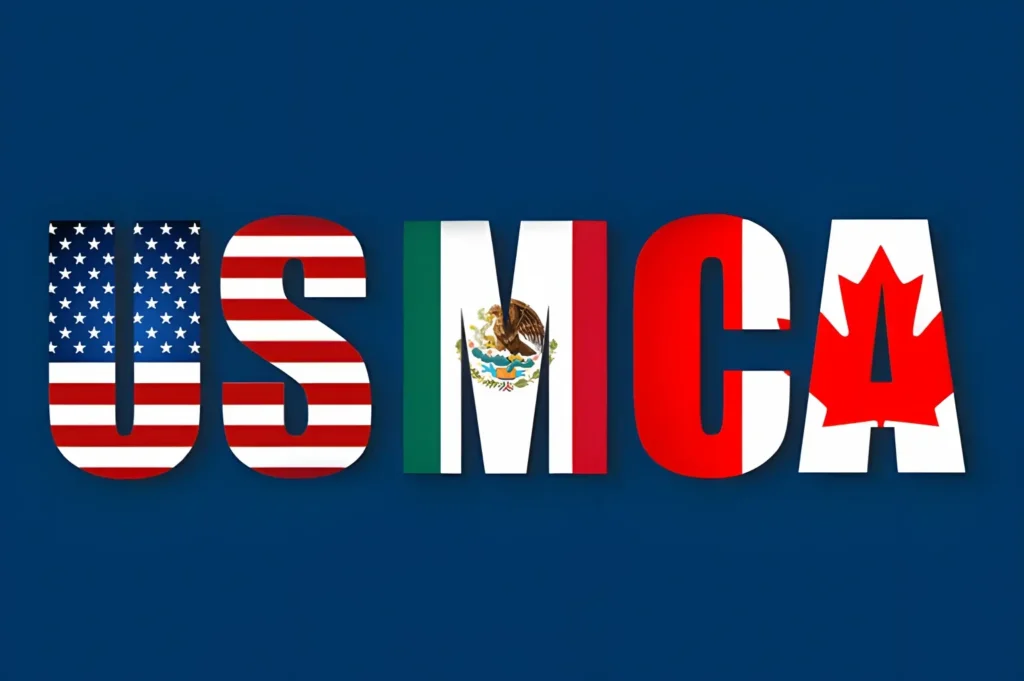
The USMCA Rewrite: 82% Regional Content, 50% U.S.-Only
While Congress targets Chinese ownership, the Trump administration is simultaneously pushing to rewrite the USMCA itself. According to four people familiar with the U.S. negotiating position, Washington wants to raise the regional value content threshold from the current 75% to 82% — with 50% of parts value required to originate in the United States specifically.
The current USMCA, which took effect in 2020, requires 40% of “core parts” value to be produced in high-wage jurisdictions (effectively the U.S. or Canada), and 45% for pickup trucks. The proposed shift would be a fundamental restructuring of North American automotive trade.
Notably, the U.S. proposal reportedly contains no provision for counting Canadian parts content in the totals — and Canada is not represented in the Mexico City talks. U.S. Trade Representative Jamieson Greer has been evasive about whether USMCA would continue as a trilateral pact or be split into bilateral agreements.
- What This Means in PracticeAutomakers that built factories in Mexico to take advantage of lower labor costs — a strategy encouraged by the original NAFTA and continued under USMCA — would face a brutal choice: relocate production to the United States at far higher cost, or lose tariff-free status. Either way, the cost of building a car in North America goes up. And those costs do not stay with the manufacturer.
Toyota’s ¥1.38 Trillion Tariff Bill
The consequences of this protectionist turn are already showing up in corporate earnings. Toyota Motor, the world’s largest automaker by volume, reported FY2026 operating income of ¥3.76 trillion ($39.8 billion) — a 21.5% decline from the prior year. The company attributed ¥1.38 trillion of that damage directly to U.S. tariffs.
Toyota’s North American operations, long a profit engine, recorded a sharp decline in earnings. Net income fell 19.2% to ¥3.84 trillion. The company forecast a further decline for FY2027, projecting operating income of just ¥3 trillion — a drop of ¥766.2 billion from already-depressed FY26 levels.
This is the paradox of the tariff wall: it kept Chinese competitors out, but it also taxed the very allies Washington claims to protect. Toyota sold 10.477 million Toyota and Lexus vehicles globally in FY2026 — resilient volume that generated record revenue (¥50.68 trillion, up 5.5%) but shrinking profit. The company is selling more cars and making less money on each one.
- The Bigger PatternToyota is not alone. Hyundai and Kia have been posting record U.S. sales — driven by hybrids and crossovers — even as their profitability compresses under tariff pressure. The Trump administration raised tariffs on South Korean vehicles to 25% in January 2026, putting Hyundai and Kia at a disadvantage against Japanese rivals, Automotive News reported. The pattern repeats across the allied auto sector: volume up, margin down.
America’s EV Market Is Going in Reverse
The protectionist experiment was supposed to give America’s domestic EV industry room to grow. It hasn’t worked out that way.
According to Cox Automotive, Americans bought 216,399 new electric vehicles in Q1 2026 — a 27% drop from the same quarter a year earlier. EV penetration fell to 5.8%, down from a peak of 10.6% in late 2025. Electrek put the decline even higher, at 28% year-over-year.
The slide coincided with the expiration of federal EV tax credits, which had propped up demand for vehicles that — without subsidies — are simply too expensive for most American buyers. Meanwhile, Chinese EVs, which retail for a fraction of the price of comparable Western models, remain barred from the U.S. market entirely. The result: American consumers have neither cheap EVs nor subsidized EVs, and the transition stalls.
Tesla, the supposed beneficiary of keeping Chinese rivals out, saw its own Q1 U.S. sales fall sharply as the broader market contracted. Protectionism did not protect Tesla from a shrinking pie — it just ensured the pie was smaller.
The Consumer Bill: $51,000 and Climbing
Behind every tariff and local-content mandate is a cost that ultimately lands on the buyer. The data is unambiguous: the average transaction price of a new vehicle in the United States hovered near $51,000 in 2025, crossing $50,000 for the first time, according to Cox Automotive/Kelley Blue Book data.
A study by consulting firm Plante Moran found that one-third of Americans can no longer afford a new car at all. The buyer base has shifted dramatically: households earning under $100,000 fell from 50% of new-car buyers in 2020 to just 37% in 2026, while households earning over $200,000 rose from 18% to 29%. The American new-car market is becoming a luxury market by default.
Some Americans have begun crossing into Mexico and Canada to purchase vehicles at lower prices — a quiet but telling signal that the protectionist wall is leaking at the consumer level. You can tariff the supply chain, but you cannot tariff a road trip.
The Contradiction at the Heart of U.S. Policy
Perhaps the most revealing feature of Washington’s current approach is its internal contradiction. The same administration that has blocked Chinese vehicles from the U.S. market has simultaneously invited Chinese automakers to build factories in the United States and transfer technology to American partners. The message is incoherent: Chinese technology is welcome, Chinese products are not, Chinese ownership is forbidden, Chinese investment is encouraged.
For global automakers trying to plan a five-year product cycle, this is not a policy environment — it is a minefield. Mercedes cannot know whether it will be allowed to sell cars in the United States next year. Toyota cannot know whether its North American supply chain will remain compliant. Hyundai cannot know whether its South Korean factories will face 25% tariffs or preferential rates. And American consumers cannot know whether the next car they buy will cost more or less than the last one.
- Journalist’s PerspectiveProtectionism is often sold as a temporary measure to buy time for domestic industry to become competitive. But the evidence from Q1 2026 suggests the opposite is happening. U.S. EV adoption is declining, not catching up. American new-car prices are rising, not falling. And the automakers being punished — Toyota, Hyundai, Mercedes — are precisely the companies that build vehicles in the United States and employ American workers. The wall is being built in the wrong place.