
The Big Picture
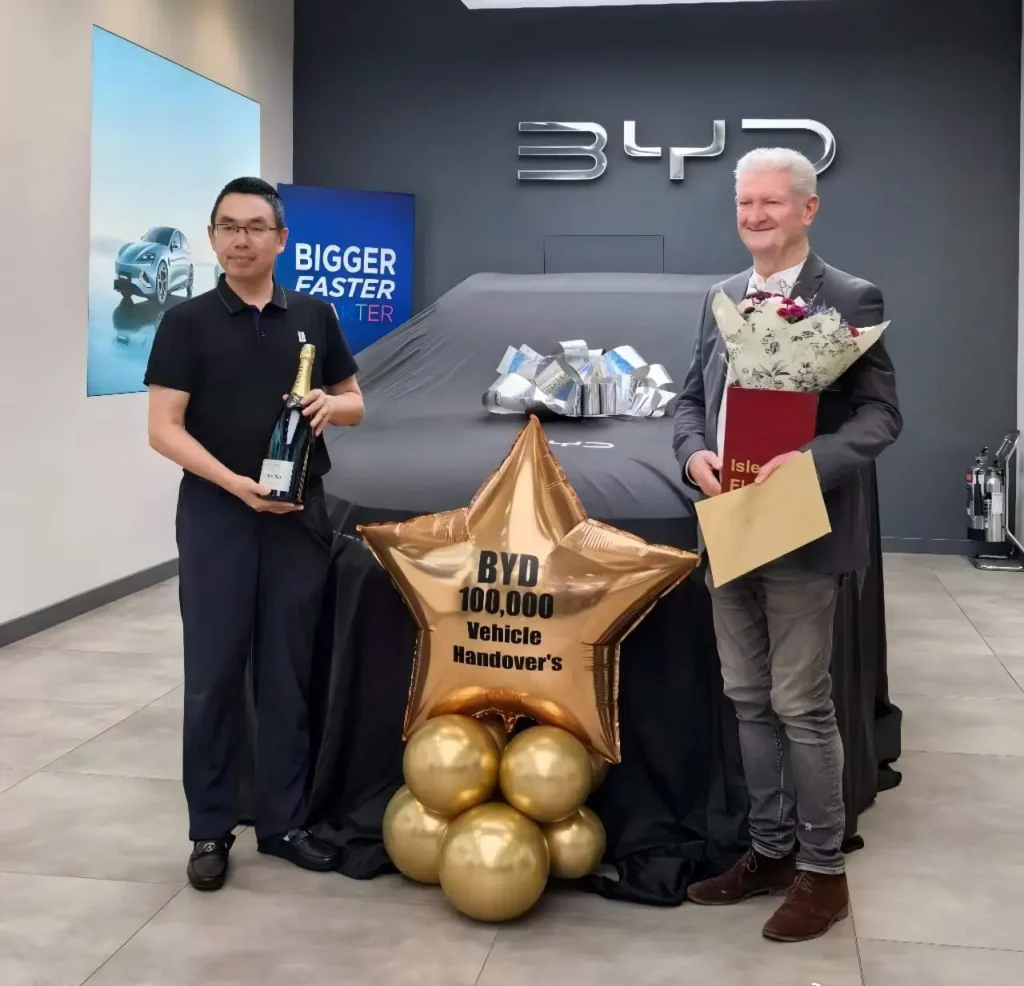
BYD delivered its 100,000th new energy vehicle in the UK this week — a milestone that took Tesla roughly eight years to reach. The striking part: BYD achieved it without qualifying for UK government EV subsidies that its competitors receive, while capturing 7.2% of the British EV market and overtaking Tesla, BMW, and Volkswagen to become the UK’s largest EV brand. If the European tariff wall was supposed to keep Chinese automakers out, nobody told BYD.
1. The Milestone: 100,000 Vehicles in Three Years
BYD executive vice president He Zhiqi announced on Wednesday that the company has delivered its 100,000th new energy vehicle (NEV) in the United Kingdom. The milestone comes just over three years after BYD entered the UK passenger car market in March 2023 with the Atto 3 (known as the Yuan Plus in China).
BYD sold 26,396 NEVs in the UK in the first four months of 2026 alone, up 124% year-on-year. That performance pushed its market share above 7%, making it the UK’s largest EV brand — ahead of Tesla, BMW, and Volkswagen, according to SMMT registration data.
He also revealed that BYD is the fastest brand in UK automotive history to reach a 5% market share.
The Acceleration Curve: BYD’s UK growth was slow at first, then explosive. It took the company 19 months to sell its first 10,000 vehicles in the UK. It then took just five months to go from 10,000 to 20,000. The trajectory from 20,000 to 100,000 has been even steeper, driven by a rapidly expanding product lineup that now spans 11 NEV models — from the £18,675 (25,080)DolphinSurftothe£47,025(63,260) Sealion 7.
2. The Tesla Comparison: Half the Time
To understand how fast BYD has moved, compare it to Tesla — the company that effectively created the UK EV market.
Tesla began UK deliveries of the Model S in 2014, with CEO Elon Musk personally handing over the first units. The company reached 250,000 UK deliveries in March 2025 — 11 years after entering the market. It crossed 300,000 in May 2026, according to Fleet News.
Working backwards from Tesla’s known milestones, the American automaker reached 100,000 UK deliveries somewhere around 2021-2022 — roughly seven to eight years after entering the market. BYD hit the same number in about three years.
| Metric | Tesla UK | BYD UK |
| Market entry | 2014 (Model S) | March 2023 (Atto 3) |
| Time to 100,000 deliveries | ~7–8 years | ~3 years |
| Qualifies for UK EV subsidy? | Yes | No |
| UK market share (early 2026) | Declining | 7.2% and rising |
| Current UK model count | 4 (Model 3, Y, S, X) | 11 |
Analyst Take: The speed comparison is not entirely apples-to-apples. Tesla entered the UK when EV charging infrastructure was scarce and consumer awareness was low — it had to build the market. BYD entered a market Tesla had already primed. But that context makes BYD’s subsidy disadvantage more striking, not less. Tesla enjoyed UK government grants throughout its growth phase. BYD has received none.
3. The Subsidy Disadvantage
Here’s the detail that makes BYD’s UK performance genuinely remarkable: BYD models do not qualify for UK government EV subsidies. Some of its competitors’ models still receive discounts of up to £3,750 ($5,040) per vehicle.
The UK’s grant program — which has taken various forms over the years — typically ties eligibility to price caps and domestic content requirements that Chinese-made vehicles fail to meet. The practical effect: a British buyer choosing a BYD over a subsidized competitor pays the full sticker price, while the competitor’s buyer gets a government-funded discount. The UK government’s Electric Car Grant page sets eligibility by price band (£37,000 ceiling) and domestic content rules that Chinese-made vehicles fail to meet.
And yet BYD is winning.
Why This Matters: European policymakers have spent the past two years designing tariff and subsidy regimes specifically to slow Chinese EV penetration. The UK approach — excluding Chinese vehicles from purchase grants while allowing them to be sold — was supposed to create a price wedge favoring domestic and allied brands. BYD’s 7.2% market share suggests the wedge isn’t working. When a product is good enough and cheap enough, a few thousand pounds of subsidy doesn’t change the purchase decision.
4. The Flash Charging Bet: 300 Stations by Year-End
Alongside the delivery milestone, He Zhiqi visited BYD’s first flash charging station in the UK, located in Uxbridge, and announced plans to roll out 300 flash charging stations across the country by the end of 2026.
The stations pair with BYD’s second-generation Blade Battery, which can charge from 10% to 97% in nine minutes. BYD unveiled the battery and flash-charging technology in March 2026, claiming it as the world’s fastest-charging production EV battery. For context, Tesla’s Supercharger network — the gold standard for DC fast charging — typically adds about 150-200 miles of range in 15 minutes.
This is a vertically integrated play that no European automaker can currently match. BYD makes the battery, makes the car, and now builds the charging infrastructure. It’s the same model Tesla used to build its Supercharger moat — but BYD is executing it at a faster clip.
Journalist’s Perspective: The charging station rollout is arguably more significant than the delivery milestone. Vehicles can be imported; infrastructure requires local presence, capital, and regulatory approval. BYD committing to 300 UK charging stations is a long-term bet on the British market that goes beyond selling cars — it’s building the ecosystem that locks in future customers. Tesla understood this a decade ago. BYD understands it now.
5. The Product Strategy: 11 Models, £18K to £47K
BYD’s UK lineup now spans 11 NEV models covering both battery electric (BEV) and plug-in hybrid (PHEV) segments. The price range — from £18,675 for the Dolphin Surf to £47,025 for the Sealion 7 — gives BYD coverage across nearly every major UK price segment. (See BYD’s UK configurator for the full lineup.)
This breadth stands in stark contrast to Tesla, which offers just four models in the UK (Model 3, Model Y, Model S, Model X) and has shown little appetite for the budget segment — see Tesla’s UK site. It also contrasts with European incumbents like Volkswagen and BMW, whose EV lineups are still relatively thin below £30,000.
The product strategy explains the acceleration curve. BYD’s first 10,000 UK sales took 19 months because it had one model (the Atto 3). The subsequent explosion coincided with the rapid addition of models across price tiers. By the time UK buyers were choosing between a £19,000 BYD and a £45,000 Tesla, the volume math changed.
The Bottom Line
BYD’s 100,000th UK delivery is not just a number — it’s a structural signal. The company reached in three years what took Tesla nearly a decade, did it without government subsidies, and did it while European policymakers were actively trying to keep Chinese EVs out. The 7.2% market share and the 300-station charging commitment suggest this is not a trial balloon — it’s a long-term occupation.
For European automakers, the implication is uncomfortable. The tariff-and-subsidy defense was designed for a world where Chinese EVs were cheap but inferior. BYD’s UK performance suggests they are now cheap and competitive — and building the infrastructure to stay. The wall may already have been breached.
Sources & Further Reading
- CnEVPost — “BYD delivers 100,000th EV in UK, plans 300 flash charging stations by year-end” (June 17, 2026) — cnevpost.com
- ChinaEVHome — “BYD Hits 100K UK Deliveries, Claims 7% BEV Share” (June 17, 2026) — chinaevhome.com
- SMMT — UK Electric Vehicle Registration Data — smmt.co.uk
- UK Government — Electric Car Grant (eligibility & price bands) — find-government-grants.service.gov.uk
- Fleet News — “Tesla delivers 300,000th vehicle in the UK” (June 3, 2026) — fleetnews.co.uk
- EV (CARBA) — “Tesla Crosses 250,000 Deliveries in UK” (March 26, 2025) — eletric-vehicles.com
- The Independent — “Tesla marks UK sales milestone as fierce competition looms” (June 3, 2026) — independent.co.uk
- CnEVPost — “BYD unveils 2nd-gen blade battery” (March 5, 2026) — cnevpost.com
- Tesla UK — Supercharging support page — tesla.com/en_gb
- BYD UK — Vehicle configurator — byd.com/uk
- The Car Expert — “Tesla Model S (2014 – present)” — thecarexpert.co.uk