

The Big Picture
BYD is undertaking the most significant organizational restructuring in its history. The company will split its all-powerful engineering academy into five brand research institutes — Dynasty, Ocean, Fang Cheng Bao, Denza, and Yangwang — and force each sub-brand to fund its own R&D, production, and procurement independently. The move reverses the centralized, founder-led model that took BYD from 427,000 annual sales in 2020 to 4.6 million in 2025, and comes as the company’s sales fell 20% in the first five months of 2026 and its shares dropped 34% from their peak. It is, in essence, a bet that the structure that built the giant is now the thing holding it back.
1. The Reorganization: Five Brand Republics
According to a Friday report by LatePost (confirmed by CnEVPost), BYD will make its sub-brands responsible for their own profit and loss, with Yangwang excluded for now. Each brand entity will draw on group resources as needed — R&D, production, procurement — but costs will be settled independently.
This follows a separate report by Jipian Lab on Wednesday that BYD is splitting its engineering academy into five brand research institutes: Dynasty, Ocean, Fang Cheng Bao, Denza, and Yangwang. The engineering academy will retain only its technology platform development function, becoming what insiders call a “relatively pure technology middle platform.”
Why This Is Seismic: For nearly two decades, BYD’s vehicle models were defined and developed uniformly by the automotive engineering academy. Core technologies — the hybrid and pure-electric platforms, the chassis, the Blade Battery — were all held centrally. Sub-brand chiefs handled sales, not strategy. Under the new structure, each brand becomes a fiefdom responsible for its own product definition, design language, and channel strategy — and its own balance sheet.
This is a sharp break from the centralized model that built BYD. From 2008 to 2024, cumulative R&D investment exceeded 180 billion yuan ($26.6 billion). In 2019, when net profit was just 1.6 billion yuan, R&D spending topped 5.6 billion — a ratio only a founder-led company could sustain. Chairman Wang Chuanfu bet on LFP batteries when subsidies favored energy density, acquired a bankrupt chipmaker to start in-house IGBT development, and drove sales from 427,000 units in 2020 to 4.27 million in 2024. The centralized model was the right structure for the build-out phase. The question now is whether it’s the right structure for the competition phase.
2. The Crisis: Why the Old Model Stopped Working
The restructuring is a direct response to a growth crisis. BYD’s own numbers tell the story:
| Metric | 2024 | 2025 | 2026 (Jan-May) |
|---|---|---|---|
| Annual NEV sales | 4.27 million | 4.60 million (+7.7%) | 1.405 million (-20% YoY) |
| Q1 net profit | — | — | RMB 4.09B (-55% YoY) |
| A-share price (from peak) | — | Peak: RMB 137.67 | ~RMB 91 (-34%) |
| H-share price (from peak) | — | — | -45% from peak |
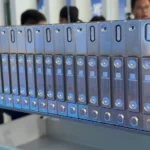
At the June 9 annual general meeting, Wang Chuanfu offered a new explanation for the sales decline: it’s not demand weakness, but a production-line transition bottleneck at the second-generation Blade Battery. The new battery, unveiled in March, charges from 10% to 70% in five minutes and has generated over 100,000 pre-orders for the Datang EV alone. Demand is not the problem; tooling is.
But the Competition Story Is Real: Even if the battery bottleneck explains the supply side, the competitive landscape has fundamentally shifted. Leapmotor posted monthly sales exceeding 80,000 units in May 2026, up more than 80% year-on-year. Xiaomi stabilized above 30,000 monthly units. Geely reached 153,000 domestic units in a single month. The Chinese EV market has moved from a one-dominant-player configuration to multi-front competition across every price band.
The clearest symptom of the old model’s limits is Fang Cheng Bao, BYD’s off-road brand. Its Bao 5 fell short of expectations and was forced into a 17% price cut within months of launch. BYD then pivoted the brand toward the mainstream — turning “premium personalized” into “another BYD.” That homogenization is exactly what the centralized model creates: when one engineering academy defines all vehicles on the same platforms, brands converge. Under the new structure, each brand’s research institute will be accountable for its own market performance — and will have the authority to define products that genuinely differentiate.
3. The Geely Parallel: “One Geely” vs. “Many BYDs”
BYD’s reorganization comes with a striking irony: it is moving toward the multi-brand autonomy that Geely is moving away from.
In 2024, Geely announced its “Taizhou Declaration”, a strategic shift from fragmentation to consolidation under the “One Geely” banner. Geely set up a unified central research institute to handle shared technologies while establishing separate vehicle research institutes for Lynk & Co, Zeekr, and Galaxy for product definition.
| Dimension | Geely “One Geely” | BYD “Brand Republics” |
|---|---|---|
| Direction | Consolidating from fragmentation | Decentralizing from centralization |
| Central R&D | Unified central institute (strengthening) | Engineering academy (shrinking to platform only) |
| Brand institutes | Lynk, Zeekr, Galaxy (product definition) | Dynasty, Ocean, FCB, Denza, Yangwang (full P&L) |
| P&L responsibility | Group consolidated | Each brand self-funding |
Analyst Take: Both companies are converging on the same middle ground from opposite directions: a strong central technology platform + autonomous brand-level product definition. Geely is consolidating to stop brand cannibalization. BYD is decentralizing to stop brand homogenization. The diagnosis is different; the prescription is the same. China’s two largest private automakers are simultaneously restructuring — a signal that the next phase of EV competition will be won by organizational agility, not just technology or scale.
4. The 2030 Bet: Global #1 or Regional #3?
At the AGM, Wang Chuanfu projected that BYD would become the world’s largest automaker by scale within five years. The 2026 overseas sales target of 1.5 million units is now considered a floor, with Morgan Stanley projecting 1.6-1.8 million. BYD expects to claim the #1 market-share position in Australia within months and is pursuing the same in Brazil.
May 2026 offered the first inflection signal: monthly deliveries recovered to 383,500 units, ending eight consecutive months of decline. Overseas exports hit a record 160,000 units — roughly 42% of monthly volume. The profit center of gravity is moving offshore.
Journalist’s Perspective: The restructuring and the 2030 ambition are the same bet. BYD cannot become the world’s largest automaker by selling indistinguishable cars under five badges in a shrinking domestic market. It can only get there if each brand develops a clear identity that travels globally — Dynasty as the mainstream workhorse, Denza as the premium executive, Yangwang as the luxury flagship, Fang Cheng Bao as the adventure specialist, Ocean as the youthful design-led option. The reorganization is not a retreat from growth; it’s a precondition for it. But it’s also a concession that the founder-led model has reached its limits. Wang Chuanfu built BYD by making decisions no subordinate would make. Now he’s betting that subordinates can make them better.
The Bottom Line
Every great automaker eventually faces the same moment: the structure that built it becomes the structure that constrains it. Toyota went through it in the 2000s. Volkswagen went through it with Dieselgate. Now BYD is going through it under the pressure of a 20% sales decline and a competitive landscape that no longer revolves around a single player.
Decentralized brand republics could unlock the differentiation and agility BYD needs to compete with Leapmotor, Xiaomi, and Geely across every price segment — and to build the brand identities that will carry it into Europe, Australia, and Latin America. Or they could produce five competing fiefdoms that cannibalize each other on shared technology, exactly the problem Geely is solving in the opposite direction.
The answer will be visible in the data before year-end. If second-generation Blade Battery production ramps as Wang promised, and if each brand begins to show distinct volume trajectories rather than converging, the reorganization will look prescient. If not, it will look like what it is: a giant, under pressure, searching for a new way to be a giant.