

You can pull up the Seal 08’s spec sheet on any Chinese auto app: 510 kW, 3.3-second 0-100 km/h, 785 km (488 miles) of CLTC range, YunNian-A air suspension, rear-wheel steering. The numbers are public. Anyone can copy them.
We’ve already taken a close look at the Seal 08’s interior and cabin tech in our earlier preview. Now the real question:what does it actually feel like when BYD crams the technology that used to live in the ¥300,000–¥400,000 ($41,670–$55,560) bracket into a car that starts at ¥196,900 ($27,350)? And more importantly — did the car pay any hidden price for that spec-sheet firepower?
01:The moment you step on the throttle, you understand “510 kW” isn’t just a number
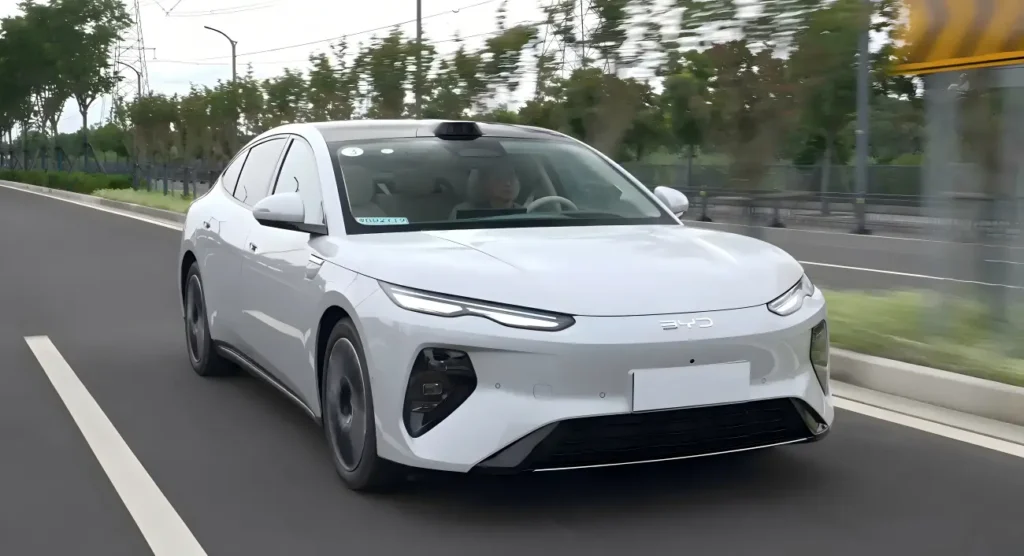
Every EV marketing department loves the phrase “push-back sensation.” It’s been worn out. The more precise way to describe what the Seal 08 delivered — the first time I buried the throttle — is this: there’s a second wave of force after the initial shove.
In Comfort mode, the pedal’s initial response isn’t twitchy. Creeping through city traffic doesn’t make you nervous. That’s a sign of mature calibration. But the moment your ankle tilts a few extra degrees, the dual motors serve up their reserves in two layers: first, the torque eruption off the line; then, a sustained pressing force that keeps you glued to the backrest well past 60 km/h (37 mph). Plenty of single-motor competitors in this price bracket start “running out of breath” in the 60–80 km/h (37–50 mph) band. The Seal 08 in that range feels like it just finished warming up.
A 3.3-second 0-100 km/h (0-62 mph) time, three years ago, was supercar territory — cars costing upwards of $139,000 (¥1,000,000+). Now it shows up in a four-door family sedan priced under $33,320 (¥239,900). That fact alone takes a moment to digest.
But what surprised me more than the acceleration was something else entirely.
02:Rear-wheel steering: making a 5-meter car “disappear” in the city
The biggest pain point of a mid-to-large sedan isn’t a lack of power. It’s that the car is simply too big. U-turns require two attempts. Garage ramps demand constant vigilance. Narrow-lane passing becomes a pulse-raising exercise. These everyday scenarios are what truly grind down a driver’s patience.
The Seal 08 comes equipped with rear-wheel steering — at low speeds, the rear wheels turn opposite to the fronts. This is a feature that used to be the exclusive province of the Mercedes S-Class and BMW 7 Series, machines costing $100,000+. Now it’s on a BYD priced around $28,000–$33,000 (¥196,900–¥239,900).
Behind the wheel, the effect was more pronounced than I expected. Not “slightly better” — the entire character of the car changes.
On a side road off Beijing’s East Third Ring Road, I instinctively prepared for a three-point turn. One turn of the wheel and we were through. That tight underground-p garage corner I always edge through carefully even in a compact car — the Seal 08 practically flicked past it. The tail-following is so precise that you occasionally forget how long this car actually is.
One sentence to summarize: it makes you forget you’re driving a large car. That’s the true value of rear-wheel steering — not showing off, but eliminating size anxiety.
Author TAKE — Why rear-wheel steering at this price is a structural disruption
Rear-wheel steering has historically been gated by cost — the actuators, the control logic, the integration work. Mercedes charges a premium for it on the S-Class. BMW reserves it for the 7 Series. BYD’s ability to include it standard on a sub-$34,000 car isn’t just a “value” play. It signals that BYD’s vertical integration — from its own steering R&D to in-house manufacturing — has crossed a cost threshold where features once reserved for flagship luxury can now be deployed at volume. Competitors relying on tier-one suppliers for these systems will struggle to match this price point without taking a loss
03:YunNian-A: When air suspension stops being “a line on the spec sheet”
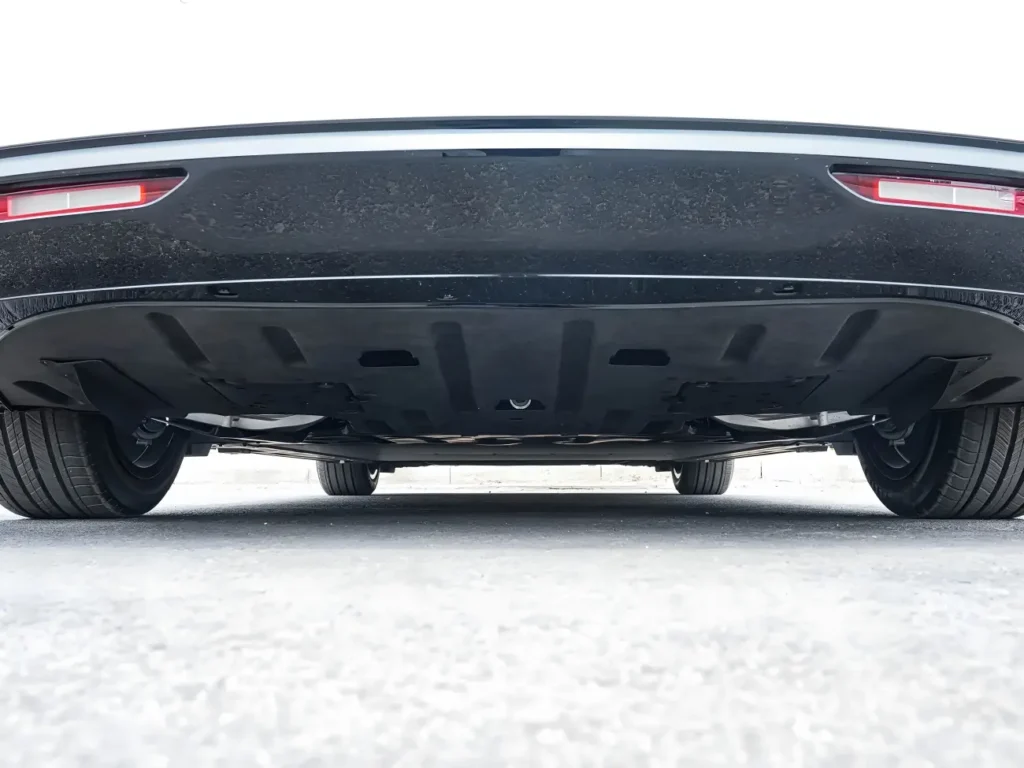
Air suspension appearing in the $28,000–$33,000 bracket is a recent phenomenon. But “having air suspension” and “having air suspension that’s properly tuned” are two very different things. The market is littered with cars that bolted on air springs only to deliver a ride that’s either floaty-as-a-boat or harsh-as-no-suspension-at-all.
The Seal 08 uses a closed dual-chamber air suspension with electromagnetic valve adjustable dampers, paired with a front double-wishbone and rear five-link setup. This hardware wouldn’t look out of place on a car costing $42,000+ (¥300,000+).
Fine surface vibration (urban paved roads)
The suspension filters high-frequency micro-vibrations with surgical cleanliness. That “buzzing” tremor that transmits through the steering wheel and seat in lesser cars? Nearly absent. This is exactly where many cars expose their chassis’ cheapness. The Seal 08 doesn’t.
Potholes and speed bumps
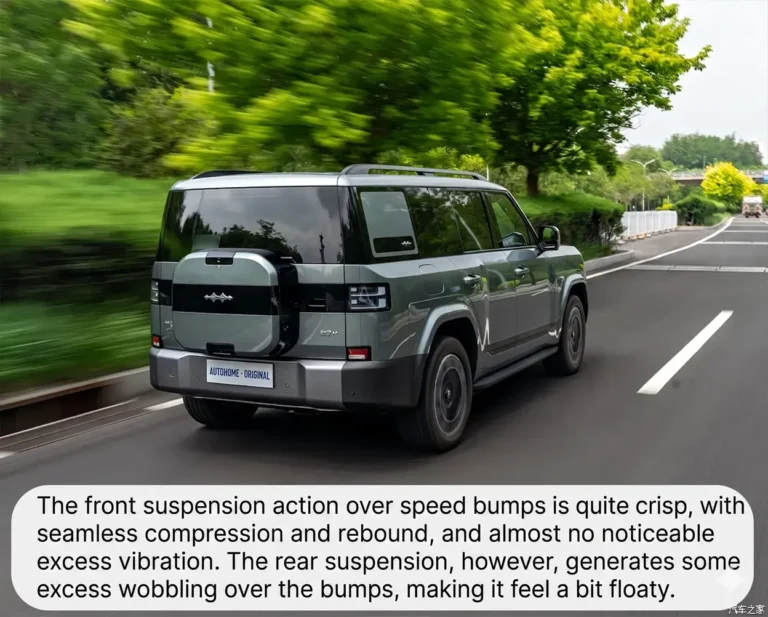
This isn’t the “cotton-soft” school of tuning. Hitting a speed bump, you can feel the suspension compress first, then rebound with a crisp, defined motion. The impact is absorbed, but road feel isn’t entirely erased. This “resilient comfort” — supple but structured — is far harder to execute than simple softness, and it’s the hallmark of a chassis with genuine premium character.
High-speed cruising and undulating roads
This is where YunNian-A earns its keep. At 120 km/h (75 mph), the chassis has a “ground-hugging glide” solidity — no float, no wobble. Over bridge expansion joints and rolling terrain, body pitch and roll are kept in check with discipline.
The sound insulation is the other surprise. At highway speeds, wind and tire noise are suppressed to levels where conversation requires no volume increase. This tier of cabin quietness, two years ago, belonged exclusively to established luxury brands.
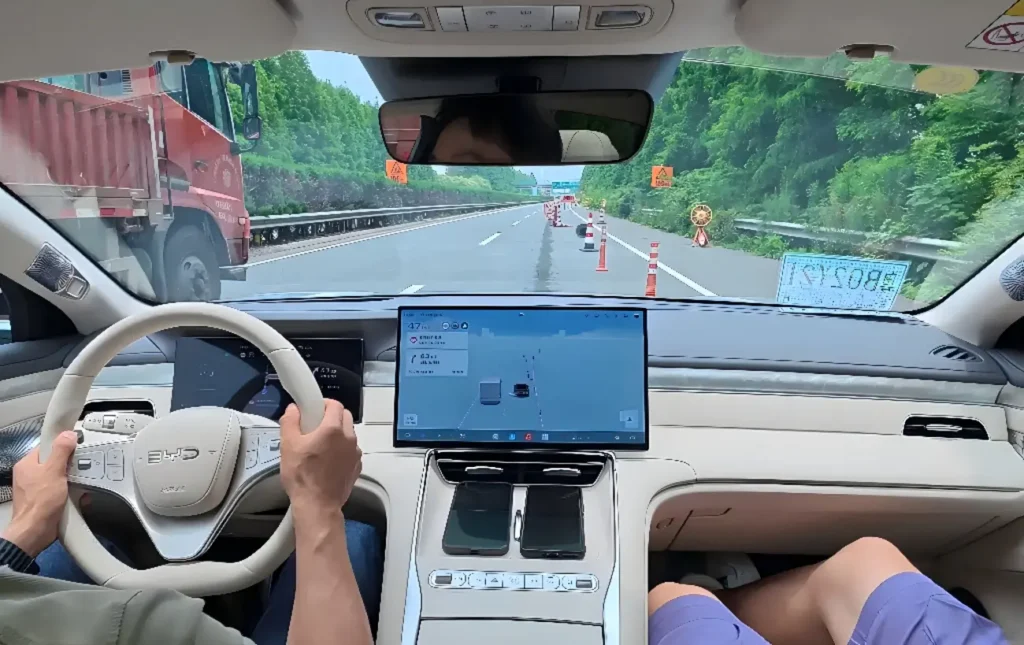
04:God’s Eye B ADAS: Honestly, the most “restrained” part of the car
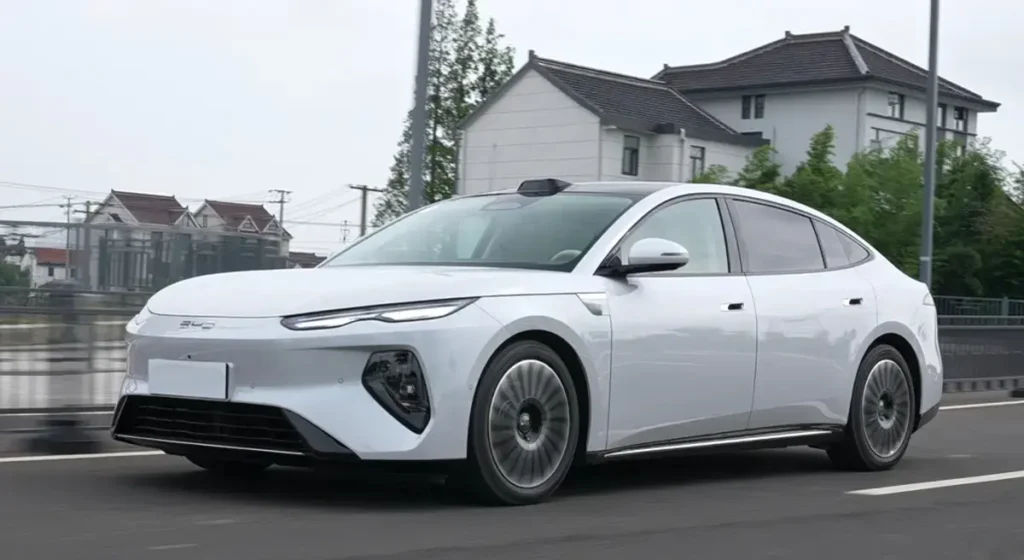
Power, chassis, handling — all maxed out. Driver assistance, by contrast, is the part I want to dwell on — not because it’s bad, but because its personality operates on a completely different wavelength from the rest of the car.
Over roughly 20–30 km (12–19 miles) of highway and urban driving, my impression of the God’s Eye B system crystallized: it’s conservative. Conservative enough that it occasionally makes you think, “That’s a bit too cautious.”
Highway cruising is rock-solid — lane-keeping and speed control are steady, more than sufficient for daily commuting. But in scenarios demanding “decisive action” — lane merges, construction zones — the system’s default choice is almost always to slow down and yield. From a safety standpoint, that’s defensible. From an experience standpoint, it means you’ll find yourself taking back control in situations where you could have glided through.
20–30 km is not enough to judge the full capability boundary of any ADAS. God’s Eye B may perform better in advanced scenarios. It may improve substantially after OTA updates. But based on this test drive’s experience, it’s a system that makes you “feel safe but never excited” — optimized for not making mistakes, not for pushing capability.
Author TAKE — The ADAS gap is real, but it’s the most “fixable” one
The Seal 08’s weakest link is software, not hardware. That’s significant because software is the one domain where OTA updates can close gaps without recall, without retooling, without supply chain renegotiation. BYD’s chassis, battery, and drivetrain advantages are structural — competitors can’t OTA their way into dual-chamber air suspension. But BYD can OTA its way into a smarter ADAS. The asymmetry favors the car that’s strong where it’s hard to change and weak where it’s easy to change. The risk, of course, is that “can improve” and “will improve” are different promises — and ADAS development has humbled far wealthier automakers.
05:Translating the spec sheet into “what this actually means”
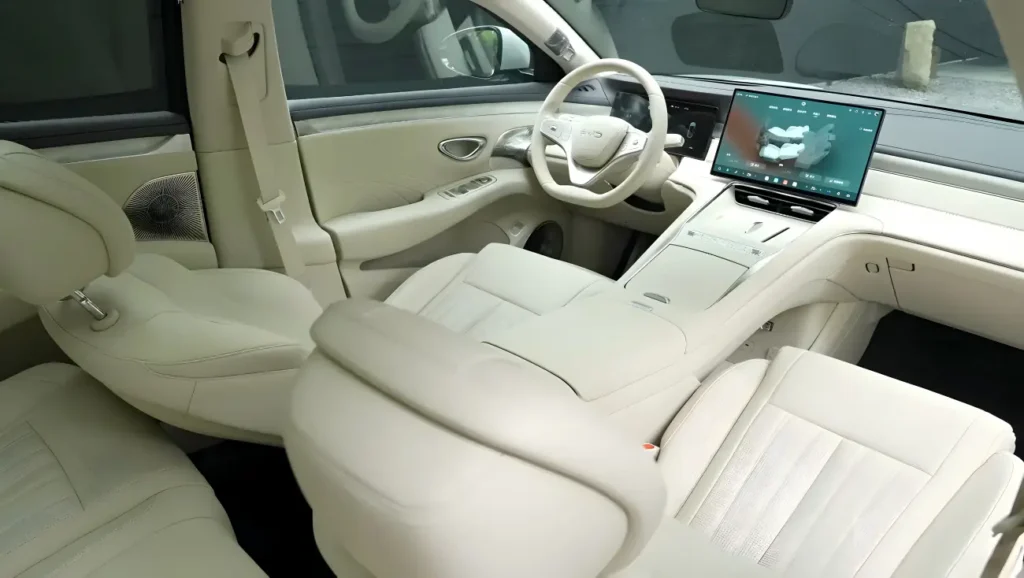
Step back from the driving impressions and consider the market significance. At this price point, you’re not buying a car — you’re buying a technology bundle that used to cost $42,000–$56,000 (¥300,000–¥400,000):
| Feature | What It Used to Cost | What the Seal 08 Does |
|---|---|---|
| Dual-chamber air suspension | Optional on Mercedes E-Class / BMW 5-Series (base $50,000+) | First large-scale deployment under $34,000 |
| Rear-wheel steering | Standard on Mercedes S-Class / BMW 7 Series ($100,000+) | Virtually unheard of at this price tier |
| 510 kW dual-motor AWD | $42,000+ performance vehicles | Supercar-tier acceleration in a family sedan |
| Gen-2 Blade Battery + flash charging | BYD flagship-exclusive | Latest tech iteration to a new model line |
This isn’t “value for money.” This is generational displacement. When a single company vertically integrates its own battery, chassis, and driver-assistance R&D, the cost floor it can reach is something the industry hasn’t seen before.
💱 Currency Note: All USD figures in this article are converted at an exchange rate of approximately 7.2 CNY = 1 USD (prevailing July 2026). Range figures use CLTC standards: 785 km ≈ 488 miles. Actual prices vary by market, taxes, and incentives.