

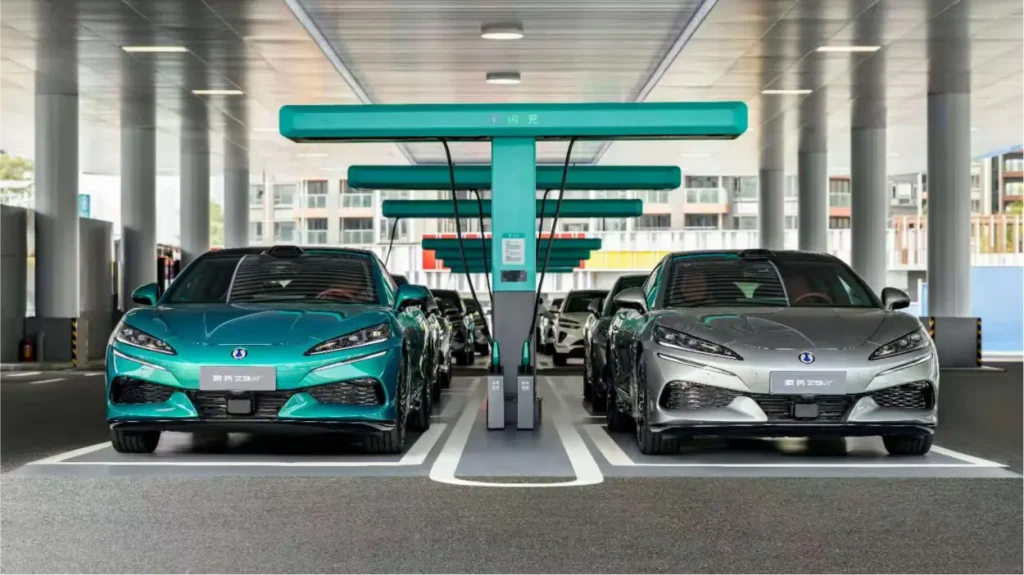
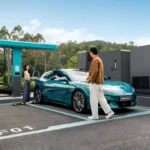
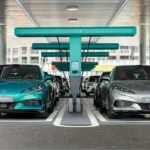
BYD opened its 10,000th flash-charging station in Shenzhen on Friday, doubling its self-built network in under five months and putting it halfway to a year-end target of 20,000 — a bet that charging speed, the foundation of its megawatt flash-charging architecture, not just vehicle range, is the next battleground for EV buyers.
From 5,000 to 10,000 in five months
BYD had 5,000 flash-charging stations in operation as of April 1 and 7,018 by June 30. The 10,000th, a flagship site in Shenzhen’s Longhua district, was formally opened at 9 a.m. Beijing time on August 28. To reach 20,000 by December 31, BYD must add roughly 80 stations a day from August 29 onward — more than double the average pace of the past five months, and a steep acceleration the company has not yet demonstrated it can sustain. It is the single biggest open question around the milestone.
A network built around density
The 10,000 stations now span 332 cities. BYD says tier-1 and tier-2 cities are 100% covered, with a station on average every 3 km in the core urban areas of Shenzhen, Shanghai, Hangzhou, Xi’an and Chongqing; tier-3 and tier-4 cities are also 100% covered, averaging within 4 km. The network reaches the extremes of China’s geography — Hulunbuir in the north, Sanya in the south, Shuangyashan in the east, Kashgar in the west, and even Everest Base Camp, Turpan and Khorgos on the border.
Notably, 4,228 of the stations are “wish” sites: locations requested by 74,281 individual users under BYD’s crowd-sourced build program. Rather than top-down planning, BYD is turning demand heat maps into actual footprint — a quiet data advantage most充电 operators, which site by real estate, do not have.
The hardware
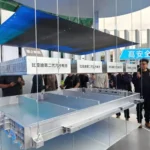
The next-generation flash charger BYD unveiled in March delivers up to 1,500 kW through a single connector, with two connectors per unit. Paired with the second-generation Blade Battery, BYD says the system takes a vehicle from 10% to 97% in 9 minutes. The network has delivered a cumulative 210 million kWh in under six months and signed up more than 1.83 million users — and, tellingly, nearly one-third of those users drive non-BYD vehicles, because the stations are open to all brands. A single gun at a Beijing station recorded 2,983 kWh in one day, serving 54 cars — a throughput BYD says rivals a gas pump.
Partners, not just poles
BYD is not building this alone. It has signed a framework agreement with Sinopec, which alone operates more than 30,000 integrated energy stations, and works with PetroChina, CNOOC, Teld and Shell, plus Alipay, Gaode Maps and JD.com for payments and navigation. The model is “gas station plus supercharger”: Sinopec’s first co-built flagship opened at Shanghai Hongqiao. The overseas push has also begun, with a target of 6,000 stations abroad and the first UK sites already live, aiming for 300 there by year-end. The architecture behind this build-out was laid out earlier in BYD’s megawatt charging stack design.
The Bottom Line
BYD reached 10,000 flash-charging stations in China on August 28, five months after crossing 5,000, and now needs to nearly double again by year-end. The network is open to all brands and leans on oil-major partners — but sustaining 80 new stations a day will be the real test.
Sources & Further Reading
- CnEVPost — BYD flash charging network to hit 10,000 stations on August 28
- CnEVPost — BYD’s flash charging network reaches 10,000 stations, halfway to full-year target
- China Economic Net — BYD’s 10,000th flash-charging station completed (Longhua, Shenzhen)
- Related: BYD megawatt flash-charging architecture
- Related: BYD second-generation Blade Battery teardown
- Related: Denza Z9S 1,100 km range with flash charging


[…] the storage alongside the trucks, and it already has the infrastructure to point at — including its 10,000th flash-charging station in China, built for passenger […]
[…] The charging claim is where Denza leans hardest, and it comes with a network attached: BYD says it has built more than 10,000 flash-charging stations across 332 Chinese cities, with 2,000 highway stations planned by the end of 2026 — roughly one every 100 km across 36 national expressway routes. That combination — a very large battery, a fast charge curve and a proprietary station network — is the same architecture EVsays examined at the station level, in the second-generation Blade pack and in the 10,000-station build-out. […]