

China’s National Intellectual Property Administration (国家知识产权局, CNIPA) published a BYD compact hybrid e-drive patent on August 28, 2026 — and the core idea is one sentence: rotate the traction motor 90 degrees, and a hybrid system sized for mid-size sedans suddenly fits a compact hatchback — the exact segment BYD is now pushing into Europe and Southeast Asia.
What the BYD Compact Hybrid E-Drive Patent Changes
In a conventional hybrid transaxle, the engine and the electric motor sit on opposite sides of the reduction gearbox with every shaft parallel. Because those shafts run across the car’s width, the whole system spreads along the axle line — a layout that works in a mid-size sedan but overwhelms a compact car’s narrow engine bay. That mismatch is exactly the problem the filing names: hybrid systems “adapt poorly to compact vehicles.”
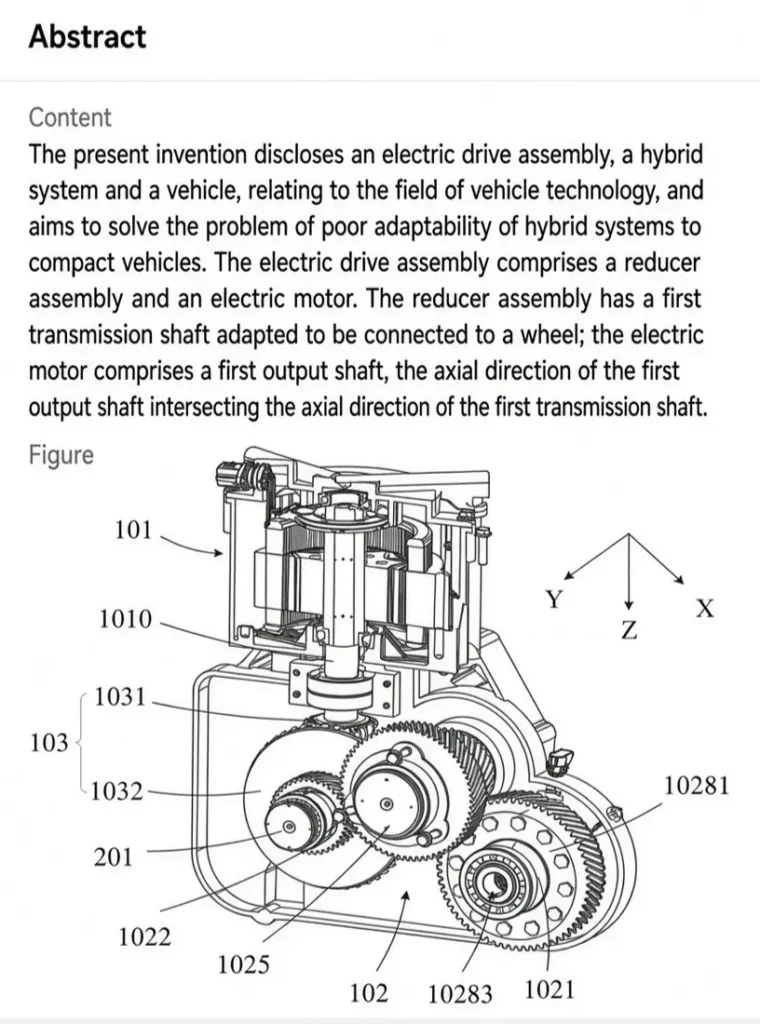
BYD’s answer is a change in geometry, not in battery chemistry or motor silicon. The motor’s first output shaft is arranged so its axis line intersects the axis line of the gearbox’s first transmission shaft — the shaft that drives the wheels. In the preferred embodiment, the two axes are perpendicular. The motor stops standing shoulder-to-shoulder with the half-shafts and takes whatever space in the bay is free instead.
Parallel Axes Become a Right Angle: How the Layout Shrinks
With the intersecting-axis arrangement, the motor can be mounted above the gearbox — consuming height instead of width — or ahead of it, behind it, or diagonally across the bay. Bevel gears (or helical gear pairs) turn the drive through the corner, and the patent’s drawings show the motor’s projection staying inside the gearbox’s footprint so nothing protrudes into the engine’s mounting space. The drive unit’s overall width shrinks — and width is precisely what a compact engine bay is short of.
The Compactness Toolbox Hidden in the Claims
The independent claim is one sentence; the dependent claims are a shopping list of space-saving tricks. The ones worth knowing:
- Nested gears — the second bevel gear tucks into the axial gap between the first driven gear and the second driving gear, shortening the assembly in two directions at once.
- A 2–20 mm gap window — the difference between the bevel gear’s axial length and the gears’ spacing must stay between 2 and 20 millimetres: below 2 mm, thermal expansion and machining tolerances risk interference; above 20 mm, precious axial length is wasted.
- Two-stage reduction — a wider gear-ratio range, plus more tooth pairs sharing the load for smoother, quieter delivery.
- A disconnectable differential — an electronic (or friction, or electromagnetic) disconnect that can decouple the front axle to cut drag, and that is itself packaged smaller.
- An e-control box parked in the gaps — above the motor-and-gearbox stack, or in the valley between two tilted motors.
- Split assembly — gearbox and motor built on parallel lines and bolted together at the end, cutting housing cost and complexity.
Four Driving Modes, One Small Package
The specification walks through a front motor, an optional rear motor and a battery pack, switched by two clutches. Engine direct drive: the engine alone drives the front wheels. Pure EV: either motor runs, for front-, rear- or all-wheel drive. Series: the engine spins the front motor as a generator while the rear motor drives. Parallel: engine and front motor pull together, with the rear motor joining for four-wheel drive on demand. The small package keeps the full dual-mode (DM) toolbox.
Why Now: BYD’s Small-Hybrid Push Overseas
The publication date matters. CNIPA released the filing on August 28, 2026 — weeks after BYD launched the Dolphin G DM-i, a 4.1-metre B-segment PHEV with 65 miles of EV-only range and 1,000+ km combined, in Europe at about $32,000. BYD already sells compact DM-i models — Dolphin DM-i, Yuan Up DM-i — across Southeast Asia and Latin America, and passed 130,000 cumulative deliveries in Thailand in July 2026. In China, cheap battery-electric minis squeeze the small-PHEV niche and buyers prefer big cars; overseas, where small cars and predictable fuel bills dominate, compact hybrids are the growth segment. Chinese patent media read the right-angle e-drive as hardware built for exactly that category — a reading BYD has not confirmed, but the geometry and the timing line up.
The Catch: A Published Application, Not a Production Plan
CN122645850A is a published application, not a granted patent — and neither is a product. BYD has not linked the design to any named model, and the company files thousands of applications a year, most of which never reach production. The patent proves BYD is engineering hybrids specifically for small cars. It does not prove a production car, a launch date, or that a future Dolphin carries this exact layout.
The Bottom Line. A CNIPA-published BYD patent shows a compact hybrid e-drive whose motor shaft sits at a right angle to the wheel shaft, shrinking the width a hybrid system needs to fit a small car — right as BYD pushes small plug-in hybrids into Europe and Southeast Asia. The filing is an application, not a production announcement: BYD has named no model and confirmed nothing. But the design’s entire reason to exist is the segment BYD is now attacking hardest.
Sources & Further Reading
- Google Patents — CN122645850A, “Electric drive assembly, hybrid system and vehicle” (CNIPA publication, 2026-08-28) — primary source.
- Electrek — “BYD launches the Dolphin G plug-in hatch with 65 miles of EV range for $32,000” (2026-07-09) — compact PHEV context.
- InsideEVs — “BYD’s New Hybrid Hatchback Could Supercharge Its European Takeover” — independent coverage of the Dolphin G DM-i.
Sourcing note: Patent details translated from the CNIPA publication CN122645850A (application 202510220823.3, filed February 26, 2025, published August 28, 2026), which first surfaced in Chinese patent media on September 7, 2026. A published application is not a granted patent. The overseas-market reading is analyst interpretation, not a BYD statement, and BYD has not linked the design to any production model. Analysis is original to EVsays.