

BYD Semiconductor has a new camera chip, and it is already in mass production: the BF314D, a 1-megapixel automotive image sensor built only for driver monitoring, announced on 26 October. The China DMS mandate it is aimed at takes effect on 1 January 2027 and requires every new passenger car with a Level 2 assistance system to watch the driver’s hands and eyes as standard, warn in stages and lock the function out if the warnings are ignored. The headline specification is not resolution. It is 25 electrons per second of dark current at 100 °C — and the market it addresses is one BYD’s own release sizes at more than 14 million vehicles in 2027.
What BYD’s BF314D Actually Is
The part is a 1-megapixel CMOS sensor with a global shutter, a monochrome array and an image signal processor on the die. BYD says it is the first product to use its own high-density pixel passivation process, and that it is already installed in production vehicles — without naming the model, the customer or the volume.
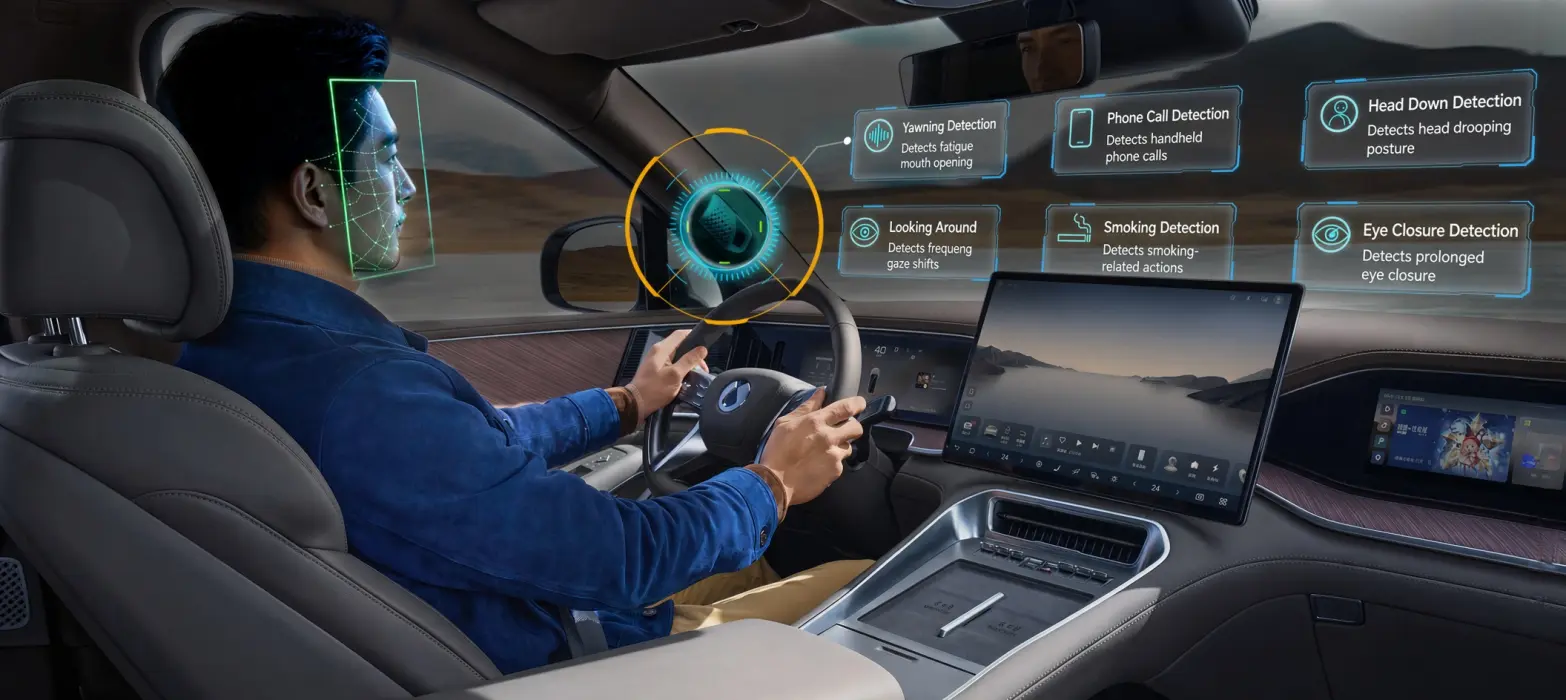
| Specification | BF314D |
|---|---|
| Resolution | 1 MP |
| Shutter | Global |
| Frame rate | up to 120 fps |
| Colour | Monochrome, no colour filter array |
| ISP | Integrated on-die |
| Dark current | 25 e-/s at 100 °C, more than 80% below the first generation |
| Dynamic range | 72 dB, 12% above the first generation |
| 940 nm sensitivity | 58% above the first generation |
| Package | CSP, automotive grade |
Every one of those percentage figures is a comparison against BYD’s own previous part, not against the market. Read them as an internal progress report, not a benchmark. Read as a whole, though, the list answers a question the release never writes down: what does a camera have to do to be legal in a Chinese passenger car from January 2027?
What the China DMS Mandate Requires From 2027
The rule is GB 47955—2026, Safety requirements for combined driving assistance systems, published in early July 2026 and confirmed by the Ministry of Industry and Information Technology to take effect on 1 January 2027. It is China’s first mandatory standard aimed squarely at Level 2, and the driver-monitoring clauses are the ones with hardware consequences.
Above 10 km/h the system has to watch hands and gaze continuously. A hand off the wheel for five seconds triggers a warning; gaze off the road for five seconds triggers another; if the driver keeps ignoring them, the assistance function is locked out for at least thirty minutes. A covered or blocked cabin camera must disable higher functions such as automatic lane change. And every vehicle needs a data-recording system with a standardised readout, so that what the assistance system saw, warned and handed back can be reconstructed after a crash.
Two exclusions matter commercially. Cars already on the road are not required to be retrofitted, and the standard’s three-tier structure — single-lane, multi-lane and navigation-assisted — means the monitoring requirement attaches to the function, not the trim. In practice, though, the market has already decided: L2 assistance is fitted to about 70% of new passenger cars in China, and more than 30% have navigation-assisted driving. That is the base the mandate lands on.
BYD’s release cites a ResearchInChina forecast of more than 14 million DMS-equipped vehicles in China in 2027. Treat that as an industry estimate rather than a settled number — but the direction is not in dispute. A component that used to be a differentiator on top trims becomes a line item on every car, and the specification table above stops looking like a datasheet and starts looking like a cost sheet.
Why One Megapixel and No Colour Filter Is the Right Answer
A driver-monitoring camera has one job: photograph a face at 940 nm, in a car, for fifteen years. Resolution beyond what the eye region needs buys nothing, and a colour filter array actively costs something — it puts a red, green or blue dye over every pixel, and each pixel then receives only the band its filter passes. For a monochrome sensor every pixel collects the full infrared signal, which is why cabin cameras are almost always black and white.
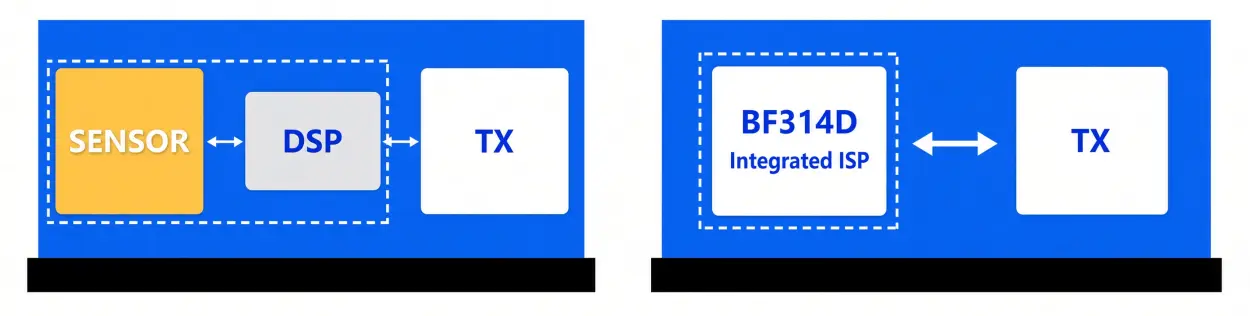
The integrated ISP is the more commercially interesting decision. A typical DMS module pairs the sensor with an external DSP to denoise and enhance the face image; putting that on the die removes a component, its surrounding circuitry and the board area they occupy. That is what lets the camera sit behind the steering column, in the instrument cluster or in the A-pillar — the three places a cabin camera actually fits — and it takes load off the domain controller, which no longer has to run an ISP algorithm before it can start classifying eyes.
The frame rate deserves a number rather than an adjective. At 120 fps the sensor produces a frame every 8.3 milliseconds. A normal blink lasts around 300 ms, which yields roughly 36 frames; at the 30 fps that many cabin cameras still run, the same blink gives about nine. Eyelid closure is a shape that changes fast, and the difference between nine samples and thirty-six is the difference between classifying a blink and guessing at one.
The Number That Decides This Market Is 100 Degrees
A cabin camera is not a phone camera. It is powered on when the car is parked in the sun and running continuously while the car is driven, and the sensor die sits in a greenhouse. BYD puts the worst case at 100 °C, which is plausible for a dashboard-mounted module on a summer afternoon.
Heat attacks this sensor in a specific way: dark current, the leakage that accumulates in every pixel even with no light hitting it, rises steeply with temperature, and its shot noise is what buries a low-light image. The eye region under 940 nm illumination is exactly a low-light image. Get it wrong and the failure is not a soft picture — it is a system that cannot tell a narrowed eye from a closed one, which produces either false alerts or missed ones.
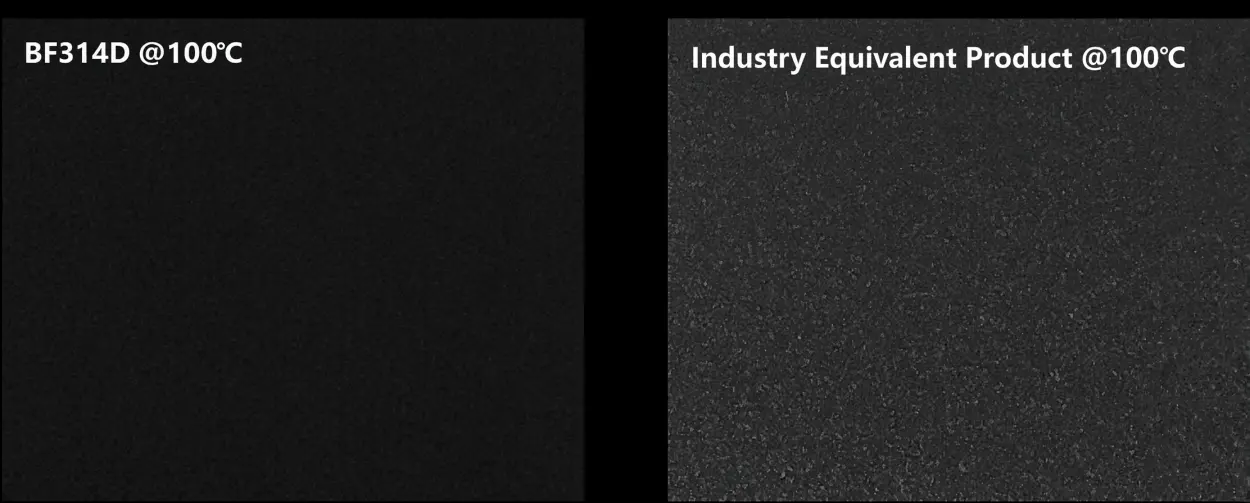
That matters more under the China DMS mandate than it did before it. A false alert is now a compliance event, and a lockout triggered by a misread eye is a customer complaint with a regulation attached.
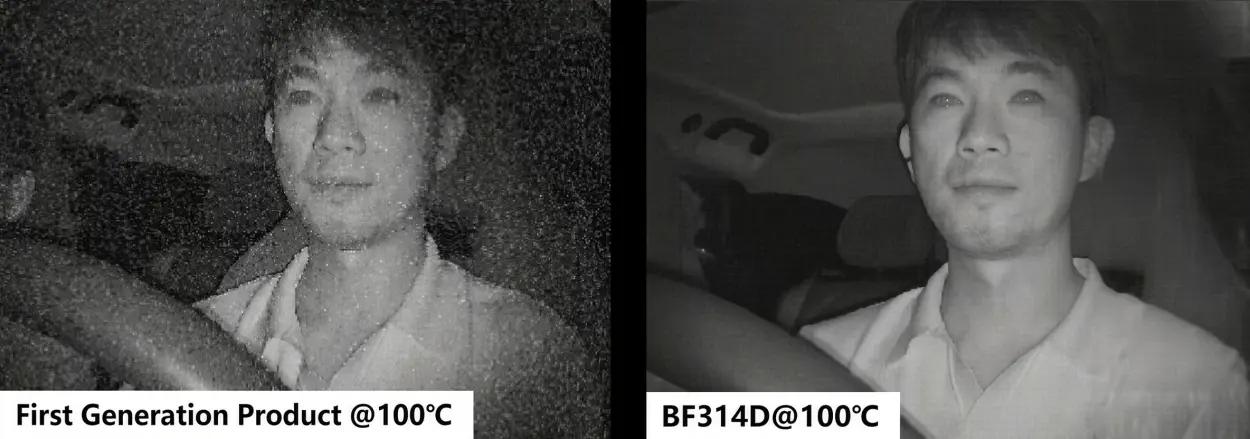
BYD’s claim of 25 e-/s at 100 °C implies a first-generation figure of about 125 e-/s — our arithmetic, from the stated 80% reduction — and the 72 dB dynamic range implies the previous part sat near 64 dB. Both are the kind of improvement that shows up as fewer false positives in a hot car, not as a better-looking image.
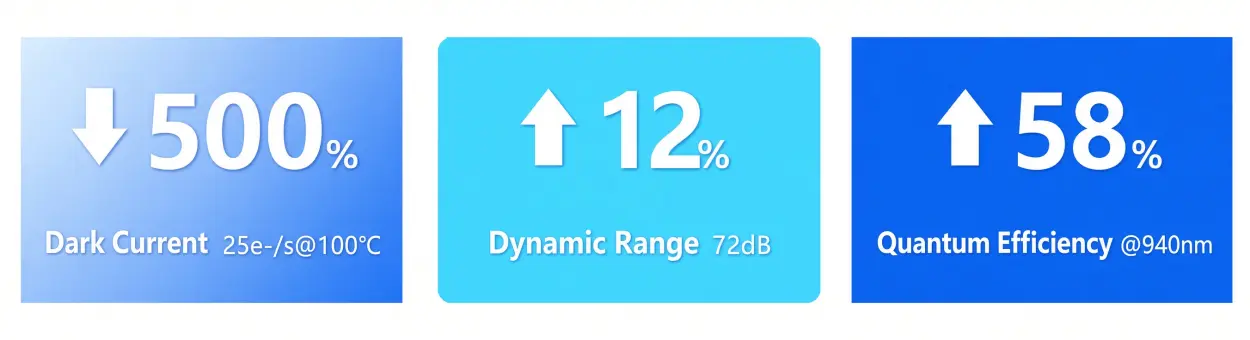
That first tile is the one place where the release contradicts itself. A reduction cannot exceed 100%, so “down 500%” is either a typo for “to one fifth” or a rounding of the 80% figure the body text uses — and 80% is the number that reconciles with 25 e-/s. We have used 80% throughout. It is a small thing, but it is the sort of small thing that tells you how much independent checking went into the rest of the card.
What the Release Does Not Say
Five gaps are worth stating plainly, because they are where a spec sheet stops being evidence.
No pixel size and no optical format. Those two numbers determine how much light each pixel collects, and therefore the real sensitivity. Without them, the 58% near-infrared gain cannot be separated into sensor design, lens and the light-guide fill material the release also credits.
No customer and no volume. “Mass production installed” almost certainly means BYD’s own vehicles, but the release does not say which, and it does not say whether any external carmaker has qualified the part. For a company that is simultaneously a carmaker and a chip supplier, that distinction decides whether this is a product or a captive component.
No price. The entire commercial argument for a 1-megapixel monochrome part with an on-die ISP is bill-of-materials cost. The number that would prove it is missing.
No field data. 100 °C is a test condition. Fifteen years of thermal cycling, and the drift of dark current over that life, is the thing a tier-one buyer actually wants.
No independent verification. “Industry-leading” and “significantly better than comparable parts” appear without a comparison table, a part number or a test house.
Author’s Take: The mandate changes what is being bought. Until now a cabin camera was a feature a brand could use to sell a trim; from January 2027 it is a regulated component that must work at 100 °C for the life of the car, on every unit, at the lowest cost that passes. In that market the winner is not the supplier with the best image. It is the one that can qualify a part in volume and then take cost out of the module.
BYD Semiconductor has an advantage no sensor vendor can copy: it can design the chip, qualify it in its own cars and ramp it on its own volume without winning a single external tender. That is also its ceiling. A rival carmaker weighing a camera from a competitor’s chip arm has an obvious reason to say no, so the addressable market is BYD plus whoever is willing to depend on it. Whether this becomes a business or stays a captive line depends on a number the release did not give: how many of those 14 million cameras BYD intends to sell to someone else.
The Bottom Line: The China DMS mandate makes driver monitoring standard equipment on every L2 car sold from 1 January 2027, a market BYD’s own release sizes at more than 14 million vehicles that year. The BF314D is a deliberately unglamorous answer — 1 megapixel, monochrome, 120 fps, ISP on the die and 25 e-/s of dark current at 100 °C — aimed at cost and thermal stability rather than image quality. It is already in production; what it is not yet is a part anyone outside BYD has been shown buying.
Sources & Further Reading
- BYD Semiconductor — “BF314D|车规级CIS为DMS装上全天候’安全之眼'” (26 October 2026) — the 1 MP resolution, global shutter, 120 fps, monochrome architecture, on-die ISP, 25 e-/s dark current at 100 °C with the 80% reduction, 72 dB dynamic range with the 12% gain, 58% near-infrared improvement, CSP package, the claim of mass-production installation, and the ResearchInChina forecast of more than 14 million DMS-equipped vehicles in China in 2027.
- Xinhua — “智驾’强标’日前发布,明年1月实施 产业链将迎优胜劣汰” (7 July 2026) — GB 47955—2026, its 1 January 2027 effective date, the five-second hand-off-wheel and gaze warnings, the lockout, the mandatory data-recording system, and the 70% L2 penetration figure.
- Ministry of Industry and Information Technology — GB 47955—2026 智能网联汽车 组合驾驶辅助系统安全要求, published July 2026 — the three-tier classification of Level 2 systems and the requirement that driver-state monitoring be standard equipment. Cited by standard number.
- EVsays — BYD’s gate driver chip passes 50 million units — the same in-house semiconductor programme, one layer down the power path.
- EVsays — BYD’s L2 assistance certification — how the company’s driver-assistance line-up is being positioned against the new standard.
- EVsays — why BYD puts L3 in 2028 — the liability side of driver monitoring, which is what the camera feeds.
- EVsays — BYD’s 4D radar chip — the outward-facing half of the same sensor stack.
- Images — the five illustrations in this article (the cabin application view, the module comparison, the two 100 °C test comparisons and the summary card) are BYD Semiconductor’s own product and technical material, published with the 26 October release, and are reproduced unaltered.
Notes: All BF314D specifications — resolution, frame rate, dark current, dynamic range, near-infrared gain and the mass-production claim — are BYD Semiconductor’s own, published on its own channels, and have not been independently tested or benchmarked by a third party; every percentage compares the part with BYD’s previous generation, not with competing products. The implied first-generation dark current and dynamic range, and the frame counts per blink, are our own calculations. Regulatory details are taken from the MIIT interpretation and the standard’s published text. EVsays has not tested the sensor or driven a vehicle fitted with it. Our editorial policy and correction policy apply.