

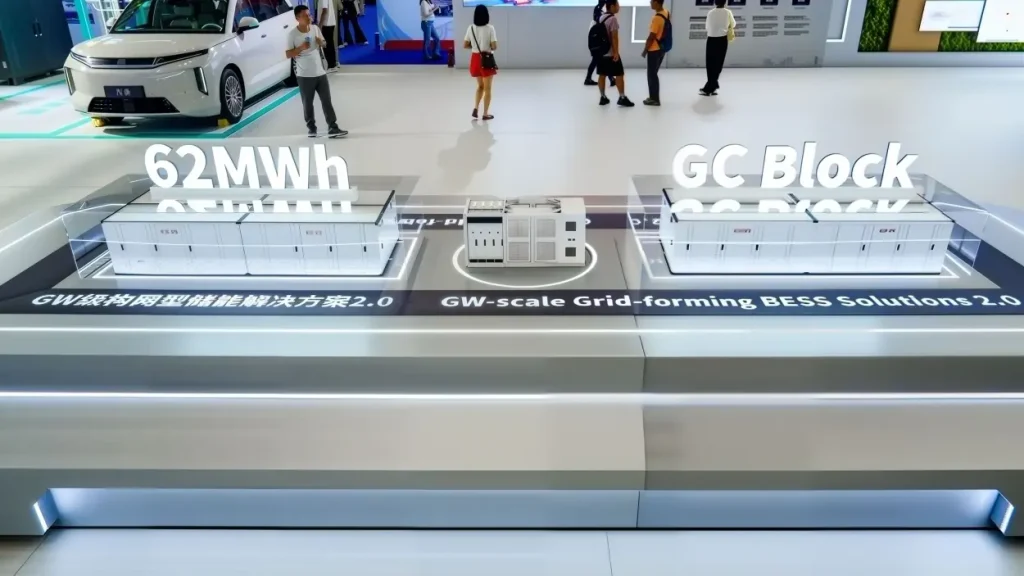
BYD Energy Storage used Shenzhen’s digital energy show to launch a grid-forming storage package built around a standardised station-level block. The headline number is 62 MWh. The number that decides whether it matters is how few of them a gigawatt now needs.
The BYD GC Block is the centrepiece of the company’s GW-level grid-forming storage solution 2.0, unveiled on September 15 at the 2026 Shenzhen International Digital Energy Exhibition, which ran from September 15 to 17. It arrives alongside two other refreshed parts — the GC Flux PCS 2.0 power conversion system and the GC Master EMS 2.0 energy management system — that together replace the GW-level grid-forming package BYD brought to the same show a year ago.
BYD GC Block: What Was Actually Launched
Three products, one system. The GC Block is a station-level standard unit — BYD’s own description puts it above the container in the hierarchy. The GC Flux PCS 2.0 is the converter that ties it to the grid. The GC Master EMS 2.0 is the software that schedules a cluster of them.
The block comes in three standardised sizes, each mapped to a duration band rather than to a customer:
| GC Block variant | Power | Energy | Duration | Blocks per 1 GWh |
|---|---|---|---|---|
| Short duration | 7.5 MW | 15.5 MWh | ~2 h | 65 |
| Medium duration | 7.5 MW | 31 MWh | ~4 h | 33 |
| Long duration | 10 MW | 62 MWh | ~6 h | 17 |
Stack the largest version and a 1 GW site needs about 100 blocks. That is the claim BYD is selling: against what it calls conventional industry practice, its block count falls 37.5%, cable sets fall 68.1%, foundations fall 19.6% and site footprint falls 17.2%. A year earlier, its Haohan system at 14.5 MWh took 69 units to reach 1 GWh of two-hour storage; the equivalent figure now is 65.
The GC Flux PCS 2.0 covers a 1.25 MW to 15.6 MW range, with a standard 20-foot container rated up to 10 MW — which BYD describes as the largest in the industry. Peak conversion efficiency is quoted at 99.5%, and the unit can run at three times rated power for 10 seconds, the margin a grid operator needs when a fault clears and a large plant has to stay online. The company says it works with both centralised and string architectures and is compatible with mainstream third-party PCS.
GC Master EMS 2.0 handles GW-scale clusters as one asset: forecast accuracy of 98.5% and regulation accuracy of 0.6%, with the system scheduling itself rather than waiting on an operator.
The 1,980 Ah Cell Behind the 62 MWh Block
The block is large because the cell is large. BYD has put a 1,980 Ah storage-specific blade cell inside it, produced with a stacked (lamination) process and aimed at two-hour-and-longer duty — in practice the four- to six-hour projects that are now the growth end of the Chinese storage market.
The cell lineage tells the story of the last four years: 350 Ah in 2022, 377 Ah in 2023, and now 1,980 Ah. Cell capacity has become the front line of the storage argument: a day after BYD’s launch, HiTHIUM made the same case with a sodium-ion cell and a 4 MWh container aimed at the same durations. Scaling the cell changes the arithmetic at the site level. In BYD’s own worked example for a 1 GW / 6.2 GWh layout, the cell count falls from roughly three million in a conventional arrangement to under one million. Battery-management complexity drops 69.4%, maintenance workload falls by more than 60%, and installation and commissioning work falls by more than 18%.
That last set of numbers is the real pitch. Storage system costs have been falling for years, although cell prices in China have moved the other way in 2026; what has not fallen as quickly either way is the labour and engineering content of building a gigawatt-scale plant. A block that is 100 units wide instead of 270 is a construction argument before it is a technology argument.
BYD GC Block vs Tesla Megablock and Sungrow PowerTitan 3.0
BYD is not making this move alone. Across the three largest storage suppliers, the same shape is emerging: the smallest thing you can buy is no longer a cabinet, it is a replicable segment of a power station.
| System | Unit concept | Capacity | Announced build speed |
|---|---|---|---|
| BYD GC Block | Station-level standard block, three duration variants | Up to 10 MW / 62 MWh | 1 GW ≈ 100 blocks; installation and commissioning work down 18%+ |
| Tesla Megablock | Four Megapack 3 units plus transformer and switchgear, integrated | 20 MWh | 20 working days to deliver 1 GWh |
| Sungrow PowerTitan 3.0 | Three platform versions (Flex / Class / Plus) | Not comparable on a single figure | Factory pre-installed and pre-commissioned; 1 GWh connected in as little as 12 days |
The comparison is directional, not like-for-like. Megablock folds the transformer and switchgear into its 20 MWh; BYD’s 62 MWh measures the storage block itself, and its station-level scope is a different unit of account. What the three have in common is the bet: standardise the repeatable part, customise only at the edges, and turn project engineering into a configuration exercise.
Why “Grid-Forming” Is the Claim That Matters
The word in the product name carries more weight than the megawatt-hours. A grid-following inverter copies the grid’s voltage and frequency; a grid-forming one establishes them. That is the difference between a battery park that supports a renewable-heavy grid and one that can stand in for the synchronous generators that grid operators are losing.
BYD’s claims on that front are specific: minute-level black start for a whole GW-scale site, 7×24 operation off-grid, and the 3× ten-second overload capability that lets the plant ride through faults without dropping. The company also quotes lifecycle effects at system level — overall site efficiency up 2.7%, lifetime discharge up 3.1%, and levelised cost of energy down 5.5%.
The commercial logic is where the AI angle enters. Alongside the grid-forming package, BYD showed an AIDC energy solution that layers power support from grid-side green generation and hub nodes, through a park-level energy management centre and a high-density server-room buffer, down to instantaneous rack-level support. Data centres are becoming the storage industry’s most demanding customer — they want firm capacity, fast response and a decarbonisation story — and that demand is already reshaping power-equipment supply, from solid-state transformers ordered for AI campuses in the US to buffered rack-level power. A standardised 62 MWh block with black-start capability is aimed squarely at that buyer. The same package is also pitched at independent storage, renewable-plus-storage, zero-carbon industrial parks and flash-charging sites, where BYD pairs its highest-power single-gun charger with a storage buffer.
Scale, for now, is a claim rather than a delivery. BYD says it has more than 650 storage projects in operation worldwide across survey, design, delivery, operation and recycling.
What the BYD GC Block Does Not Tell Us Yet
Four things are worth holding back from the headline.
62 MWh is not a container. It is BYD’s station-level standard unit — a larger integrated section of a plant — and the company’s own framing places it above the cabinet in the hierarchy. Reading it as a single 20-foot box with 62 MWh inside would be wrong by a wide margin.
Every performance figure here is the manufacturer’s. The 99.5% efficiency, the 3× ten-second overload, the 98.5% forecast accuracy, the 69.4% reduction in battery-management complexity, the 17.2% footprint saving and the LCOE improvement are company numbers. None has been published with third-party test data, and several are comparisons against an unnamed “conventional” baseline.
The superlatives are unattributed. “World’s largest 20-foot 10 MW” and “highest station-level standard block” are BYD’s descriptions, not adjudicated results, and the 650-plus projects figure is cumulative across a decade of products rather than evidence about this generation.
There is no named customer and no price. No GW-scale project has been announced with solution 2.0, no grid-forming performance has been demonstrated publicly, and no pricing has been given. The nearest real test is whether a utility or an AI data-centre developer signs for a site large enough to show the black-start and 24/7 claims in operations rather than on a slide.
Accuracy note: BYD Energy Storage launched its GW-level grid-forming storage solution 2.0 on September 15, 2026, at the Shenzhen International Digital Energy Exhibition (September 15–17). All product figures — the three GC Block variants, the 1,980 Ah blade cell, the 62 MWh capacity, the 10 MW / 99.5% / three-times-overload PCS specification, the 98.5% forecast accuracy, the black-start and 7×24 claims, the footprint and complexity reductions, and the LCOE improvement — are manufacturer statements. We have not independently verified any of them and no third-party test data has been published. The 650-plus project figure is cumulative across BYD’s storage product generations rather than specific to solution 2.0. Comparisons with Tesla’s Megablock (20 MWh, including transformer and switchgear) and Sungrow’s PowerTitan 3.0 are directional: the products define their standard units differently, so capacities are not like-for-like. No pricing or customer names were disclosed. As of writing we found no English-language trade coverage and no English-language release from the manufacturer.
Sourcing note: The primary source is BYD Energy Storage’s official announcement on its own channels (September 17, 2026), which carries the launch date, the three GC Block variants, the 1,980 Ah cell, the PCS and EMS specifications and the lifecycle claims. Chinese-language industry coverage supplied the system-level arithmetic and the competitive context: the storage trade press published the 1 GW / 1 GWh configuration tables, the cell-count and workload comparisons, and the Haohan comparison from the 2025 show, while the same coverage set the launch against Tesla’s Megablock and Sungrow’s PowerTitan 3.0. EVsays did not attend this event: every figure in this article is either the manufacturer’s own or a calculation from the manufacturer’s published numbers, and the analysis of what the launch does and does not establish is ours. Our editorial standards are set out in our editorial policy, and corrections are handled under our correction policy.
Sources & Further Reading
- BYD Energy Storage (比亚迪储能) — official announcement, 2026-09-17 — the launch itself: GC Block, the 1,980 Ah storage blade cell, GC Flux PCS 2.0 and GC Master EMS 2.0, the 650-plus project count, and the zero-carbon park, flash-charging and AIDC packages shown alongside.
- Sina — “1 GWh needs only 17 units: BYD Energy Storage launches a 62 MWh product” (2026-09-15) — the 1 GWh and 1 GW configuration arithmetic, the cell-count and workload comparisons, the Haohan comparison from the 2025 show, and the positioning against Tesla Megablock and Sungrow PowerTitan 3.0.
- Storage and Power Market (储能与电力市场) — launch report with the GC Flux PCS 2.0 range, the 1.25–15.6 MW capacity spread, the GC Master EMS 2.0 accuracy figures and the lifecycle efficiency and LCOE claims.
- International Storage Network (国际储能网) — exhibition report covering the opening ceremony, the BYD Energy Storage management attendance and the grid-forming framing of the launch.