
The Big Picture
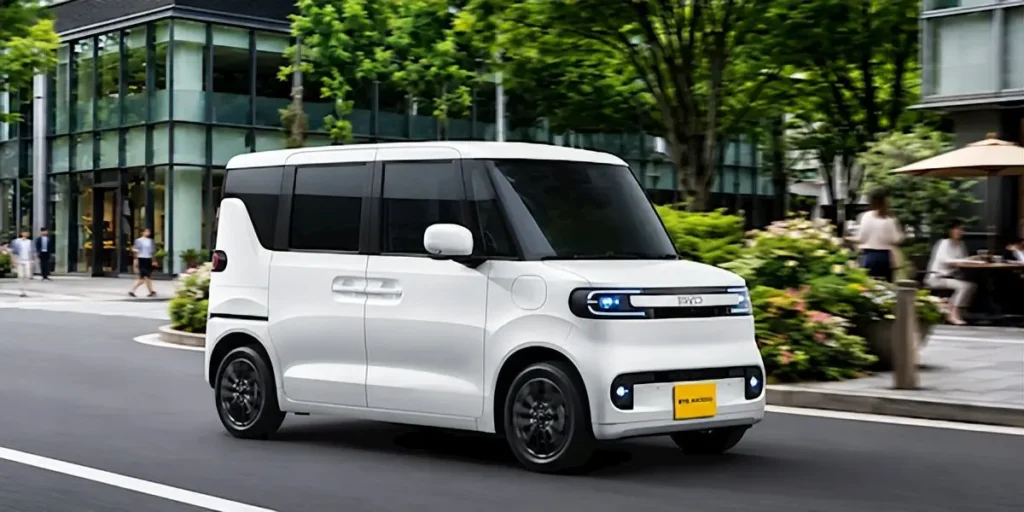
- The car: BYD Racco — a ground-up kei car EV for Japan. ¥2,145,000 (~$14,800) before subsidies, 320 km WLTC range (top trim), power sliding doors on both sides.
- The segment: Japan’s kei car market — 1.7 million units a year, one-third of the domestic market, dominated by Suzuki, Honda, and Daihatsu. No foreign brand has ever meaningfully cracked it.
- The reception: Japan’s National Mini Vehicle Association president publicly welcomed the entry. Kyodo News ran full English coverage.
The Car That Japan Didn’t See Coming
On July 28 in Tokyo, BYD Japan president Liu Xueliang stood next to a boxy little vehicle that looked like something Honda or Suzuki would build — because it was. The BYD Racco (海獭) wasn’t a Chinese-market car with a right-hand-drive retrofit. It was designed from scratch to fit Japan’s kei car regulations: 3,395 mm long, 1,475 mm wide, 1,800 mm tall — hitting the dimensional ceiling on every axis. Right-hand drive. Four seats. A shape that Japanese buyers recognize instantly as “super-tall wagon.”
And then Liu dropped the price: ¥2,145,000, roughly $14,800 at current exchange rates, with a ¥150,000 government clean-energy subsidy that pushes the effective entry price below ¥2 million. For context, the Nissan Sakura — Japan’s best-selling kei EV — starts at ¥2,333,000 and delivers 180 km of WLTC range from a 20 kWh battery. The Racco 300 starts at ¥2,398,000 and delivers 320 km. That’s 78% more range for ¥65,000 more — about $430.
Kyodo News covered the launch as a national-interest story, which tells you everything about what this means to Japan’s auto establishment.
The Specs That Make Rivals Look Old
| BYD Racco 200 | BYD Racco 300 | Nissan Sakura | Honda N-Box (ICE) | |
|---|---|---|---|---|
| Battery | 22.4 kWh LFP | 35.84 kWh LFP | 20 kWh | — |
| WLTC Range | 210 km | 320 km | 180 km | — |
| Starting Price | ¥2,145,000 | ¥2,398,000 | ¥2,333,000 | ¥1,739,000 |
| Power Sliding Doors | ✅ Both sides | ❌ | ✅ | |
| V2L/V2H | ✅ | ❌ | ❌ | |
| L2 ADAS | ✅ Standard | ✅ | ✅ | |
| Six Airbags | ✅ Standard | ✅ | — | |
The Racco is the first kei car in history with power sliding doors on both sides. On the premium trim, a foot sensor projects a light guide onto the ground — wave your foot, and the door unlocks and slides open. It’s the kind of feature that sounds gimmicky until you’re in a Tokyo parking lot with 30 cm of clearance on each side and a child seat in one arm.
V2L and V2H support — the ability to power a home from the car’s battery — isn’t a luxury feature in Japan. It’s a disaster-preparedness feature. Typhoon season knocks out power to millions of households every summer. A kei car that doubles as a home generator is a genuine selling proposition.
Inside: 10.1-inch floating center screen, NFC phone key, heated seats and steering wheel, a heated cupholder, and a front bench design with a column shifter that lets you slide out either side in tight spaces. The rear seats fold flat to create 1,372 liters of cargo space.
Why This Is Harder Than It Looks
Japan’s kei car market moves about 1.7 million units a year — roughly a third of the country’s new vehicle sales. It has been an unbreachable fortress for foreign automakers for decades. Suzuki, Honda, and Daihatsu (Toyota’s kei car arm) dominate through a combination of model-specific dealer networks, tax incentives unique to Japan’s vehicle classification system, and a product philosophy — tiny vehicles that maximize interior space through packaging tricks no full-size car can match — that no foreign manufacturer has successfully replicated.
BYD’s approach was different. Instead of adapting an existing model, the company spent years developing the Racco specifically for Japan. 90% of the vehicle’s components are manufactured by BYD in-house — the same vertical integration strategy that turned a RMB 19.8 billion CXMT investment into RMB 3.27 trillion and is now powering its humanoid robot ambitions. For the Racco, it lets BYD offer a 320 km battery in a segment where 180 km is considered normal, at a price point that undercuts the segment leader.
“We want to deliver unprecedented convenience and enjoyment to all people across Japan through our technology,” Liu said at the launch. He also revealed that BYD’s cumulative deliveries in Japan will hit 10,000 units by the end of July, with 77 sales points across the country, including 56 official dealerships.
The reception from Japan’s auto establishment was notably warm. Akima Shunichi, president of the Japan Mini Vehicle Association, publicly stated the Racco’s entry was “recognition of the kei car’s future prospects” — language that reads less like a warning and more like an invitation.
The Soft Underbelly
BYD is still tiny in Japan. The brand commands about 1.3% of Japan’s imported car market, and its 77 sales points are a rounding error compared to Suzuki’s 2,000-plus dealer network. The kei car market runs on trust built over decades — Suzuki’s Wagon R has been on sale for 32 years. A Chinese brand with a five-year track record in Japan, no matter how good the product, faces a brand-awareness wall that no spec sheet can climb. But BYD has been doing this math for a while: its Hungary sales jumped 227% year-on-year in June, and overseas deliveries now make up 43% of total sales. Japan is the next piece.
BYD’s stated target of 10,000 Racco units per year is modest — roughly 0.6% of the kei car market. But the Racco isn’t about volume in 2026. It’s about proving a Chinese automaker can build a vehicle that Japanese buyers recognize as one of their own. If the Racco sells 10,000 units in its first year, that’s 10,000 Japanese households who will have spent a year telling their neighbors “no, it’s actually really good.” That’s worth more than any advertising campaign.
Author’s Take
There are two ways for a Chinese automaker to enter Japan. The first is what BYD tried from 2023 to 2025: import China-market cars, convert them to right-hand drive, and compete on price. Cumulative sales after two years: under 10,000 units. The second is what the Racco represents: build something Japanese buyers don’t just accept as “good for the price,” but actually want. The Racco has power sliding doors — the Honda N-Box’s killer feature — but also V2L for typhoon season, a 320 km battery that turns a kei car into a viable only-car for a two-car household, and a sub-¥2 million subsidized entry price. Those aren’t “Chinese EV” features. They’re “Japanese family car” features.
The real test isn’t whether the Racco sells — it will. The test is whether it creates a beachhead that other Chinese brands can follow through. Because if BYD can crack the kei car market, the argument that Chinese EVs only win where price matters dies. And that argument’s expiration date just moved up.
The Bottom Line
The BYD Racco is a ¥2,145,000 kei car that goes 320 km on a charge, has power sliding doors, and can power your house during a typhoon. It undercuts the Nissan Sakura by ¥188,000 while offering 78% more range. Japan’s Kei Car Association president welcomed it publicly. The kei car market — Japan’s most impenetrable auto segment — just got its first serious foreign competitor in history.
BYD’s target is a modest 10,000 units a year. But if the Racco works, it won’t be about volume. It’ll be about proving that a Chinese automaker can build a car that Japanese buyers want, not just a car they can afford.
Sources & Further Reading
- Kyodo News — “China’s BYD Rolls Out Ultracompact EV to Challenge Japan’s Minicar Market” (July 28, 2026)
- Wangtong News — “BYD Racco Launches in Japan: Full Specs and Pricing” (July 28, 2026)
- Tencent News — “First Japan-Specific BYD Kei Car Launches” (July 28, 2026)
- ifeng Auto — “BYD Racco Pricing vs. Nissan Sakura Comparison” (July 28, 2026)
- BYD Japan / PR Times — Official Press Release (July 28, 2026)