

BYD has patented a tire that senses the road, changes its own pressure and adjusts its own sidewall stiffness — turning the last “dumb” component of a car into an active part of the chassis.
The four patents
China’s National Intellectual Property Administration has published a batch of BYD tire patents covering four directions: a variable electronically-controlled tire skeleton, independent four-wheel inflation and deflation, an inner-wall grating sensor layer, and a dual-layer multi-chamber run-flat design. The filing is dated October 15, 2025, and was published April 10, 2026 (application CN202511475874.7). Together the pieces form a self-contained system rather than a single “magic tire.”
How the self-inflation works
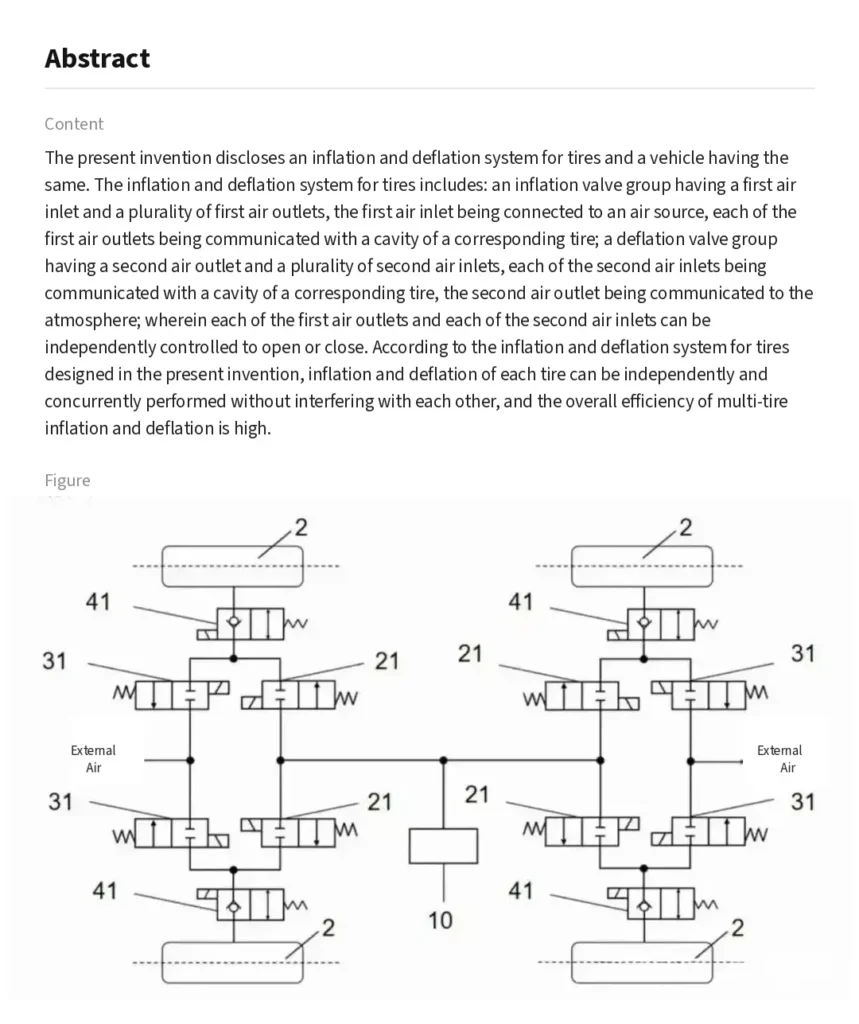
The core patent gives each wheel its own inflate and deflate solenoid valves, so all four tires can be adjusted independently and in parallel. That is a step beyond what military wheeled armor and Land Rover’s early central tire-inflation systems could do — those mostly control pressure by axle, or share a single air line, so tires change pressure one at a time or as a whole vehicle. In BYD’s design, dropping one tire’s pressure for a specific surface does not drag the other three along.
The sensing layer
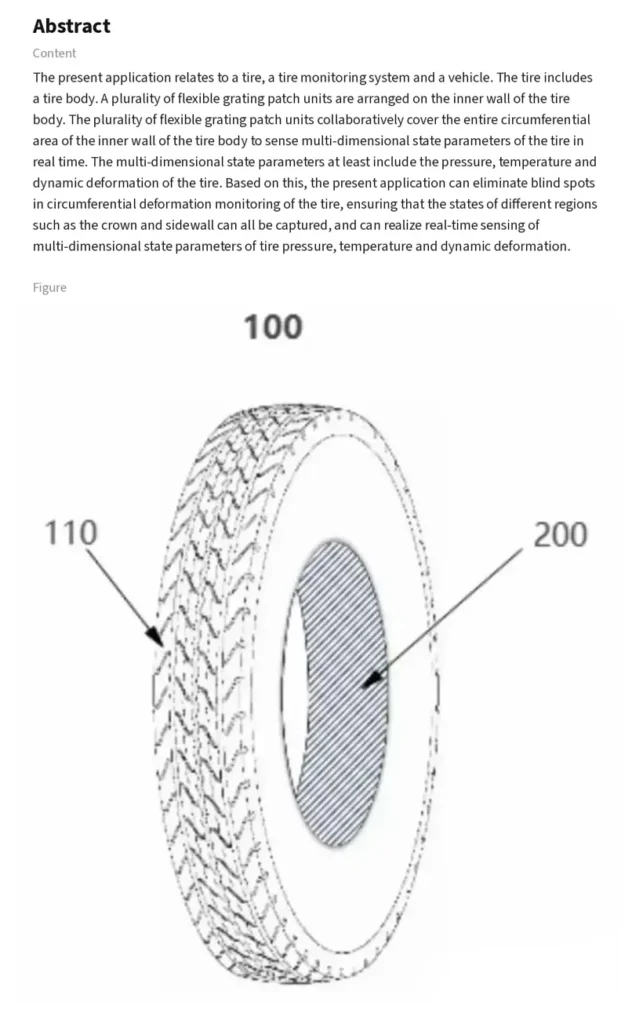
A second patent covers flexible grating sensors bonded across the tire’s entire inner wall. Unlike a conventional tire-pressure monitor that samples at a single point, the grating layer watches the whole tire — pressure, temperature and dynamic deformation — eliminating the blind spots where a slow puncture or localized damage hides. The system uses that data to decide, on its own, when to add or bleed air: lower pressure for sand and mud to enlarge the contact patch, restore standard pressure on pavement, and top up a slowly leaking tire before it forces a roadside stop.
The variable skeleton
The most ambitious piece is a tire skeleton with 12 electrically-actuated telescoping support ribs and micro-motors. It can soften or stiffen the sidewall on the fly: relax at low speed to cut rolling resistance and extend range, tighten in the rain or at speed to enlarge the contact patch and improve braking. That is aimed squarely at the tire industry’s “devil’s triangle” — the long-standing trade-off between low rolling resistance, wet grip and wear that Michelin and Goodyear have spent decades finessing with rubber compounds and tread patterns.
Why it matters
Tires have always been the one component a carmaker buys rather than builds. Michelin, Goodyear and their peers own the intellectual property in rubber chemistry and tread design, and every automaker tunes its chassis around whatever tires it can buy. BYD’s patents move the tire inside the vehicle’s control loop: the tire reports what it feels, the DiSus suspension and e4 drive respond, and the tire adjusts itself in the same conversation. If it works, a carmaker defines the tire’s dynamic behavior instead of outsourcing it — a direct challenge to the suppliers’ decades-old lock on the segment.
The catch
These are published patents, not a production announcement. BYD has not said when, or whether, any of this reaches a showroom. The obstacles are real: a self-inflating system needs a compressed-air source and sealed plumbing that survives years of road salt and vibration; the variable skeleton adds motors and moving parts to a component that must stay round at 200 km/h. No tire maker or rival automaker has publicly responded.
The Bottom Line
BYD has published a batch of patents for a smart tire that self-inflates, senses road conditions and varies its own sidewall stiffness — a direct push against the tire-supplier lock held by Michelin and Goodyear. The patents are real, but they are a long way from production, and BYD has made no announcement about timing.
Sources & Further Reading
- Google Patents — BYD smart tire patent CN121822009A (original filing)
- China Energy News / Kuaikeji — four-wheel independent inflation, grating sensing
- Phoenix Auto / Wangtongshe — BYD self-developed tire patents
- QQ News — patent matrix and automatic pressure adjustment
- Related: BYD second-generation Blade Battery teardown
- Related: BYD megawatt flash-charging architecture
- Related: BYD Sealion 08 debuts with DiSus-A air suspension