
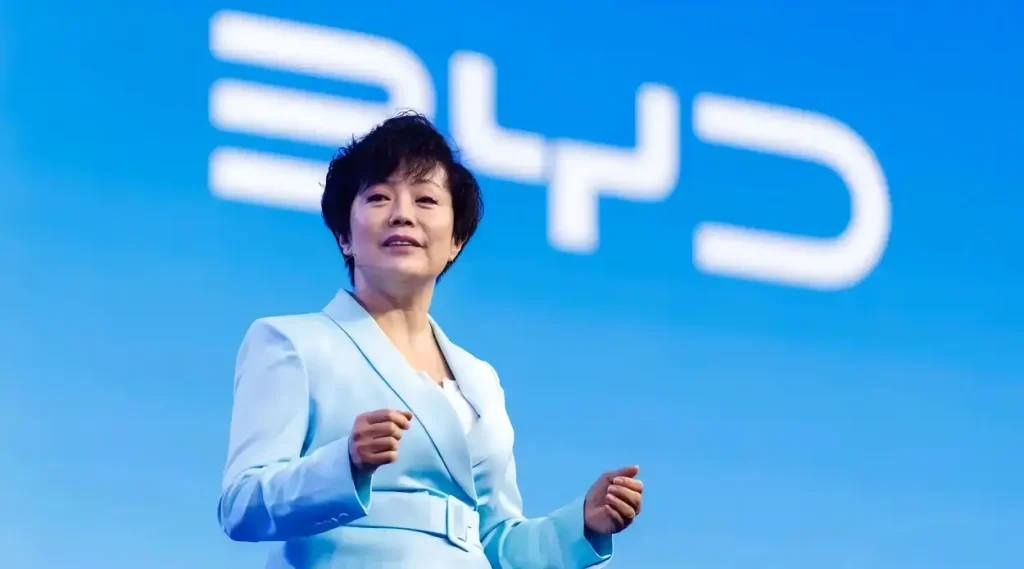
On September 13, 2026, BYD executive vice president Stella Li told Carwow.es in an interview recorded in Valencia, Spain, that the BYD solid-state battery programme will reach its first vehicle next year. “Talking about solid-state battery, BYD is in the leading position; we’re in the leading position for the commercial line, and for the technology,” she said. “So to prove that, even next year we will have one model that will be the first model with this technology there.” It is a striking claim — and it directly contradicts what the same executive said three months ago.
BYD Solid-State Battery: What Stella Li Actually Said
The remarks were made on camera to the Spanish car-buying channel Carwow.es and reported in English by CarNewsChina the same day. The full interview is published on YouTube.
She also used the interview to write off the combustion engine. The video is published under a title that states the position outright — “The combustion engine has no future — it is no longer needed” — though that line is the channel’s Spanish-language framing of her remarks rather than a verbatim English quotation from BYD. It is consistent with what she has said in English: in a July 2026 interview with the Serbian weekly NIN, she noted that BYD “ceased production of vehicles powered solely by internal combustion engines in 2022”, and concluded that with fast charging, “there is now no excuse not to drive an electric car”.
Li framed the company’s battery work as broad rather than narrow: “Any battery technology, I guarantee you will find in one corner of BYD R&D; we are studying that.” She added that the battery division is working not only on cell chemistry but on “manufacturing capability and the equipment design” — the unglamorous half of the problem.What she did not provide is as important as what she did. There was no model name, no production date, no cell specification and no pack-level performance figure. On the record as reported, the claim amounts to a technology demonstration target — not a retail launch, and not a manufacturing timeline. BYD has not said which nameplate will carry it.
Why the BYD Solid-State Battery Turnaround Is Real — and Narrow
In June 2026, Li was asked about solid-state batteries by Auto Express and gave the industry a bucket of cold water: “BYD is in a leading position for solid-state technology, but at this point in time our second-generation Blade battery is much better in terms of efficiency and cost. I don’t think that solid-state is ready for the mass market yet.”
Three months later, she says a solid-state vehicle arrives next year. The reasonable read is not that the physics changed in a quarter — it is that BYD has decided a single demonstration vehicle is now worth building, and worth saying out loud.
The company’s own roadmap, outlined separately by FinDreams Battery chief technology officer Sun Huajun, has not moved: small-batch trials involving roughly 1,000 vehicles around 2027, with large-scale commercial production targeted around 2030. A three-year gap between showing one car and building them at volume is exactly what the word “demonstration” is for. Electrek reported in February that BYD’s investor relations department had pointed to limited-batch solid-state production in 2027, consistent with that framing.
| Timeline | What it actually means |
|---|---|
| 2027 — one vehicle | A demonstration vehicle, model unnamed. Engineering validation on real roads, not a product launch. |
| Around 2027 — ~1,000 vehicles | FinDreams’ stated small-batch trial volume. Still a fleet, not a product line. |
| Around 2030 | Target for large-scale commercial production, once cost and yield allow. |
Early deployments are expected on BYD’s most expensive nameplates — Yangwang and flagship Denza models — where the cost premium of early solid-state cells is easier to absorb. That is the standard playbook: launch the technology where the sticker price hides it.
BYD is not alone in promising a date near the end of the decade’s first half. Toyota has targeted a 2027–2028 launch with Idemitsu Kosan; Samsung SDI is aiming at solid-state mass production in 2027; Nissan has pointed to 2028; Changan has begun in-vehicle testing; MG has taken the semi-solid route as an interim step. None of those timelines establishes who is ahead, and BYD’s own announcement does not change that.
The Engineering Between a BYD Solid-State Battery and a Show Car
FinDreams is pursuing an inorganic sulfide solid electrolyte based on lithium phosphorus sulfur chloride (LPSC). Sulfides conduct ions well — that is why the industry keeps coming back to them — but they bring four problems that a lab cell hides and a car exposes.
- Interfaces. As electrodes expand and contract, solid-solid contact degrades, raising impedance and eroding capacity retention. Some sulfide architectures need sustained mechanical stack pressure, which becomes a pack-structure and compression-control problem.
- Electrode processing. Conventional wet processing uses solvents that can react with sulfide electrolytes, pushing development toward dry electrode processes based on PTFE fibrillation. FinDreams has been working with domestic equipment suppliers at pilot facilities — scaling that to high volume is a separate challenge from proving it works.
- Moisture. Sulfide electrolytes can generate hydrogen sulfide (H₂S) on hydrolysis. Cell and pack environments have to stay sealed through manufacturing and years of operation.
- Cost. Specialised sulfide precursors currently cost dozens of times as much as conventional liquid-electrolyte materials, which squeezes both cell economics and the pace of scale-up.
BYD has reported 20 Ah and 60 Ah solid-state prototypes targeting energy density approaching 400 Wh/kg — a cell-level figure. Cell-level energy density does not translate into equivalent pack performance once cooling, compression hardware and packaging are added, and the company has published no pack number. Recent filings with the China National Intellectual Property Administration show work on composite cathode structures and on interfaces between sulfide and halide solid electrolytes, as CarNewsChina reported in August.
BYD is developing the technology inside China’s All-Solid-State Battery Collaborative Innovation Platform (CASIP), a government-backed initiative tied to an estimated $830 million state research programme — the same framework that produced the international standard China pushed through the IEC in August, and the platform whose 2026 roadmap was set at a Beijing summit.
BYD Solid-State Battery vs BYD’s Own Blade Pack
The hardest competitor to a BYD solid-state battery is not CATL. It is BYD’s own second-generation Blade pack.
When Li poured cold water on solid-state in June, the alternative she named was the Blade battery. BYD’s own marketing claim is that a Blade-equipped car charges from 10% to 97% in about nine minutes through its flash-charging architecture. That matters more than it sounds: solid-state’s headline advantages are energy density, safety and fast charging. If a cheaper lithium-iron-phosphate pack already delivers the charging speed customers can feel, the premium chemistry has to win on something else — range per kilogram, cold-weather behaviour, or packaging freedom.
That is why BYD’s chief scientist Lian Yubo has talked about liquid lithium-ion and all-solid-state systems coexisting for 15 to 20 years rather than one replacing the other. It is also why our own analysis of the sector concluded that 2027 is a pilot-production race, not a mass-production one — and why the technical comparison of solid-state against liquid electrolytes remains the right frame.
There is also a policy tailwind worth noting. China’s new battery consumption tax, which we covered in July, taxes lithium-ion cells at 2% from September 2026, rising to 4% in September 2027 — while exempting solid-state, sodium-ion and fuel-cell batteries until the end of 2028. Beijing is, in effect, paying manufacturers to keep the solid-state option open.
BYD Solid-State Battery and L3: Two Timelines From the Same Interview
Chinese-language coverage of the same Valencia interview also reported Li pointing to July 2027 for China’s L3 automated-driving rules, with BYD deeply involved in the process. EVsays could not verify that specific remark against the published video, so it should be treated as reported rather than confirmed.
What is a matter of public record is the regulation itself. China’s first mandatory national standard for L3 and L4 automated driving — GB 44721-2026, Safety Requirements for Autonomous Driving Systems in Intelligent Connected Vehicles — was approved in late July 2026 and takes effect on July 1, 2027, according to People’s Daily. It upgrades what had been advisory guidance into binding law, covers M- and N-category vehicles equipped with L3 or L4 systems, and mandates simulation, closed-course and on-road testing. Analysis of the standard notes that its testing requirements effectively mandate multi-sensor fusion with lidar or radar redundancy — an awkward fit for camera-only approaches.
Put the two together and BYD’s 2027 looks less like one launch and more like a pair of regulatory and engineering deadlines landing in the same window. Both are gated by external factors: one by manufacturing yield and precursor supply, the other by the legislature, insurance rules and liability precedent. Neither is gated by product ambition. That is the part of the announcement that will still be true in twelve months.
Accuracy note: Stella Li’s quotations are drawn from the Carwow.es video interview as reported in English by CarNewsChina on September 13, 2026; EVsays has not obtained an independent transcript beyond the passages quoted. The 400 Wh/kg figure is a cell-level prototype target reported by CarNewsChina, not a pack-level measurement, and no pack figure has been published by BYD. The ~1,000-vehicle trial volume and the ~2030 mass-production target come from FinDreams CTO Sun Huajun’s publicly reported roadmap and are planning figures, not company guidance for retail availability. The L3 timeline attributed to Li in Chinese-language coverage could not be verified against the video and is labelled as reported. The combustion-era framing in the headline rests on the Carwow.es video’s own title and on Li’s consistent position in other English-language interviews; CarNewsChina’s report of the Valencia interview does not quote her using those words. BYD has not named the vehicle. Analysis and interpretation are original to EVsays.
The Bottom Line: BYD stopped building combustion-only cars in 2022, and now says it will put a solid-state battery in one vehicle next year — a real shift in posture, and a deliberately narrow one. The demonstration car will test whether a sulfide cell can survive outside the lab; the 2030 target is when we will learn whether it can survive a balance sheet. Until then, the honest reading of the BYD solid-state battery story is a company hedging: keeping the chemistry alive and the option priced in, while selling flash-charged LFP packs to everyone else.
Sources & Further Reading
- CarNewsChina — “BYD to put solid-state battery technology into a vehicle next year, executive confirms” (2026-09-13) — the primary English-language report; source of Li’s quotations and the technical background on sulfide electrolytes.
- Carwow.es (YouTube) — Stella Li interview, Valencia, September 2026 — the primary source video in which the claim was made.
- NIN (Serbia) — “Stella Li for NIN: Cars are becoming an extension of our home and office” (2026-07-01) — Li in English on BYD ending combustion-only production in 2022 and on fast charging removing the excuse not to drive electric.
- Auto Express — “Excited for solid-state EV batteries? BYD has some bad news” (June 2026) — Li’s earlier position that solid-state was not ready for the mass market.
- Electrek — “BYD hits a milestone with solid-state EV batteries due out as soon as 2027” (2026-02-09) — limited-batch production plans via BYD investor relations; Sun Huajun’s timeline.
- CarNewsChina — “BYD files six solid-state battery patents, eyes 2027 production with dual-electrolyte cathode cells” (2026-08-06) — composite cathode and sulfide/halide interface filings.
- CarNewsChina — “BYD, Chery and China’s battery titans set 2026 solid-state roadmap at Beijing summit” (2026-02-08) — the CASIP platform and its government backing.
- People’s Daily (English) — “China releases mandatory national standard for autonomous driving system safety” — GB 44721-2026, effective July 1, 2027.
- iEVChina — “China Unleashes First Mandatory L3 Autonomous Driving Standard” — breakdown of GB 44721-2026 requirements, including the effective multi-sensor-fusion mandate.