

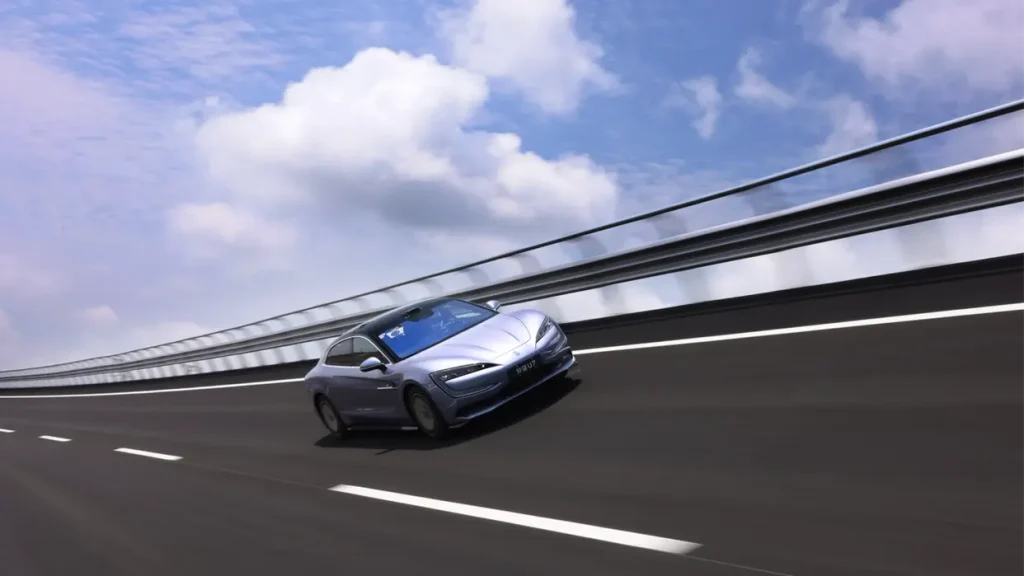
The BYD Yangwang U7 endurance run covered 30,000 kilometers in 8 days, 19 hours and 58 minutes at an average speed of 240 km/h — a run that compressed two to three years of typical driving into barely over a week, and left the battery holding 98.7% of its capacity, Xinhua Finance reported.
The test
At the Yangwang U7 “Driver’s Conference” held at BYD’s Shaoxing race circuit on August 25, Yangwang said the run set a new world endurance record for a production car. The vehicle was picked at random from a dealership lot — a 2026 U7 with no modifications and no special hardware tuning. The test ran in Nanning, where August temperatures average above 36°C and humidity sits near 80%. The car cruised at a constant 240 km/h with the air conditioning fixed at 24°C, swapping drivers but never stopping the car, covering more than 3,300 km a day.
What survived
Over the run the car completed more than 350 rapid charge-and-discharge cycles. Yangwang credits the second-generation Blade Battery — with its dual cold-plate direct cooling and dual-pole safety design — plus a track-grade thermal management system shared with the U9 supercar, segmented permanent-magnet motors, and the e4 distributed four-motor architecture. After the test, the battery’s state of health measured 98.7%, which Yangwang says clears its own warranty standard.
The car
The U7 is Yangwang’s flagship full-size sedan, priced from 658,000 to 888,000 yuan (about $90,800 to $122,500). The pure-electric version pairs a 150.01 kWh pack with four motors making 960 kW (1,306 hp) for a 0–100 km/h time of 2.9 seconds and up to 1,006 km of CLTC range; an extended-range version adds a 2.0T four-cylinder. Both ride on the e4 four-motor platform and the DiSus intelligent body-control system. Before this record, the U7 had already driven a round trip from Shenzhen to the Goodwood Festival of Speed in the UK — another 30,000 km across Eurasia.
The software play
Alongside the endurance result, Yangwang launched “Tuning Master,” China Economic Net reported, a feature that opens up stepless adjustment of suspension damping and stiffness through the e4 and DiSus hardware, letting each owner redefine the car’s driving character. It will be pushed to all U7 owners via OTA. An official customization program also launched, with three co-created show cars on display.
The bigger signal
Chexun reports the U7 logged 758 test vehicles and more than 10.49 million km of cumulative testing before launch — over 340 times the new national standard. The endurance record is the latest in a deliberate shift in how high-performance EVs are judged: from one-off numbers like the 2.9-second sprint toward long-cycle reliability under sustained heat and high-frequency charging.
The Bottom Line
BYD’s Yangwang U7 completed a 30,000 km endurance test in 8 days, 19 hours and 58 minutes at a 240 km/h average in 36°C Nanning heat, finishing with 98.7% battery health after 350 rapid-charge cycles. The run — plus a new owner-tunable suspension feature — positions the ¥658,000–888,000 flagship against Europe’s luxury sedans on reliability, not just straight-line speed.
Sources & Further Reading
- Xinhua Finance — 30,000 km endurance test, 98.7% battery retention
- China Economic Net — “Tuning Master” launch and endurance record
- Chexun — 758 test cars, 10.49M km before launch
- Yiche — Yangwang U7 specs and pricing
- Related: BYD second-generation Blade Battery teardown
- Related: BYD megawatt flash-charging architecture
- Related: BYD Da Han EV opens pre-sale at Chengdu
- Related: BYD third-generation Tang debuts at Chengdu
- Related: BYD Sealion 08 debuts at Chengdu with 900 km range