

The Big Picture
- What: Chery’s Jetour brand revealed the Zongheng F700 — a full-size PHEV pickup truck with 1,300 km combined range, 45.5% thermal efficiency, and an 800V platform.
- Powertrain: Chery Kunpeng Super Hybrid CDM-O, 2.0TD engine (155 kW / 340 Nm), CATL 4C Shenxing battery (20-80% in 10 minutes).
- Debut: Guangzhou Auto Show, November 2026.
- Why it matters: Chery is entering the PHEV pickup market that BYD Shark and GWM Cannon are already fighting over — and bringing an 800V architecture they don’t have.
1. Chery Jetour Zongheng F700 PHEV: The Spec Sheet
| Specification | Detail |
|---|---|
| Powertrain | Kunpeng CDM-O PHEV (2.0TD + electric motor) |
| Engine power | 155 kW / 340 Nm |
| Thermal efficiency | 45.5% |
| Battery | CATL 4C double-layer Shenxing |
| Fast charge | 20-80% in 10 minutes |
| Platform voltage | 800V |
| Combined range | 1,300 km |
| Fuel consumption | 1.39L/100km |
| Dimensions | 5,495 × 2,050 × 1,985 mm |
| Wheelbase | 3,350 mm |
| Seating | 4-seat or 5-seat |
| Payload | 181-223 kg |
| Debut | Guangzhou Auto Show, November 2026 |
The Chery Jetour Zongheng F700 PHEV pickup enters a market defined by the BYD Shark — and the spec sheet reads like it was built specifically to one-up it. The 45.5% thermal efficiency figure is the standout. For context, Toyota’s most efficient production hybrid engine achieves about 41%. BYD’s Xiaoyun 1.5L PHEV engine hits 43%. If the 2.0TD Kunpeng engine delivers 45.5% in real-world conditions, it would claim the highest thermal efficiency of any production PHEV engine on the market.
2. Why a PHEV Truck
Pickup trucks present a unique challenge for electrification. They need to tow. They need to traverse unpaved terrain. They need range that survives a full day of work plus the drive home. Pure electric pickups — the Rivian R1T, the Ford F-150 Lightning — solve some of these problems but introduce others: weight, charging infrastructure, and range anxiety under load.
A PHEV pickup addresses all three. The combustion engine handles sustained high-load scenarios — towing a trailer up a mountain pass, for example — while the battery handles daily urban and suburban driving. The 1,300 km combined range means the F700 can theoretically drive from Shanghai to Beijing and back on a single tank and charge. That’s not a luxury feature for a work truck. That’s a requirement for markets like Australia, Southeast Asia, and Latin America, where Chery’s Jetour brand has export ambitions.
3. The Competition: Shark vs Cannon vs F700
| Model | Powertrain | Range | Voltage | Key Edge |
|---|---|---|---|---|
| BYD Shark | PHEV | ~840 km | 400V | BYD brand, global distribution |
| GWM Cannon | PHEV | ~1,000 km | 400V | Established pickup pedigree |
| Jetour F700 | PHEV | 1,300 km | 800V | Range + charging speed |
The F700’s two advantages over the incumbent BYD Shark are the 800V architecture (the Shark uses a 400V platform) and the 1,300 km combined range (the Shark claims approximately 840 km). The 10-minute 20-80% charge is a meaningful differentiator for commercial users who value uptime.
4. The Interior: Screens, Not Switchgear
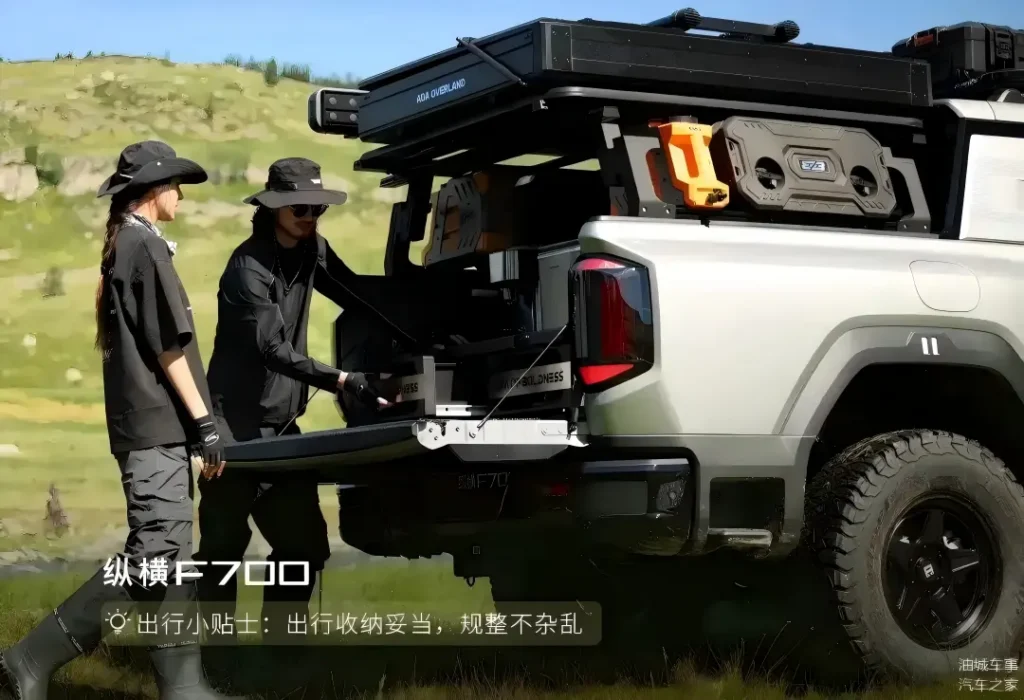
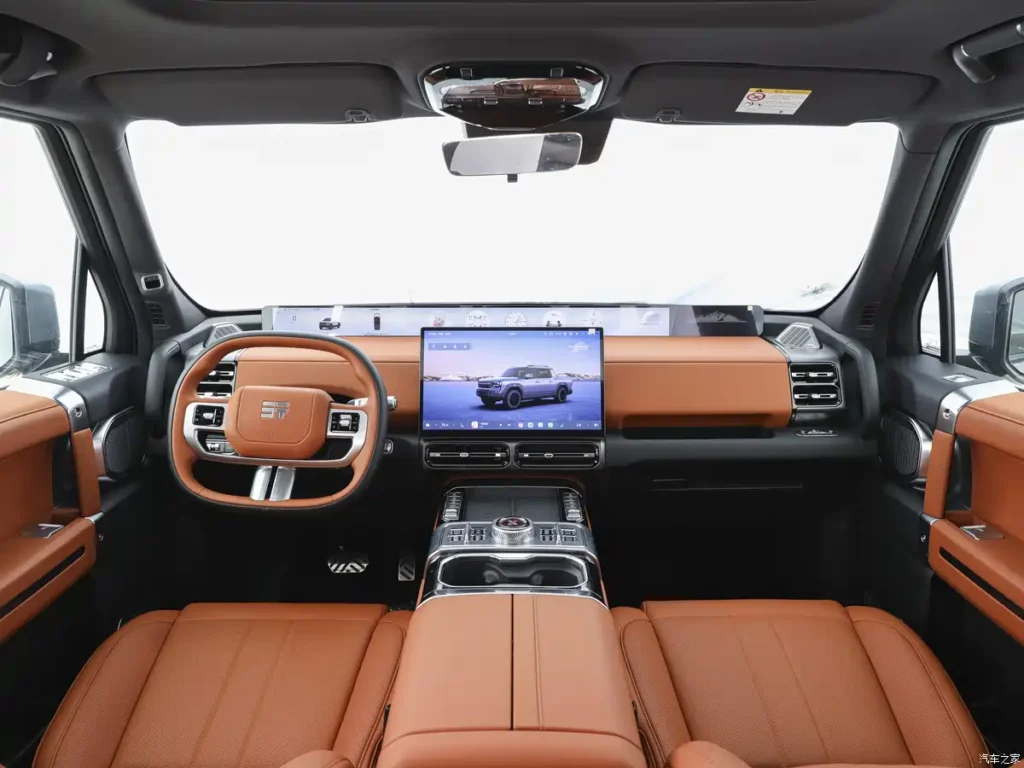
Jetour equipped the F700 with a cabin drawn from the G700 SUV: a 15.6-inch floating central display paired with a 35.4-inch panoramic screen running Zongheng OS. Multi-screen synchronization and vehicle telemetry are standard. The exterior follows an angular, military-inspired aesthetic — prominent rectangular grille, heavy-duty door handles, semi-floating roof, and integrated rear step plates for cargo access.
Author’s Take: The F700 is not going to outsell the BYD Shark. BYD has too large a head start in global distribution and brand recognition. But the F700 doesn’t need to outsell the Shark to be a success. It needs to offer a technically credible alternative — 800V where the Shark has 400V, 1,300 km where the Shark has 840 km — and capture buyers who value those numbers. In the export markets where Chery’s Jetour brand is active (Middle East, Southeast Asia, Latin America), a PHEV pickup with a spec sheet that beats BYD’s is enough to get a seat at the table. Whether it stays there depends on execution.
The Bottom Line
The Jetour Zongheng F700 is Chery’s answer to a question the global pickup market has been asking: what comes after the diesel truck? The answer, for now, is a plug-in hybrid with an 800V architecture, a 45.5% thermally efficient engine, and 1,300 km of range. The F700 will debut in November. The BYD Shark is already shipping. The GWM Cannon is already established. The window of opportunity for a third entrant is narrow — but the F700’s spec sheet makes a case that hasn’t been made before.