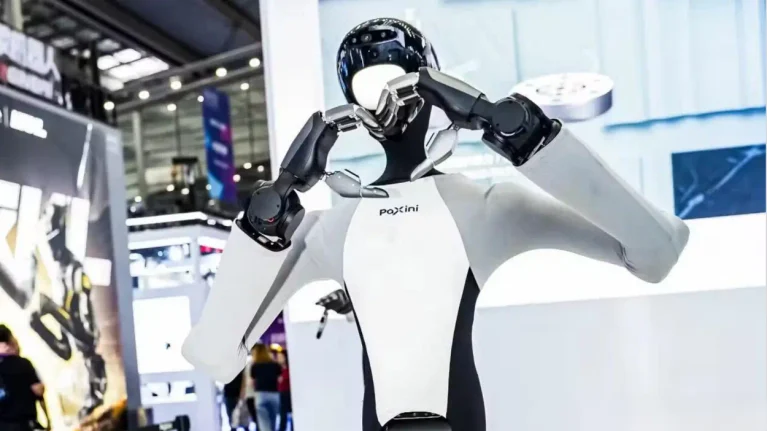


Chinese makers shipped more than 97% of all humanoid robots globally in the first half of 2026 — about 19,100 units, more than triple the 5,100 shipped a year earlier. Shanghai’s AgiBot led with 8,400 units (44% of the world), Hangzhou’s Unitree followed with 5,900. The data, reported by Bloomberg, comes from U.S. research firm Smart Analytics Global (SAG).

The numbers behind the dominance
According to SAG, a California-based consultancy, the world shipped roughly 19,100 humanoid robots in the first six months of 2026. That is more than three times the 5,100 units recorded in the same period of 2025 — a growth curve steep enough to turn a research curiosity into a recognizable manufacturing category.
China’s share of that total: over 97%. For context, estimates from Omdia and Morgan Stanley put China’s share of the 2025 full-year market at 85–90%, with TrendForce taking a more conservative line. The first half of 2026 suggests the gap to the rest of the world is widening, not closing.
Two companies own the leaderboard
AgiBot (also known as Zhiyuan Robot), based in Shanghai, shipped 8,400 units in H1 — about 44% of the entire global market and enough to make it the clear No. 1. Unitree, out of Hangzhou, shipped 5,900 units. Together the two account for the bulk of every humanoid robot that left a factory anywhere on earth in the period.
The comparison that matters is across the Pacific. SAG notes both companies individually out-shipped the combined U.S. leaders — Tesla, Figure AI, and Agility Robotics — by a wide margin. That is not a close race; it is a different order of magnitude.
From demo floor to factory floor
The more interesting shift is what these machines are actually for. SAG founder and chief analyst Linda Sui points out that industrial and commercial use now accounts for more than 70% of shipments, up from roughly 50% a year ago. Humanoid robots are moving out of trade-show choreography and into real roles — repetitive line tasks, logistics, and customer-facing retail, the last of which Beijing’s Pudong district is now piloting as a dedicated robot zone.
That is the difference between a headline and an industry: when buyers stop clapping and start deploying, the volume follows.
The geopolitical overhang
The lead is not risk-free. In late July, the U.S. Federal Communications Commission moved to block certification for imports of new foreign-made humanoid and quadruped robots — a move widely read as aimed at Chinese manufacturers. China’s Foreign Ministry pushed back, calling the escalation protectionism that “won’t raise U.S. competitiveness.”
Sui’s own caveat is the one to watch: regulatory uncertainty and geopolitical risk could shape the industry’s next phase. A 97% share looks very different if a large end market starts slamming the door.
The road ahead
SAG expects about 60,000 units globally for the full year 2026 and projects the market reaching 500,000 units by 2030. If those curves hold, the companies that spent 2025 and 2026 building (mass-production) muscle — AgiBot and Unitree chief among them — will be the ones supplying it.
Author’s Take
The 97% figure is a snapshot, not a verdict. China’s edge is real and structural — dense supply chains, state-backed demand, and two firms that treated these machines as products, not prototypes. But the FCC move is a reminder that export-led dominance can be taxed at the border. The smart read: China won the first lap on volume; the second lap will be decided by who can sell outside China without permission slips.
The Bottom Line
In the first half of 2026, the world built 19,100 humanoid robots and China built almost all of them. AgiBot and Unitree are no longer challengers to Western robotics — by volume, they are the category. The open question is whether Washington lets that lead keep compounding.
Sources & Further Reading
- Bloomberg (via Sina), “Industry data: Chinese humanoid robots exceed 97% of global shipments,” Aug 10, 2026 — news.sina.com.cn
- TechNews (Taiwan), “China’s humanoid robots dominate: 97% market share in H1,” Aug 10, 2026 — technews.tw
- AAStocks / Yahoo Finance HK, “Smart Analytics Global: China humanoid robots 97% of global shipments,” Aug 10, 2026 — hk.finance.yahoo.com
- Related: CRAIC 2026: China’s humanoid robots run real industrial scenarios with zero remote control
- Related: BYD’s humanoid robot debut and its broader premium electrification bet