

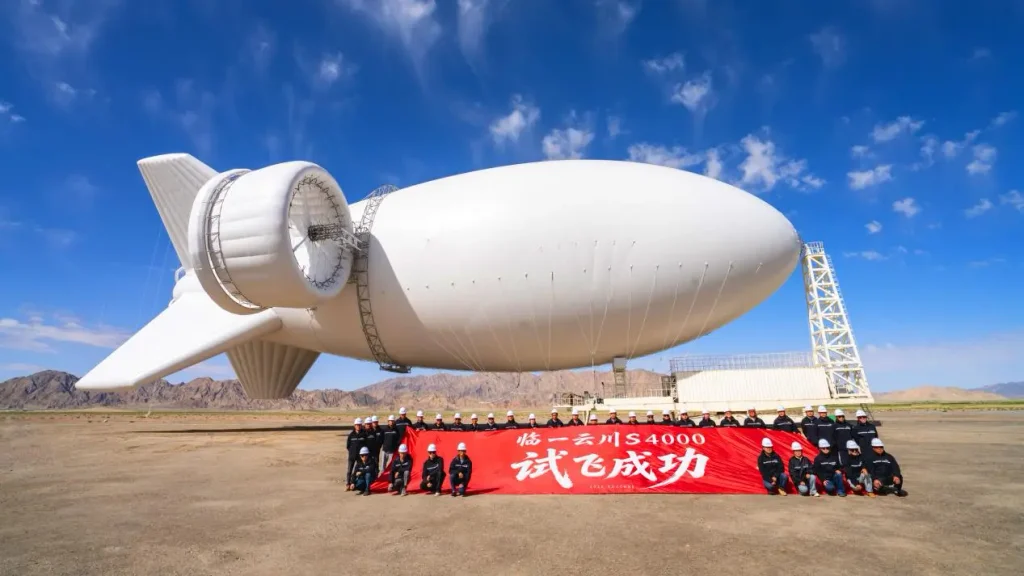
China has moved a step closer to turning the sky into a power plant. Lin Yi Yunchuan Energy Technology (临一云川) said its S4000 stratospheric airborne wind-power system completed a full flight-validation cycle — launch, stable hover, power generation and recovery — at a test base in northwest China, in what state media described as the world’s first successful airborne wind-power test at 4,000 meters.
A “flying power station,” not a turbine
The S4000 looks like a giant airship — 67 meters long, 40 meters wide and 23 meters tall — but it has no engine and burns no fuel. A helium buoyancy platform carries a lightweight power-generation module to altitude, where a ducted-ejector diffusion system captures high-altitude wind and converts it to electricity. A tethered cable carries the power back to the ground. The system is the upgraded successor to the company’s S2000, a megawatt-class unit built for urban environments that completed its first test flight in January 2025 and set four industry records.
For the S4000, the headline numbers are operating altitude and grid readiness: a maximum flight ceiling of 4,000 meters, an airborne payload above one ton, an output voltage spanning 10 to 35 kilovolts, and a designed service life of 20 years. Lin Yi Yunchuan says the envelope covers deployment across most of China’s terrain, from desert and plateau to island.
Why go so high
The entire premise rests on a simple physics fact: wind energy scales with the cube of wind speed, and the air several kilometers up is faster, steadier and far more abundant than anything near the ground. Lin Yi Yunchuan cites high-altitude wind energy density of up to 10 kilowatts per square meter — dozens of times what ground-based wind farms see — and Chinese research bodies estimate parts of the country’s upper-air jet streams reach 30 kW per square meter. The resource is, in theory, large enough to dwarf total human demand.
The engineering problem is holding a generator stable and transmitting power across a kilometers-long tether. Lin Yi Yunchuan says it worked with Tsinghua University’s Department of Electrical Engineering and the Chinese Academy of Sciences’ Aerospace Information Research Institute to crack three industry-common hurdles: airship stability, lightweight motor design, and kilometer-scale medium-voltage DC transmission. The company claims full independent intellectual property across the system.
Where the power would go
Lin Yi Yunchuan lays out three use cases. The first is straightforward grid connection, feeding clean power into the network. The second targets places the grid barely reaches — mountains, islands, mining sites and border outposts. The third is the trendy one: mounting radar, communications and monitoring gear on a long-endurance, self-powering platform to serve China’s fast-growing “low-altitude economy” of emergency response, security patrols and communications networking.
The company has already built a national supply chain: a Beijing R&D headquarters, a Changsha pilot base, a Zhoushan high-performance skin-material center that began production in May 2026, a Yueyang final-assembly “super factory,” and a Chengdu Xinjin assembly base. Chief executive Dun Tianrui (顿天瑞) says the team began exploring the underlying technology in 2017, and that the data from this high-altitude test will feed development of a next-generation S6000-5MW model.
The policy tailwind
None of this happens in a vacuum. High-altitude wind power has been written into China’s 15th Five-Year Plan (2026–2030) for renewable energy as a priority “new clean-energy technology,” giving the sector a state-backed runway that Western airborne-wind ventures rarely enjoyed. That puts the S4000 in the same company as another recent Chinese clean-tech milestone — the country’s lead role in the world’s first IEC standard for EV solid-state batteries — both attempts to set the global benchmark in a frontier energy technology.
The Bottom Line
Lin Yi Yunchuan’s S4000 completed what state media call the world’s first 4,000-meter airborne wind-power validation — a 4,000m “flying power station” aimed at remote grids and the low-altitude economy. The engineering is real; the commercial leap from test flight to deployed megawatts is the test still to come.
Sources & Further Reading
- CCTV — S4000 airborne wind-power system completes full flight validation
- CNR — S4000 clears high-altitude operational challenges
- Science and Technology Daily — Lin Yi Yunchuan S4000 validation
- The Paper — World-first 4,000m airborne wind-power validation
- Chengdu Business — 4,000m “airborne power station” breaks through
- Related: China leads the world’s first IEC standard for EV solid-state batteries