

The Big Picture
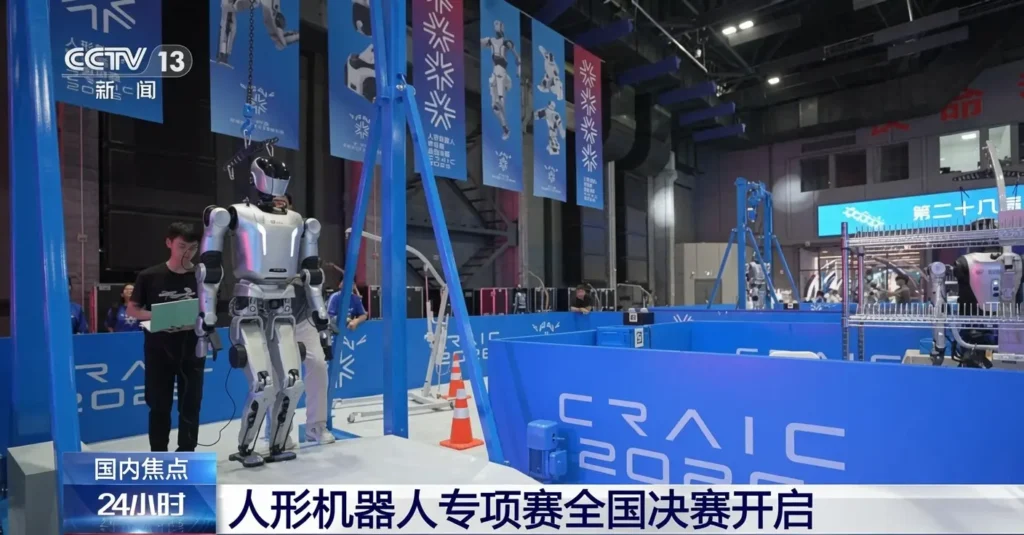
- The event: 28th CRAIC Humanoid Robot Finals — 213 teams from 100+ universities, 350+ robots, 7,000 registered students. Held at Shougang Park, Beijing.
- The shift: Full-size humanoid robots ran industrial tasks with zero remote control for the first time. 50-minute autonomous window. Real factory conditions — uneven terrain, obstacles, precision parts.
- The message: China’s humanoid robot benchmark has moved from “can it walk?” to “can it work?”
The Arena Where Skating Became Coding
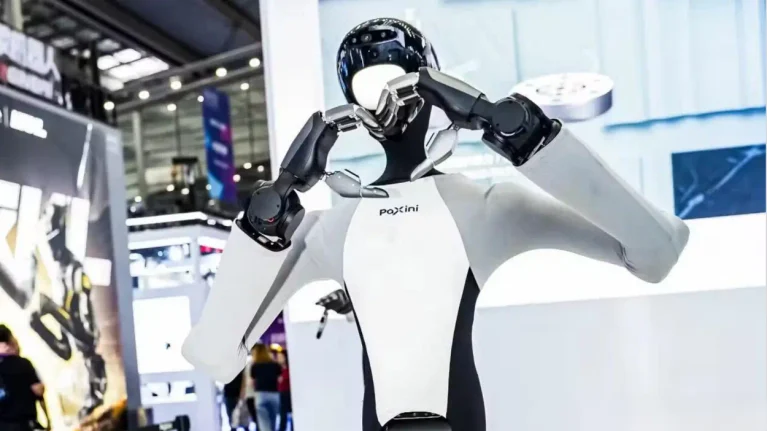
The last time Shougang Park’s Ice Hockey Hall drew international attention, it was February 2022 and athletes were competing for Winter Olympics medals. On August 1, 2026, the ice was gone and the venue was filled with something Beijing had never hosted before: 350 humanoid robots — roughly the height of a short adult — climbing slopes, sorting auto parts, and navigating obstacle courses with no one holding a controller.
This was the 28th China Robot and AI Competition (CRAIC) humanoid special-competition finals, covered by China Daily and CCTV state television. It drew 7,000 registered participants from nearly 200 universities, narrowed through regional qualifiers to 213 teams. The robots competed in three size categories — small, medium, and full-size — but the full-size category is where the story is, because the rules changed in a way that says something about where this industry is heading.
The Change: No Remote Control. No Safety Net. 50 Minutes.
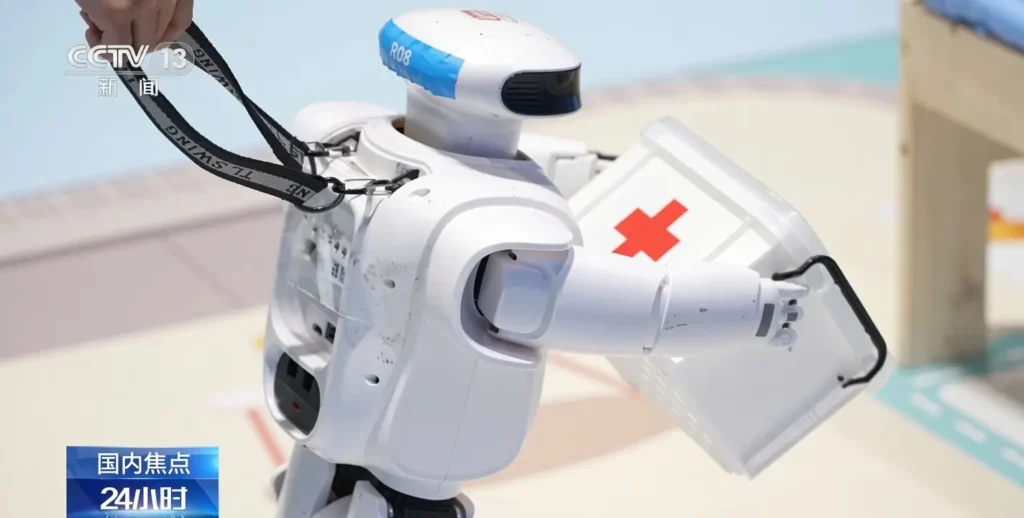
Previous competitions allowed remote operation — a human operator with a controller, making real-time corrections. This year, the full-size category eliminated it entirely. Robots had to use onboard sensors — LiDAR, cameras, inertial measurement units — to perceive the environment, plan their own movements, and execute tasks without any external guidance.
The tasks weren’t abstract benchmarks either. The organizers 1:1 replicated real factory conditions: hazardous-area inspection routes, SMT (surface-mount technology) production-line loading and unloading, and automotive component sorting — exactly the kind of repetitive industrial work that automakers like BYD and XPeng want their own humanoid robots to handle. The robots had 50 minutes to finish everything. If they fell or mis-sorted, they kept going or failed.
“The industrial scenes are very different from our lab,” one Xi’an University of Technology competitor told CCTV. “We need to improve generalization — the ability to handle unpredictable factors.” A Tsinghua team member said they logged “tens of thousands of hours” in simulation before bringing their model to the physical stage.
The competition’s technical director, Yuan Quande, told China Daily the design was intentional: “We included industrial inspection scenarios that aren’t just for steel mills — the same technology applies to power-grid inspection, security patrols, logistics sorting.” The goal is to make robots that work in one factory work in any factory.
What the Numbers Say: Lepu Kuafu’s Production-Line Report Card
While universities competed for prizes, the industry was watching for different numbers. Lepu Kuafu (乐聚夸父) — one of China’s leading humanoid robot companies and a partner in the competition — used the event to release real-world production-line data that, until now, had stayed inside factory walls:
| Metric | Performance |
|---|---|
| Continuous operation | 8 hours |
| Per-box cycle time | 28 seconds |
| Carton unstacking success rate | 95.8% |
| Flexible handling (FAW/JAC lines) | 92% |
| Small-parts loading (Zhaofeng Machinery) | 94.3% |
| Domestic component rate | 95% |
| Unit cost | ~¥100,000 (~$13,800) |
Those numbers matter because they translate the academic competition into an economic argument. A ¥100,000 robot that works an 8-hour shift at 95%+ accuracy in a factory that currently pays a human worker ¥80,000-120,000 a year to do the same job starts to look less like a science project and more like a line item on a procurement spreadsheet.
Lepu’s Foshan factory — designed for 10,000-unit annual production — has already received orders from multiple industries. The company’s approach mirrors what automakers are doing with their own robot programs: use real factory conditions as a training ground, iterate on the data, and bring the cost down through manufacturing scale.
Why a Student Competition Matters to the EV Industry
The CRAIC finals aren’t just an academic exercise. They’re a talent pipeline. Competition winners get access to full datasets and model toolchains. The best performers are recruited directly by major robotics and automotive companies. The Shijingshan district — where the competition was held — is building a dedicated humanoid robot data training center, with the goal of creating a “training-ground → competition selection → pilot validation → ecosystem incubation” closed loop.
This is the same talent-development architecture that China used to build its EV industry: university competitions as a proving ground, real industrial data as feedback, government-backed infrastructure as an accelerator. It worked for batteries and electric motors. The CRAIC finals suggest it’s being applied to bipedal manipulation with the same playbook.
Harbin Institute of Technology professor Sun Lining, speaking at the event, predicted that “within about five years, humanoid robots will achieve widespread application in several scenarios.” He noted that next year’s competition will likely feature even more realistic industrial environments — a signal that the gap between “competition conditions” and “factory conditions” is closing faster than most people expect.
Author’s Take
The zero-remote-control rule is the real headline from this competition. For years, humanoid robot demos — including Tesla’s Optimus and Boston Dynamics’ Atlas — have been criticized for what happens off-camera: the remote operator with a joystick, the carefully choreographed path, the fifth take that gets posted as “look what it did.” Removing the controller removes the safety net. If the robot falls on a slope, that’s on the algorithm, not the operator.
The 50-minute time limit adds another layer. A robot that can walk up stairs in a lab eventually can walk up stairs in a factory. A robot that can walk up stairs, sort parts, navigate obstacles, and do it all within a shift window — without a human correcting it — is a robot that can replace a shift worker. That’s the bar the CRAIC just set, and it’s a bar the auto industry is watching closely.
The Bottom Line
The CRAIC 2026 humanoid robot finals in Beijing marked a shift in how China’s robotics industry measures progress. Full-size robots operated with zero remote control for the first time, tackling real factory tasks — slope climbing, parts sorting, hazard inspection — in 50-minute autonomous windows. Lepu Kuafu reported 95.8% industrial accuracy at an ~¥100,000 unit cost, bringing humanoid robots closer to an economically rational factory-floor investment.
China’s playbook — university competitions feeding into industrial deployment, backed by government infrastructure — is the same one that built the EV industry. The zero-remote-control rule is the signal that the next phase isn’t about demos. It’s about shifts.
Sources & Further Reading
- CCTV — “Humanoid Robot Competition Finals: Zero Remote Control, Real Industrial Scenes” (August 2, 2026)
- China Daily — “CRAIC 2026: On-Site Report from the Industrial Robot Exam” (August 2, 2026)
- Beijing Daily / Tencent — “200+ University Teams Compete in Humanoid Robot Skills” (August 2, 2026)
- Science and Technology Daily — “CRAIC 2026 Finals Open at Shougang Park” (August 1, 2026)